

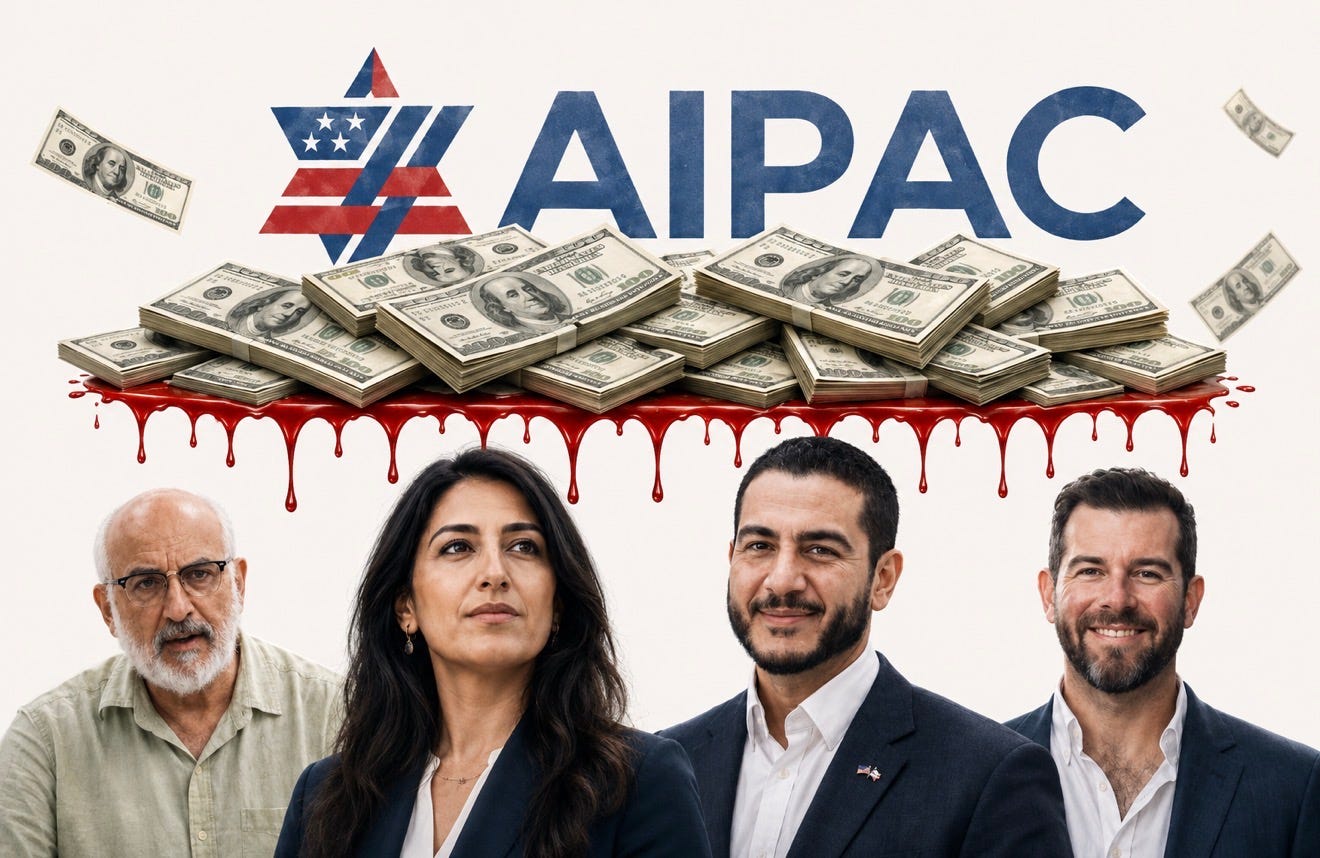
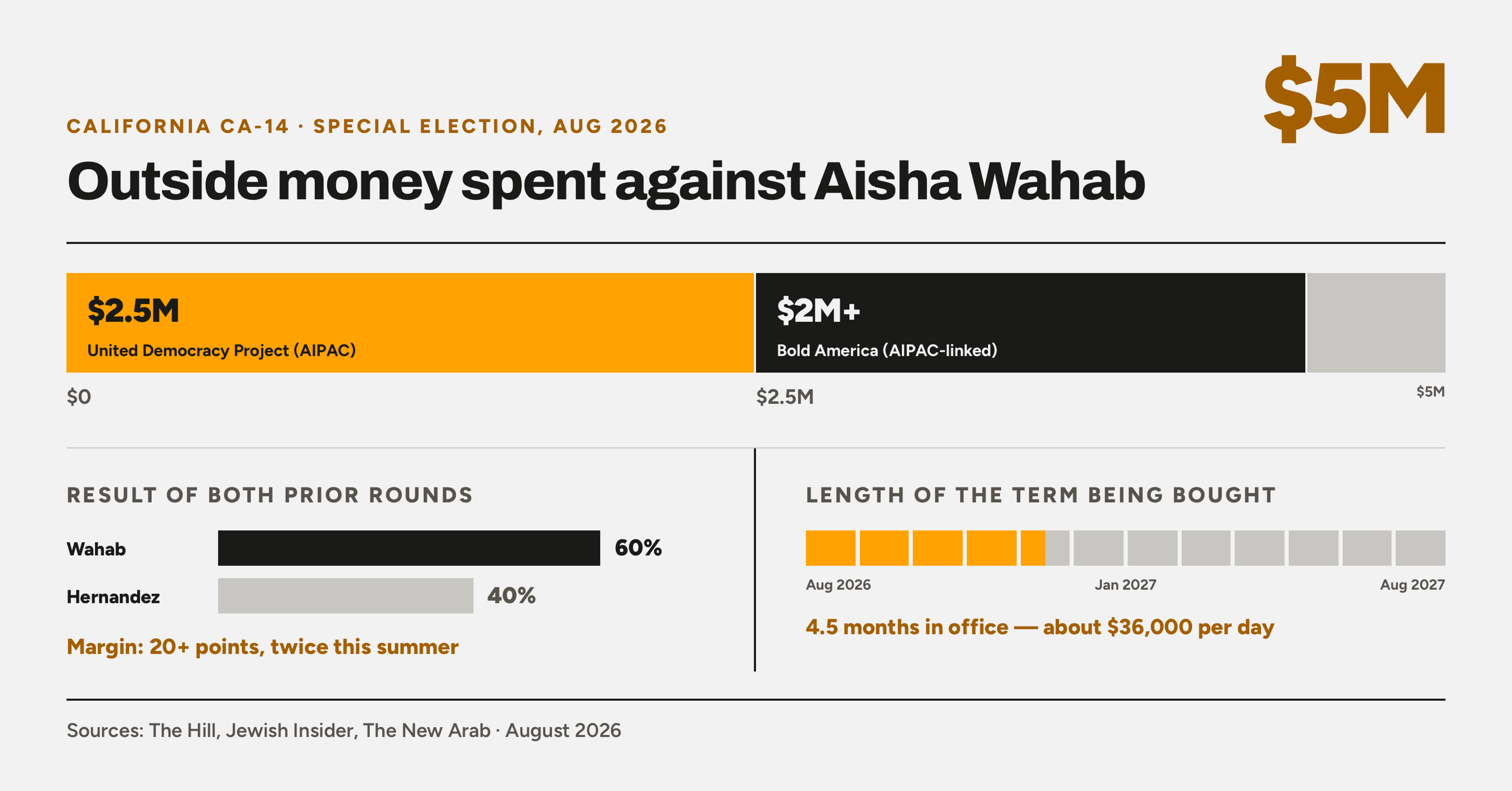
Today, voters in California’s 14th Congressional District decide who replaces Eric Swalwell, who’s running for governor. Whoever wins will serve just four and a half months until January. And still the pro-Israel lobby has decided it’s worth millions of dollars to win it anyway.
State Sen. Aisha Wahab has already beaten her opponent, BART board member Melissa Hernandez, twice this summer, by more than twenty points each time. Wahab is the first Afghan American and first Muslim ever elected to the California State Senate, a former foster kid who worked her way up from the Hayward City Council talking about rent and the cost of living. Her campaign hasn’t centered on Israel. Instead she’s mostly talked about affordability, same as everyone else in the district.
Somehow none of that has mattered to the United Democracy Project, AIPAC’s super PAC, which has put roughly $2.5 million behind ads attacking Wahab, much of it focused on painting her as soft on crime. A second group, Bold America, tied to former members of the Congressional Hispanic Caucus and funded in part with AIPAC-linked money, has added more than $2 million on top of that. Add it all up and estimates of the total spent against a single state senator run close to $5 million, again, in a race she’s already carried twice by landslide.
A UDP spokesperson told Jewish Insider the group considers Wahab “pretty extreme in her points of view on Israel.” But if you ask anyone canvassing in Alameda County what her platform actually is and you’ll get an answer about housing, not foreign policy.
This is the model: Find a Democrat who has said anything, even mildly, about ending unconditional military aid to Israel. Bury them in outside money. It doesn’t matter how small the race is or how long the odds are.
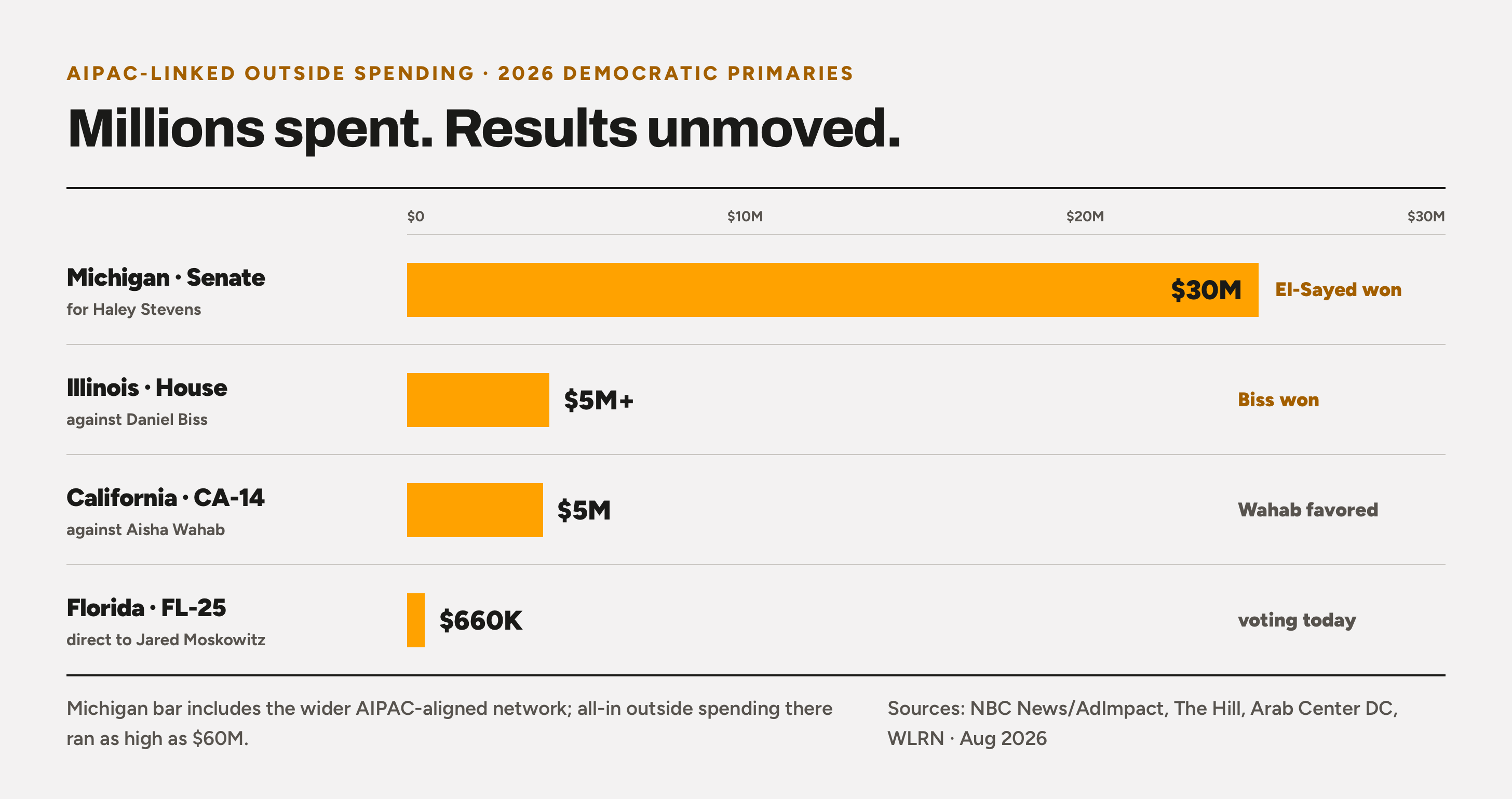
Nine days earlier, and two thousand miles east, the same Zionist machine tried the same thing on a much bigger stage and lost anyway. In Michigan’s Democratic Senate primary, Rep. Haley Stevens had AIPAC’s network behind her to the tune of roughly $30 million, with total outside spending on her behalf estimated as high as $60 million by some counts. The most expensive Democratic primary in American history. Her opponent, Abdul El-Sayed, a public health doctor and former Wayne County health director, ran on Medicare for All, getting corporate money out of politics, and an arms embargo on Israel. He called the war in Gaza a genocide on camera, in ads, at debates, without flinching.
He won. By about one point, after being outspent nine to one on advertising, according to the ad-tracking firm AdImpact. El-Sayed is now the Democratic nominee for a swing-state Senate seat that could decide who controls the chamber. He made the point himself, more than once: a campaign that needs sixty million dollars to survive one opponent probably isn’t confident it can win the argument on its own terms.
The fight isn’t over, and it’s worth being honest about that too. A new Fox News poll taken August 6 to 10 has Rogers leading El-Sayed by four points in the general election, 51 to 47, while Democrat Jocelyn Benson leads her race for governor by five. Set those two numbers side by side and the gap is real: NBC News found El-Sayed running 18 points behind Benson among independents, 11 points among Black voters, and 8 points among women in the same poll. That’s residue from a primary in which outside groups spent tens of millions branding him extreme and, in ads that ran down the stretch, sexist, an argument AIPAC is expected to keep funding on Rogers’ behalf through November. Democratic strategists are already talking through how to close the gap: tie Rogers to Trump as hard as possible, debunk the sexism charge directly, and lean on the parts of El-Sayed’s platform that poll well with moderates and independents. AIPAC didn’t stop him from winning the nomination. It bought itself a narrative it gets to keep using for three more months.
AIPAC doesn’t always lose, and it’s worth saying so. That same night in Missouri, AIPAC-backed Rep. Wesley Bell fought off a comeback attempt from Cori Bush, the district’s former congresswoman and one of the most outspoken critics of military aid to Israel in the House. But look at where the wins keep stacking up. Progressive organizer Analilia Mejia beat an AIPAC-backed opponent in a New Jersey primary and went on to flip a House seat in a special election. In Illinois, Daniel Biss survived fifteen challengers and more than $5 million in AIPAC-linked attack spending, in part by running directly against the lobby. Donavan McKinney and Rashida Tlaib also won that night, their Michigan primaries falling the same evening as El-Sayed’s. None of that has slowed AIPAC down. If anything, the spending has grown.
You can watch the same pattern play out even where there’s no realistic path to victory. In Maryland’s 4th District, the journalist Sam Husseini just secured the Green Party’s nomination to challenge Rep. Glenn Ivey, a two-term Democrat Husseini has taken to calling “AIPAC Ivey.” Husseini, who is Palestinian-Jordanian-American and works as a senior analyst at the Institute for Public Accuracy, has spent the last year and a half confronting the officials who defend Washington’s role in the war on Gaza, in person, on camera. Security dragged him out of Blinken’s final briefing as Secretary of State in January 2025. Last month he was ejected after confronting Schumer at a National Press Club event. Husseini knows he probably isn’t beating Ivey in a heavily Democratic district running as a Green. He’s running anyway, because putting “AIPAC” next to his opponent’s name on an actual ballot, over and over, does something a press conference can’t.
Here’s what makes all this spending look less like strength and more like panic. Pew found in April that sixty percent of all Americans, not just Democrats, now hold an unfavorable view of Israel, including eighty percent of Democrats, up from sixty-nine percent the year before and fifty-three percent in 2022. A spring survey from the Arab American Institute found thirty-nine percent of likely voters now believe AIPAC and groups like it have too much influence over American politics, against twenty-seven percent who disagree. Fifty-nine percent of Democrats say they’d be more likely to back a candidate calling for less or no military aid to Israel, a position that would have ended a campaign a decade ago and now sits close to a majority view inside the party AIPAC has spent generations trying to keep in line.
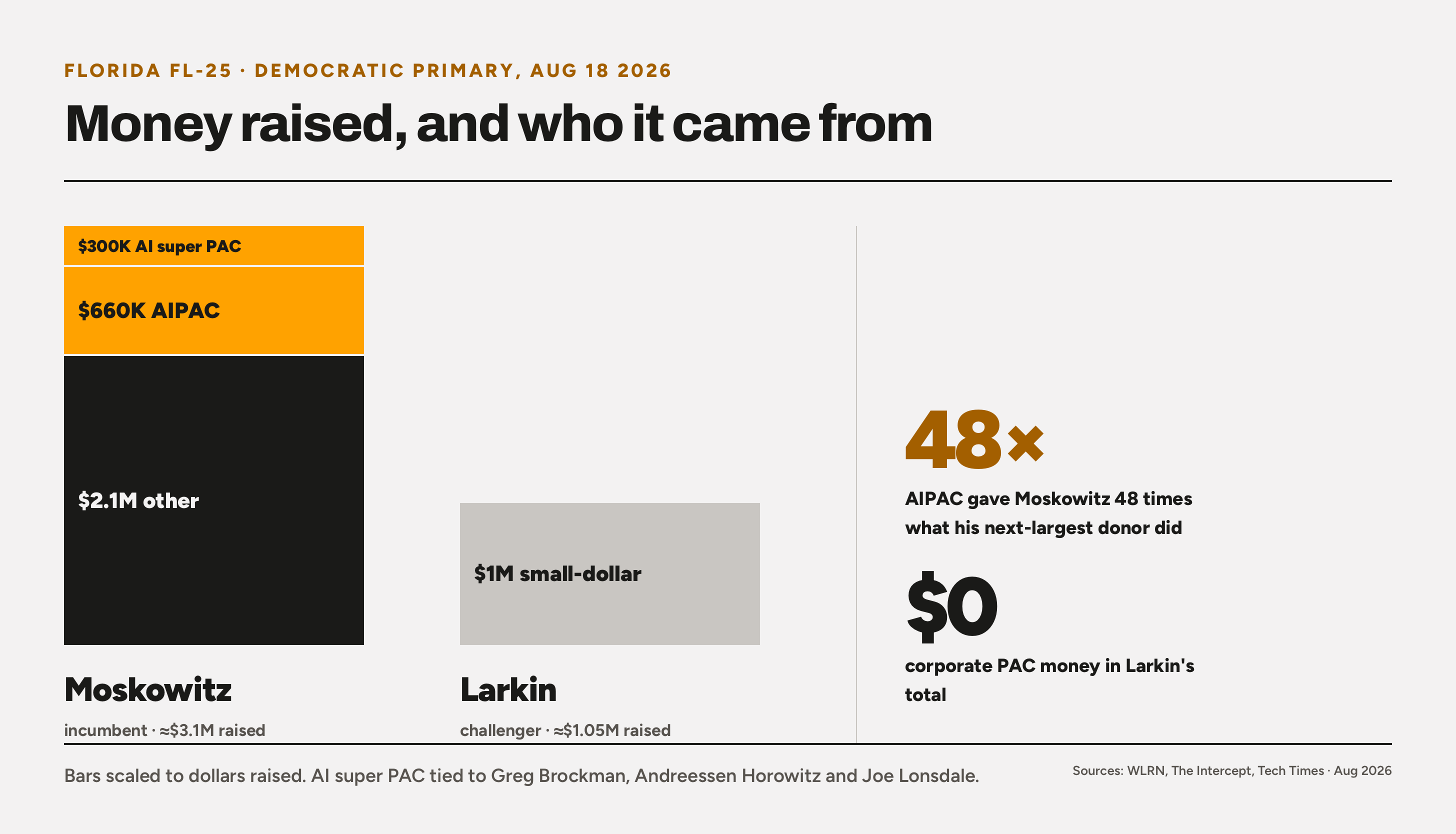
Florida is running its own version of this experiment as this piece goes up. On the same day as the California runoff, voters in the state’s 25th District are deciding a Democratic primary between Rep. Jared Moskowitz, whose single largest donor relationship is AIPAC at more than $660,000, nearly 48 times what his next-biggest contributor gave, and Oliver Larkin, a 34-year-old union organizer and DSA member who calls himself an anti-Zionist and wants an immediate end to military aid to Israel. Larkin has raised just over a million dollars, almost all of it in small individual donations, and taken zero corporate PAC money.
Moskowitz has outraised him roughly three to one and picked up backing from a new corner of the influence industry: an AI-industry super PAC tied to OpenAI’s Greg Brockman, Andreessen Horowitz, and Palantir’s Joe Lonsdale spent more than $300,000 defending him, the first time that network has stepped into a Democratic primary against a DSA challenger.
Dueling internal polls show a dead heat by Larkin’s count and a comfortable Moskowitz lead by his own. Whichever number holds up, AIPAC money and AI money converging to protect the same incumbent tells you which interests recognize each other.
It would be a mistake to treat any of this as a uniquely American story. Europe has its own version of AIPAC, and almost no one has heard of it. It’s called ELNET, the European Leadership Network, and its own people have shamelessly described it as the AIPAC of Europe. Since 2022, at least $11 million has flowed through its U.S. nonprofit arm from more than a hundred American donors. ELNET has flown more than a hundred Bundestag members alone to Israel on all-expenses-paid trips, and it takes credit for helping push through the $3.5 billion drone deal selling Israeli drones and missile systems to Germany, the largest arms deal in Israeli history. It lobbies for the same things AIPAC lobbies for: cutting off funding to UNRWA, pushing the IHRA definition of antisemitism through European parliaments, keeping the arms trade running no matter what’s happening in Gaza. Same donors, same playbook, same closed doors, just across the pond.
The lesson from California, Michigan, Maryland, and Florida this month has nothing to do with AIPAC running low on cash. It has more money than ever, but changed is what the money can buy. It can flood a mailbox, dominate the news cycle, and bury a state senator in attack ads over an election seat that will barely survive the summer.
What AIPAC money can no longer do is convince the American people that defending an unconditional relationship with a government carrying out a genocide is worth their vote. Wahab is expected to win today, same as she has twice already. AIPAC will spend the same amount, or more, on the next race, and the one after that, and the one after that. It has already shown us there’s no price tag for trying to dispel a truth that we have all seen with our own eyes.
Swalwell is not running for governor! He dropped out months ago and is being investigated for rape!