


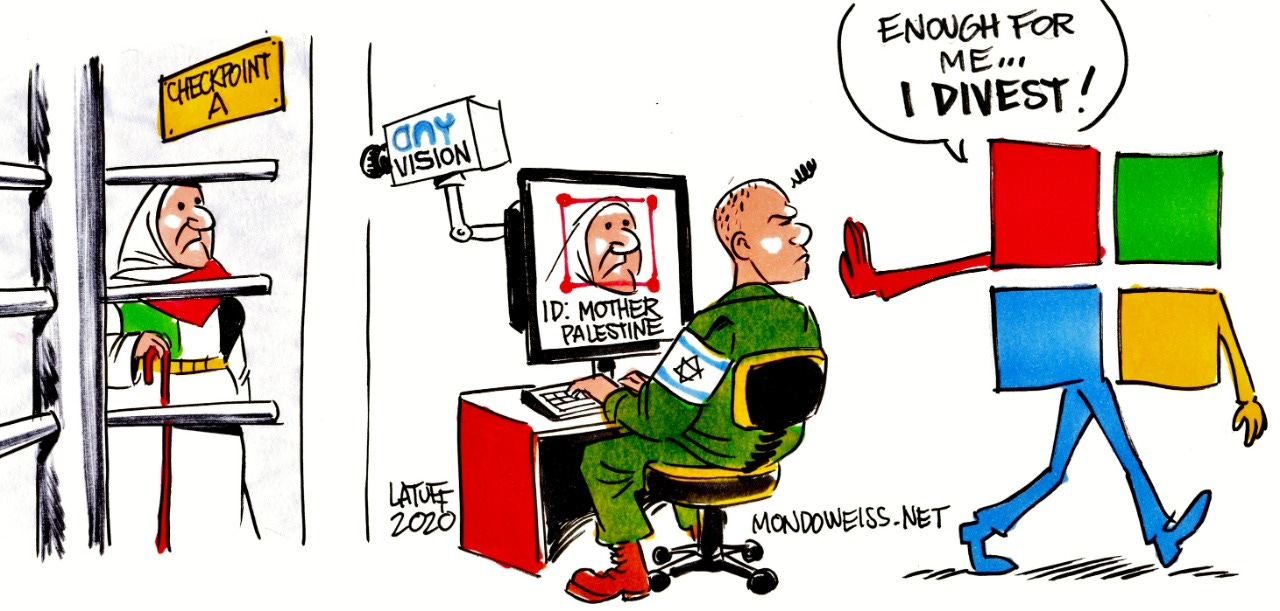
In the first months of the assault on Gaza, Israel's army uploaded three and a half million photos of Palestinians to Amazon's cloud. It told Amazon it was moving them there so it could use Rekognition, Amazon's face-matching software, and according to the Guardian it then used Rekognition to analyze them. Around the same time, a small group of Israeli soldiers was working out of Amazon's own offices on the 28th floor of a Tel Aviv tower, exploring how to run the army's Gaza face recognition program on Amazon's servers.
The Guardian revealed the upload today, citing leaked documents and military sources. Amazon's response was that it has no “visibility” into what its customers do.
Key facts
Israel’s army uploaded about 3.5 million photos of Palestinians to Amazon Web Services in early 2024 so it could use Rekognition, Amazon’s face recognition software, according to leaked documents reported by the Guardian.
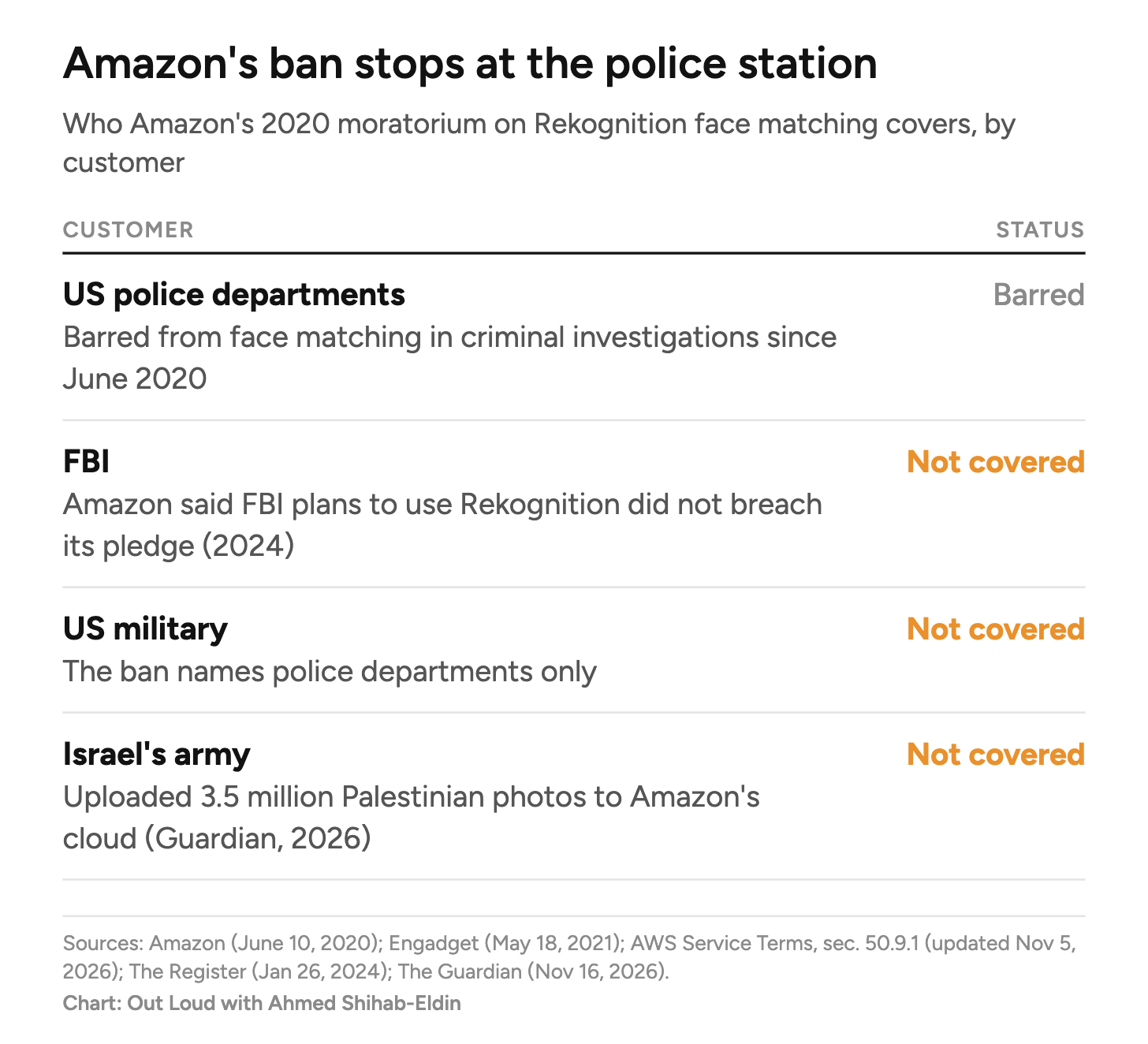
Since June 2020, Amazon has barred US police departments from using Rekognition’s face matching in criminal investigations. The ban names police departments only.
Under Project Nimbus, a $1.2 billion cloud contract signed in 2021, Amazon cannot restrict how Israel uses its products, according to leaked Israeli Finance Ministry documents.
Six years ago Amazon decided this software was too dangerous for American police. Since 2020 it has barred American police departments from using Rekognition to match faces in criminal investigations. The rule stops at the edge of the American police station. Amazon says it does not cover the FBI. It does not cover the US military. It has never covered the Israeli army, which holds a file on every Palestinian from the age of sixteen and, in the middle of a war, wanted Amazon's help putting names to millions of faces. The ban depends on who the customer is, and anyone who isn't an American police department can still buy.
The photos came from a unit soldiers call Rolling Stone, after the army's central database on Palestinians. It holds family details, property, work permits, checkpoint crossings and the ID card photo every Palestinian sits for at sixteen, and sources told the Guardian those photos were routinely fed into the army's face recognition programs. Through 2023 Rolling Stone moved large amounts of that data into Amazon's cloud, the same year Amazon opened its Israel cloud region. Under Nimbus, Amazon keeps a segregated section of its Tel Aviv datacentres for military material, which the company and its client call the “walled garden.” A military source said Amazon was needed because of the “very large scale” of images collected at Gaza checkpoints. The Guardian could not confirm the 3.5 million images came from there or whether the work on the 28th floor ever went live, and AWS calls such office visits routine.
Project Nimbus is a $1.2 billion contract, signed in 2021, under which Amazon and Google supply cloud services to Israel's government and military. Israel picked AWS as its main cloud provider under the deal. Two years later Amazon committed $7.2 billion to its Israeli infrastructure through 2037. Last year the UN special rapporteur on the occupied Palestinian territories, Francesca Albanese, named Amazon in her report on the corporations sustaining what she called an economy of genocide. I covered her report the week it came out.
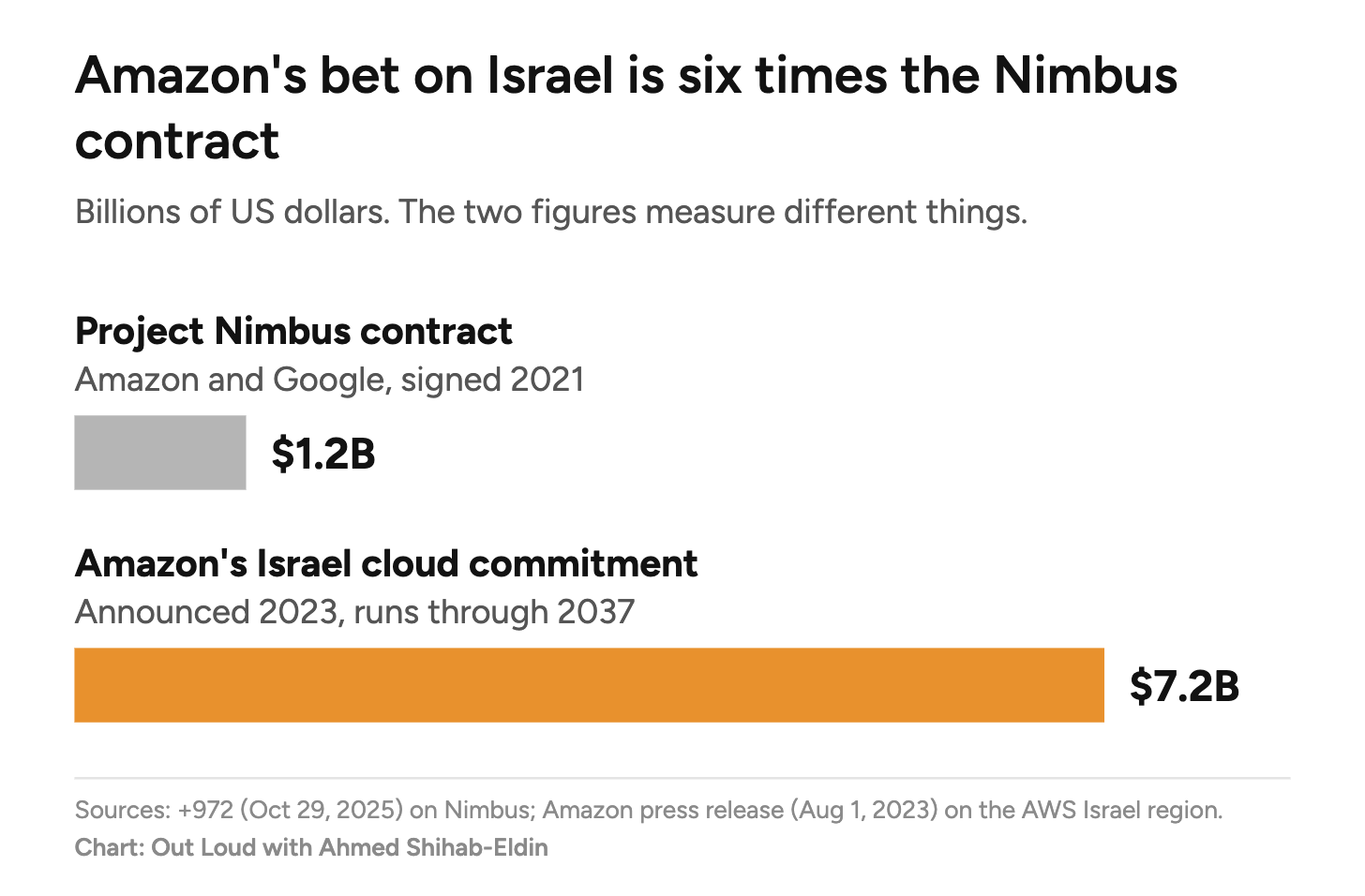
Last year the Guardian, +972 and Local Call obtained leaked Finance Ministry documents showing that the contract “prohibits Google and Amazon from restricting how Israel uses their products,” even when that use breaches their own terms of service. Israel may use any service as long as it does not break Israeli law, infringe copyright or resell the technology. The Finance Ministry called the reporting “baseless.” Google said “nothing has changed” and would not say which terms it accepted. Amazon has not published the contract.
In September 2025, after reporting on Israeli mass surveillance of Palestinians, Microsoft cut off services to an Israeli military unit. “We do not provide technology to facilitate mass surveillance of civilians,” its president, Brad Smith, wrote. Critics said the cut touched only a small slice of Microsoft's work for Israel. It still proved a cloud company can act. Microsoft's own workers had pushed for it for months. Ibtihal Aboussad was fired in April 2025 after confronting the company's AI chief on stage at its 50th anniversary, and she told me why on Out Loud. The Guardian notes that the Nimbus terms would bar Amazon from taking the same step Microsoft took. Amazon agreed to that before a single photo from Gaza reached its servers.
The night before the Met Gala in May, which Jeff Bezos co-chaired, the protest group Everyone Hates Elon projected a video of Chris Smalls onto Bezos's $120 million Manhattan penthouse. Smalls founded the Amazon Labor Union. Last summer he spent five days in an Israeli prison after soldiers seized the Handala, an aid boat bound for Gaza, and in the video he lays out how Amazon powers Israel's military. Hours after the Guardian story broke, the group posted it again.
Israel built its face recognition in the West Bank first. In 2023 Amnesty International documented two systems in the West Bank. Red Wolf scanned faces at checkpoints against databases made up only of Palestinians. Blue Wolf let soldiers photograph Palestinians in Hebron with a phone app and match them against a mass database. Former soldiers told the Washington Post they were rewarded for taking as many photos as possible, children included. Amnesty called it automated apartheid.
At the Gaza checkpoints, people were pulled out of the line and detained, and many were held incommunicado, which UN bodies and rights groups describe as enforced disappearance. Soldiers called the checkpoints Nakaz, the Hebrew word for drainage.
In March 2024 the New York Times reported that the program, built on the Israeli firm Corsight and Google Photos, flagged civilians as having ties to Hamas. The poet Mosab Abu Toha says he was stopped at a checkpoint in northern Gaza as his family tried to leave for Egypt. He was handcuffed, blindfolded, beaten and interrogated for two days. Then soldiers told him it had been a mistake. That program was running in the same months the army moved 3.5 million Palestinian faces into Amazon's cloud.
On June 10, 2020, weeks after a Minneapolis officer killed George Floyd, Amazon posted a short statement pausing police use of Rekognition for a year. It hoped Congress would write rules in the meantime. In May 2021 it extended the ban “until further notice.” Its service terms, updated this month, still bar police departments from using Rekognition's face comparison in criminal investigations.
In 2024, Justice Department documents showed the FBI planning to use Rekognition, and Amazon said that did not breach a pledge written for police departments alone. The US military is not a police department. Neither is the Israeli army.
Washington has drawn this line before, for other people's companies. In October 2019 the Commerce Department blacklisted Hikvision, SenseTime and Megvii, among others, saying they were “implicated in human rights violations and abuses” against Uyghurs and other Muslims in Xinjiang. Two of those firms were leaders in face recognition. Their offense was powering a state's surveillance of a captive population. Amazon's cloud now holds 3.5 million faces of another one, and Washington has taken no similar step.
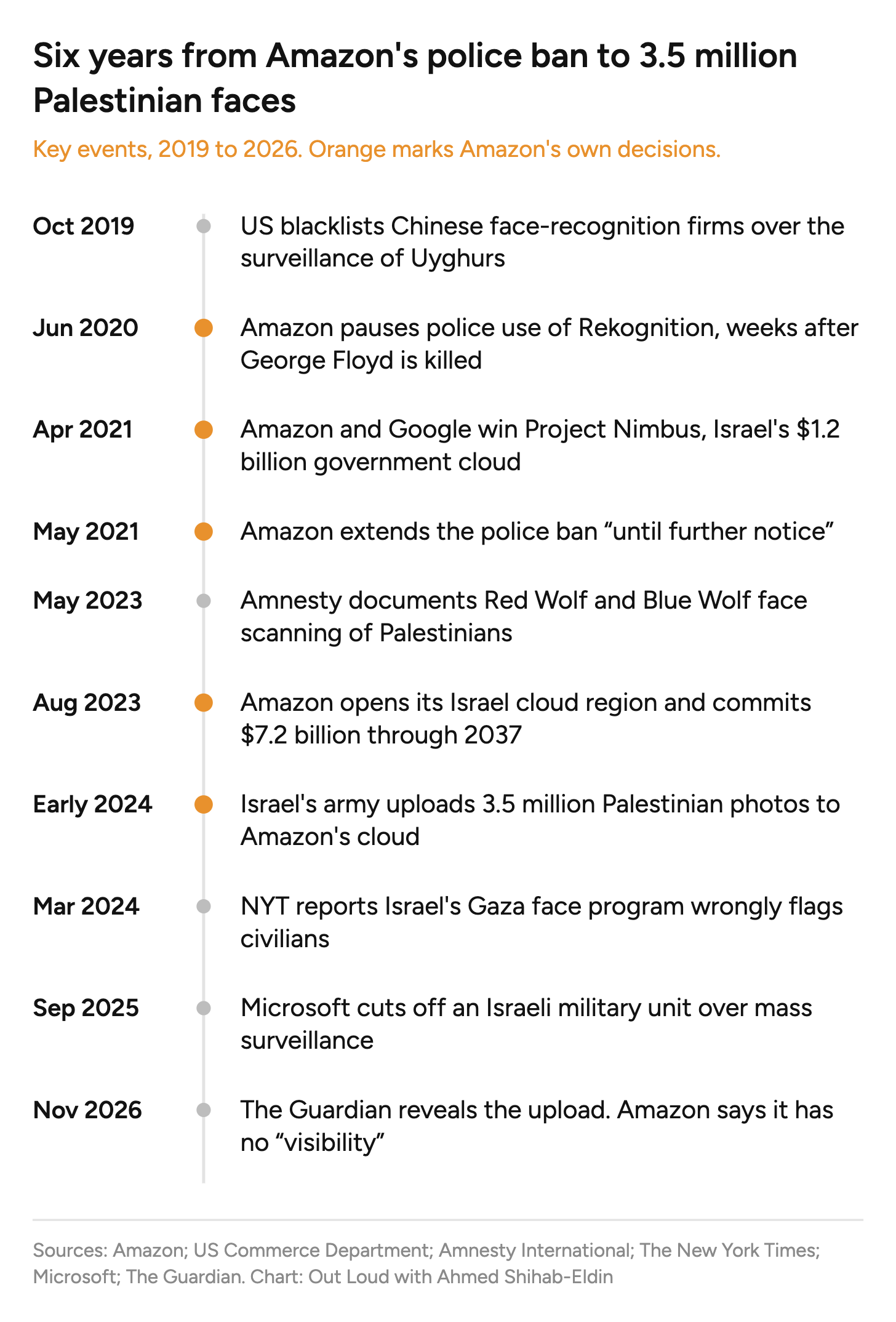
Amazon decided American faces needed protection from its software when the faces belonged to people facing American police. Washington decided Uyghur faces needed protection when the software was Chinese. Palestinian faces get neither. Amazon signed a contract that bars it from saying no, and Washington has no rule that reaches the company doing the hosting.
Amazon says it aligns its conduct with the UN Guiding Principles on Business and Human Rights and commits to “identifying, assessing, prioritizing, and addressing adverse human rights impacts connected to our business.” A contract that forbids it from acting on what that assessment finds cannot sit beside that promise.
1. Answer the question. Amazon should say what Rekognition did with the 3.5 million images, whether the results were used at checkpoints, and what the army's walled garden holds. “No visibility” is a choice it made in a contract, and it can unmake it.
2. Extend the ban. The reasoning behind the 2020 moratorium applies with more force to an occupying army running checkpoints than to a city police department. Amazon should bar face recognition use by any military or intelligence service against a population under occupation, starting with Israel's.
3. Publish and renegotiate Nimbus. Amazon should release the no-restriction clause and remove it. Microsoft showed a cloud company can cut off a unit engaged in mass surveillance. Amazon should hold the same power.
4. Apply the 2019 standard. The Commerce Department used export controls when Chinese firms powered surveillance of Uyghurs. The same test should apply when the companies are American and the population is Palestinian, and Congress should start with hearings on Nimbus.
5. Use the leverage that exists. Amazon's shareholders and its workers can demand the answers the company will not volunteer, and the human rights due diligence it says it already does.
I'm working on turning this reporting into a full video episode of The Quiet Part Out Loud, coming soon on my YouTube channel. It brings in the people who were scanned, the Amazon engineer who was fired after speaking out against Nimbus, and where the same software turned up next. If you subscribe to Out Loud here on Substack, the episode lands in your inbox the day it goes live, with every document behind it.
You can also subscribe to the channel on YouTube.
More from Out Loud on surveillance tech:
Palantir, Epstein and Thiel, Paragon's exposed spyware dashboard, and Israel inside Al Jazeera.
Boycott amazon
izrill is disgusting and depraved. So are tech bro billionaires who profit off genocide. End izrill from the River to the Sea.