


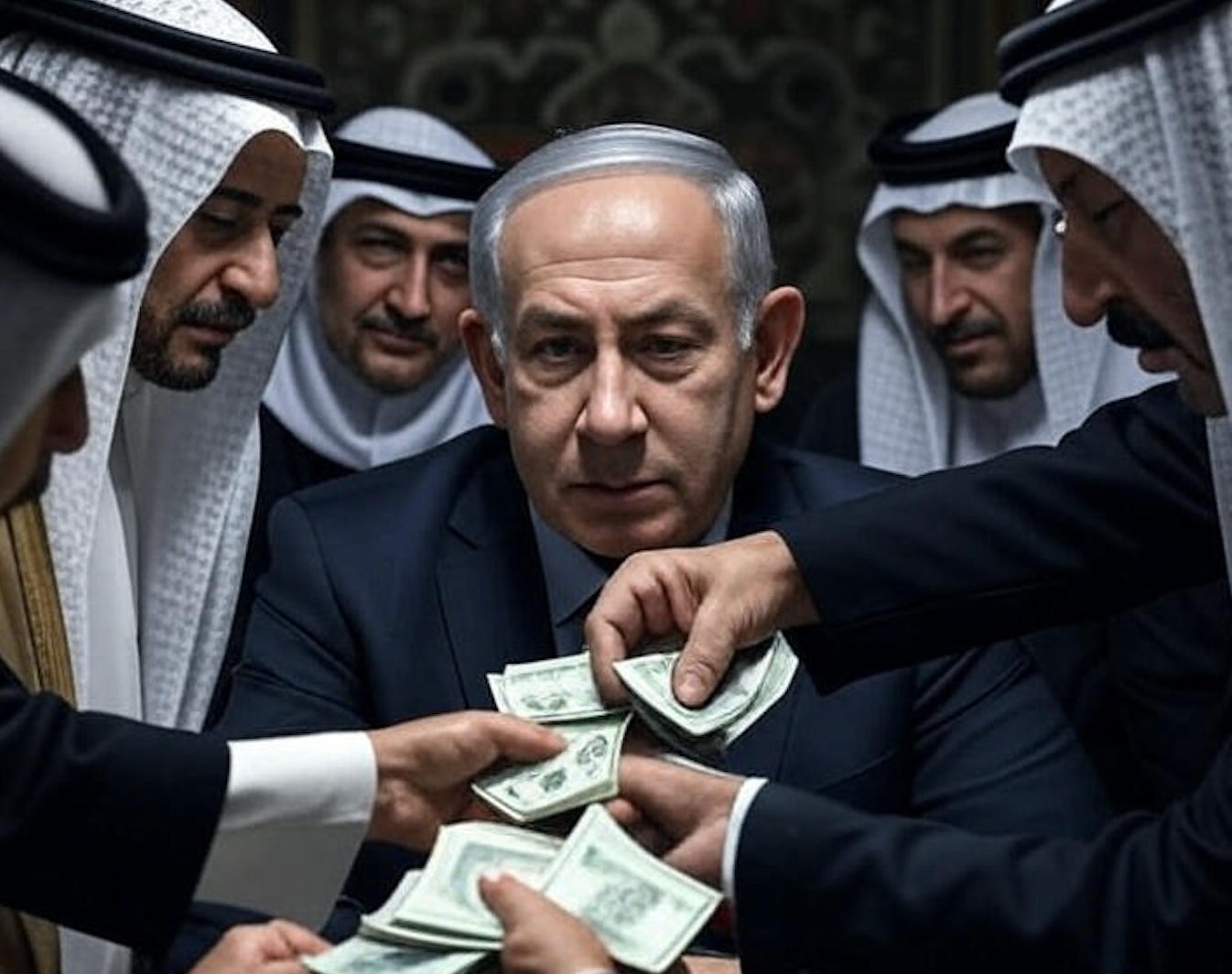
Let’s say the quiet part out loud, right here at the top:
While a recent UN Independent International Commission of Inquiry has concluded what conscience already knew: Israel is committing genocide in Gaza—over 70,000 lives extinguished, millions driven from their homes, entire neighborhoods ground into dust —Yet Egypt and other Arab states are not only averting their gaze; they are deepening their embrace of the very regime orchestrating the slaughter.
Billions in gas contracts, tech transfers, and agricultural swaps flow like lifeblood across borders, while cries of “solidarity” echo hollow in the chambers of power. This deliberate betrayal, where profit margins eclipse mass graves, and ledgers outweigh lives is among the most damning realities we face. I have long studied the cynical choreography of regional alliances, the way words are bent into weapons. But never before have I seen pragmatism paraded in the garb of profiteering amidst a genocide so visible, so undeniable. Let us name it without hesitation: blood money.
The Gaza war, ignited by Hamas’s October 7, 2023, attacks and Israel’s belligerently brutal and disproportionate response, has become a litmus test for regional loyalties. Public outrage across the Arab world—massive protests in Amman, Cairo, and other Arab capitals—demanded boycotts and severed ties. Yet, behind the chants and condemnations, trade data tells a shockingly different story.
Israel’s commerce with Arab states isn’t just surviving this genocide, it is exploding, surging by double and triple digits in some cases. Turkey—a non-Arab, Muslim-majority powerhouse—slammed the door on Israel with a full trade ban in May 2024. The contrast couldn’t be more profound: one nation’s moral stand versus a collective Arab pivot toward profit over principle, Zionists over Palestinians.
Turkey’s Defiant Stand: A Ban Amid the Bombs
Start with Turkey, where President Recep Tayyip Erdoğan has long styled himself as the Palestinian cause’s unlikely champion. After Hamas’s assault and Israel’s relentless retaliation, Erdoğan didn’t mince words: He labeled Israel’s actions “genocide,” compared Prime Minister Benjamin Netanyahu to Hitler, and joined South Africa’s ICJ case against Israel. Domestic pressure eventually forced his hand. Following electoral drubbings in March 2024—losing key cities like Istanbul to opposition parties—Erdoğan faced accusations of hypocrisy. How could Turkey condemn Israel’s “massacres” while exporting $1.1 billion in goods to Tel Aviv in the war’s first quarter?
The response was swift and symbolic: Partial curbs in April on 54 product categories, from steel to jet fuel, followed by a complete trade halt in May. Direct bilateral trade, once worth $7-9 billion annually, plummeted—down 70-80% in 2024, and virtually zero by mid-2025. In August 2025, Turkey banned Israeli vessels from its ports and aircraft from its airspace, disrupting firms like Israel’s ZIM, a publicly traded Israeli international cargo shipping company headquartered in Haifa, where my mother grew up.
Yes, loopholes persist—goods rerouted through Greece or Palestinian Occupied Territories, with exports to the latter spiking 543% in 2024, and maritime tracking shows third-country vessels (e.g., non-Turkish or non-Israeli flagged ships) continuing to carry Turkish cargo from Turkish ports to Israel as recently as September 9, 2025. UN Comtrade data indicates Turkey exported $393.7 million worth of goods to Israel indirectly in the first half of 2025, including energy products where Turkey remained a top supplier. But the intent is clear: Turkey chose solidarity over shekels, sacrificing its exporters. As Foreign Minister Hakan Fidan reiterated on September 14, 2025, Turkey has “completely cut off” trade amid Israel’s “continued massacres.”
The Arab Surge: Gas, Gold, and Guns Over Gaza
Now, pivot to the Arab states, where defiance gives way to complicity. The Abraham Accords—Trump-era pacts normalizing ties for the UAE, Bahrain, and Morocco—have fueled a trade boom. Israel’s commerce with Arab and Muslim countries jumped 16% in 2023, and the trajectory soared into 2025, unmoved by the death toll caused by Israel’s genocide in Gaza.
Egypt, Gaza’s neighbor, chokes aid at Rafah while funneling billions through pipelines. Why is Egypt signing massive gas deals with Israel? To fuel its economy, at the cost of Gaza’s children. In August 2025, Egypt sealed a $35 billion agreement for 130 billion cubic meters of gas from Israel’s Leviathan field through 2040, tripling prior flows, alongside a $610 million pipeline expansion in September. Israel supplies 60% of Egypt’s gas for European re-export, propping up Cairo’s debt-ridden economy. Trade surged 167% in 2024, nearing $4 billion in 2025 projections. President Abdel Fattah el-Sisi decries Gaza’s “humanitarian crisis,” but his deals ensure Israel’s war machine thrives.
By trading billions while Gaza mourns, is Abu Dhabi prioritizing gold over grief? Trade hit $3.24 billion in 2024, up 11%, with Israel exporting $664 million in tech and importing $940 million in gold and jewelry. By July 2025, monthly trade reached $293 million, contributing to $6.4 billion since 2021. The UAE pledges $100 million for Gaza aid, but trade expansion clearly overshadows humanitarian optics. The Comprehensive Economic Partnership Agreement, covering 96% of tariffs, keeps goods flowing—chlorides to semiconductors.
Jordan’s 1994 peace treaty binds it to Israel, and trade reflects it: $264 million in the first seven months of 2024 jumped to $375 million in 2025, a 42% rise. Israel imported $368 million in potash, a group of potassium-containing minerals and salts, used as an essential fertilizer for plants and phosphates in 2024, exporting $108 million back. Gas pipelines, supplying 40% of Jordan’s energy, make cutting ties unthinkable, despite protests. Morocco, an Accords signatory, exported $141.5 million in 2024—textiles, agri-food, sugar—up from $118 million in 2023, while importing $115 million in defense technology. Its arms purchases from Israel hit 11% of its total, ignoring massive pro-Palestinian rallies that are still ongoing.
Bahrain’s growth is staggering: trade soared 879% in early 2024 to $70.5 million, with 2025 projections at $150-200 million, fueled by tech and tourism. Israel exported $6.4 million in 2024. Saudi Arabia, without formal ties, keeps official trade low ($55,000 in 2022), but informal deals—tech, logistics are reported to be in the hundreds of millions tied to Vision 2030’s hunger for Israeli innovation.
Notably, Kuwait stands apart, maintaining no trade with Israel due to its longstanding boycott and lack of diplomatic relations, with official figures showing negligible or zero bilateral exchange.
The Stark Comparison: Turkey’s Drop vs. Arab Ascent
The numbers expose the betrayal. Below, a table breaks down the chasm between Turkey’s principled collapse and the Arab states’ opportunistic rise.
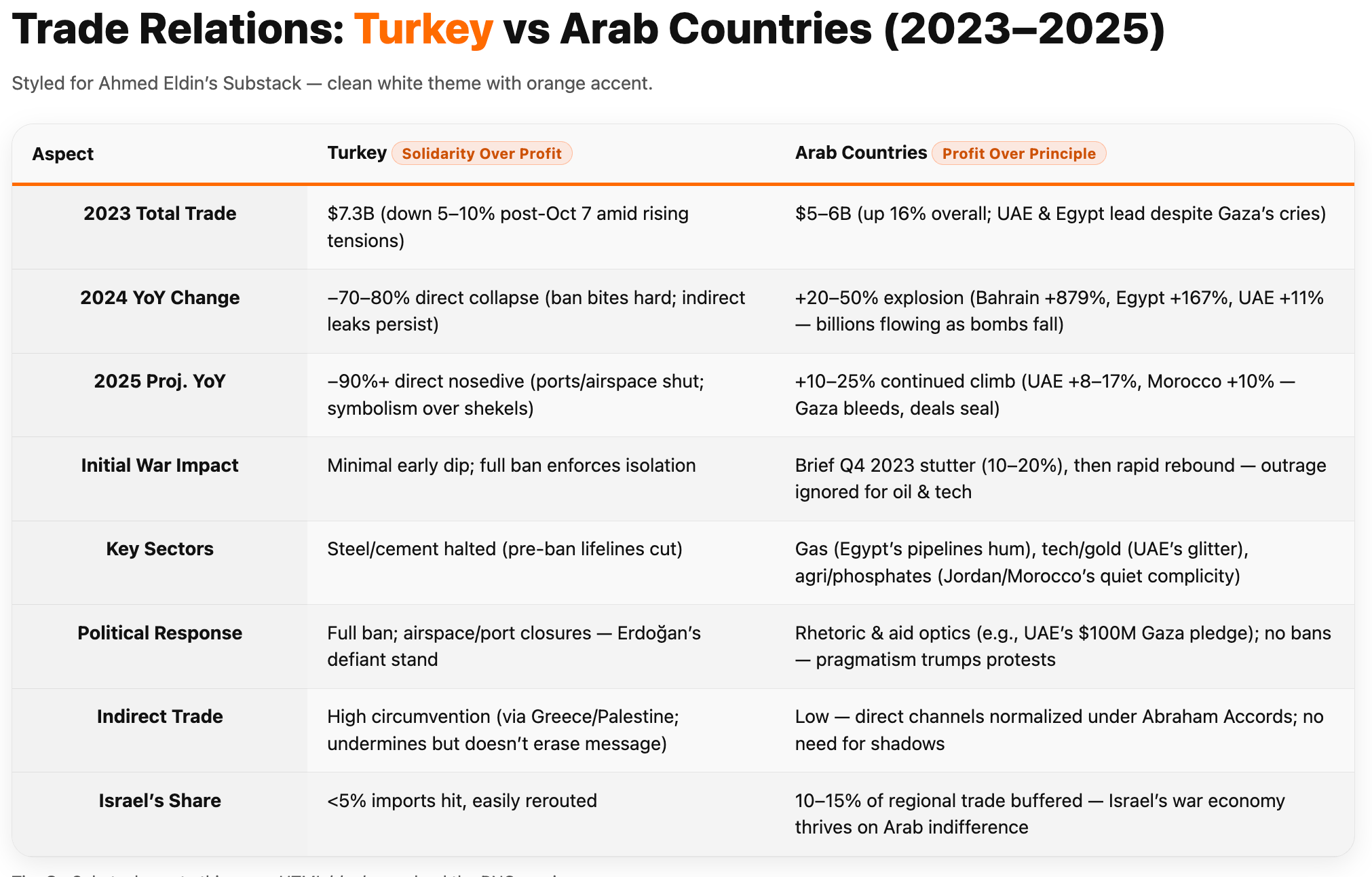
Between 2023 and 2025, Turkey’s trade with Israel collapsed by more than 90 percent, plunging from $7.3 billion to under $500 million. This sharp decline occurred despite ongoing indirect trade leaks, reflecting Ankara’s decision to bear significant economic losses on principle. In stark contrast, Arab trade with Israel has surged. Projections for 2025 show trade volumes rising to $7–8 billion, representing a 20–40 percent increase since 2023. Individual cases highlight the scale of this growth: Bahrain recorded a staggering 900 percent spike, Egypt’s trade rose by 167 percent in 2024, and the United Arab Emirates posted growth of 11–17 percent.
These figures reveal a fundamental divergence: while Turkey sacrifices economically to uphold its political stance, several Arab states are actively propping up the very regime carrying out a genocidal campaign against Palestinians. As a result, Israel remains largely unaffected by Turkey’s withdrawal, with Turkish exports making up less than five percent of its total imports.
A Betrayal’s Legacy: Toward a Reckoning?
Why do Arab states trade billions while Gaza bleeds? Because stability trumps solidarity, and all the more so in the era of Trump. When states in the region choose to profit while Palestinians suffer at the hands of their tormentors, what becomes of unity? What becomes of humanity? The Abraham Accords, now five years old, have not only endured but flourished, demonstrating that economic interests consistently outlast moral outrage.
When Arab states deepen trade ties with Israel even as it seizes more land in the West Bank, that behavior directly contradicts the underlying logic of the Abraham Accords. The normalization agreement included a tacit understanding that Israel would “suspend” plans for unilateral annexation of occupied territories, essentially removing annexation from the immediate agenda. Over time, both observers and signatories including the UAE have warned that annexation would cross a “red line” for the Accords and would undermine their spirit as a framework for regional integration and peace.
By continuing to trade and normalize relations while Israel makes territorial grabs in the West Bank, Arab governments are essentially erasing the chance for any political cost of those grabs. They reward behavior that the Accords were implicitly meant to discourage. The agony in the West Bank takes a different form than the totality of annihilation in Gaza: homes leveled overnight, thousands imprisoned without charge, checkpoints choking every movement, and more than a thousand Palestinians killed since October 2023. In Jenin and Tulkarm, Israel’s military has razed homes and infrastructure, forcibly displacing tens of thousands—an operation widely condemned as deliberate mass expulsion. A few days ago, Israeli forces shot dead a 19-year-old youth during a raid near Jenin, marking the second killing in the occupied West Bank in two days as Israel accelerates its annexation plans in the territory.
By contrast, Turkey’s isolation illustrates a different path—flawed yet defiant. For Palestinians, the contrast is a painful reminder: solidarity is too often reduced to empty press releases, even as billions in trade continue to qqqsrael. This sense of betrayal risks deepening fractures across the Arab street, sowing the seeds for either new movements of resistance or, just as dangerously, a retreat into apathy’s .
Until leaders match their words with their wallets, we must accept that the enablers of the genocide are not only in Tel Aviv, Europe or the US—the simple truth is, they sit much closer than any of us want to sit with, cloaked in silence and billions in trade. Blood money stains not in secret ledgers, but in figures announced openly, hiding in plain sight. These are not revelations unearthed by deep investigation, but truths so ordinary they have become invisible—facts the world prefers to avert its eyes from, or mutter about between sips of endless coffee, chasing stimulation to drown the deeper demand: to feel the full weight of rage and grief that genocide compels.
Are you enraged? Watch my latest podcast interview with Susan.
There is no honor in supporting apartheid and genocide. Never was, and never will be.
This is SUCH B.S.
⛔️❌😡 "Must honour our TRADE contracts" is NO EXCUSE For FUNDING & PROFITING From MassMurder-MassDestruction, ResourceRape-RegimeChange GENOCIDES 😡❌⛔️
and EVERY LEADER KNOWS ~
that ALL HUMANITY KNOWS and believes this ~