


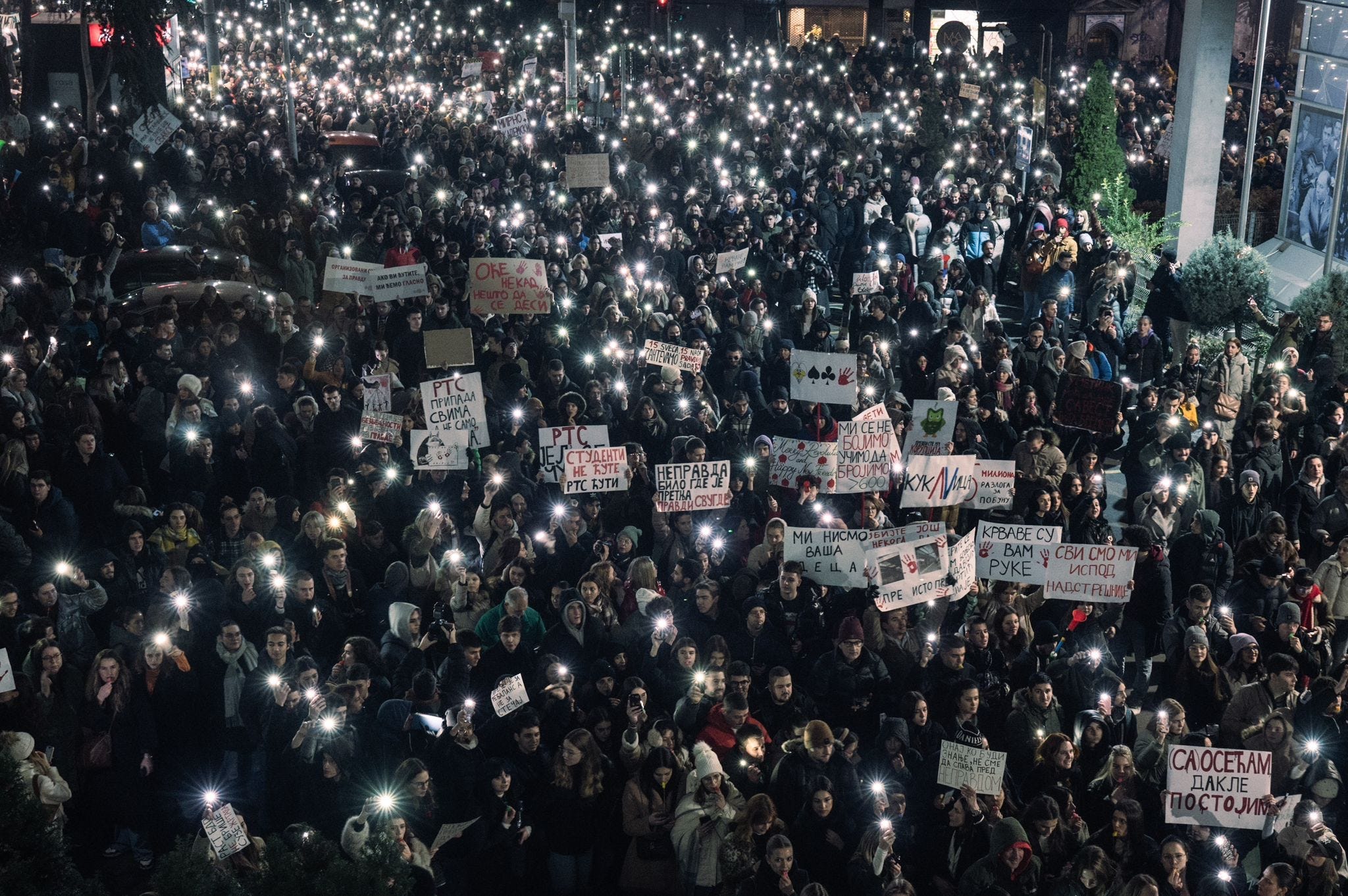
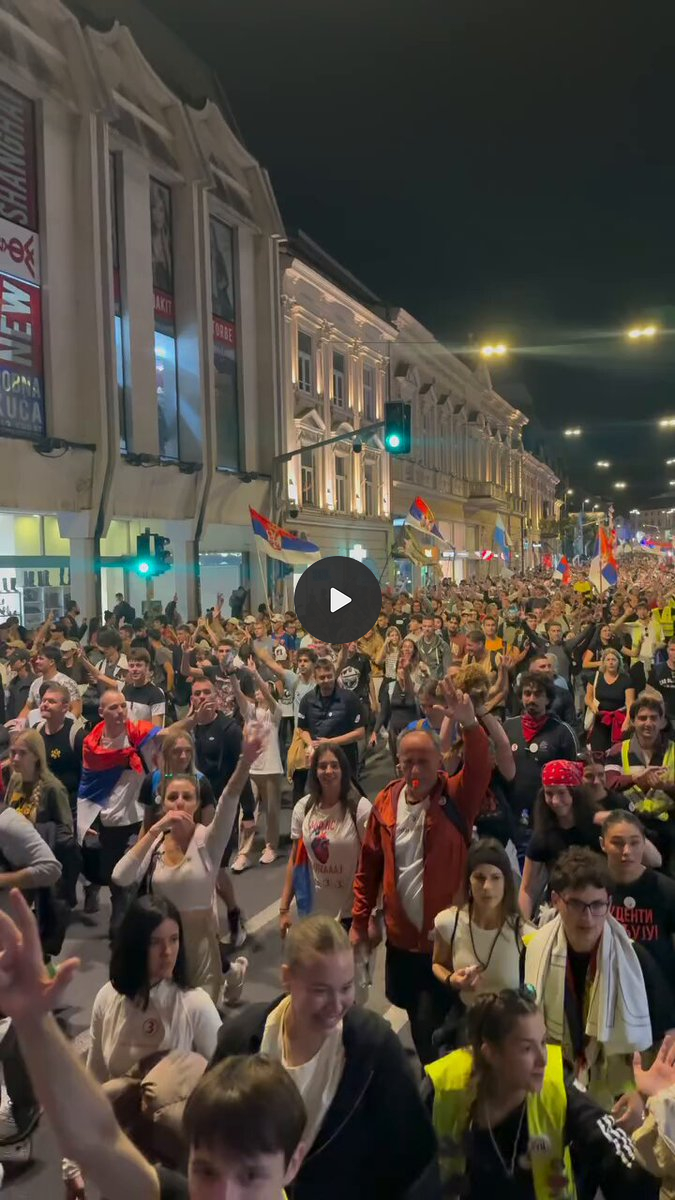
Serbia’s students started the youth revolt now spreading across Europe, and they are the only ones so far who have turned it into a real threat at the ballot box. This week they converge on Belgrade for one last show of strength before Sunday’s vote.
Marchers left Zaječar in the east on October 16, Gornji Milanovac on October 18, and Valjevo and Šabac on October 19, and the final column set out from Novi Sad on October 20. Some of them will have walked more than 200 kilometers by the time they arrive. Walking is how this movement speaks. In January 2025, students walked from Belgrade to Novi Sad to honor the victims of the station collapse, and they have since cycled and run across Europe to put their demands before European institutions.
On Thursday at 6 p.m., the columns meet in Belgrade’s Slavija Square for a final rally called “Victory Calls,” just before the campaign silence begins. Sunday’s main contest pits Aleksandar Vučić’s Serbian Progressive Party against the Student List, which grew out of two years of protests led by university students. On October 16, Vučić held his first rally in Novi Sad since the collapse, trying to show his party’s strength in the city at the heart of the resistance to his rule.
When I wrote last week about Europe’s youth revolt, from the lycées of Paris to the streets of Tirana, I left Serbia out. That was a mistake.
Every movement in this wave is still learning what Serbia’s students already know, and the lessons come in a sequence.
The three-minute version, if you would rather watch.
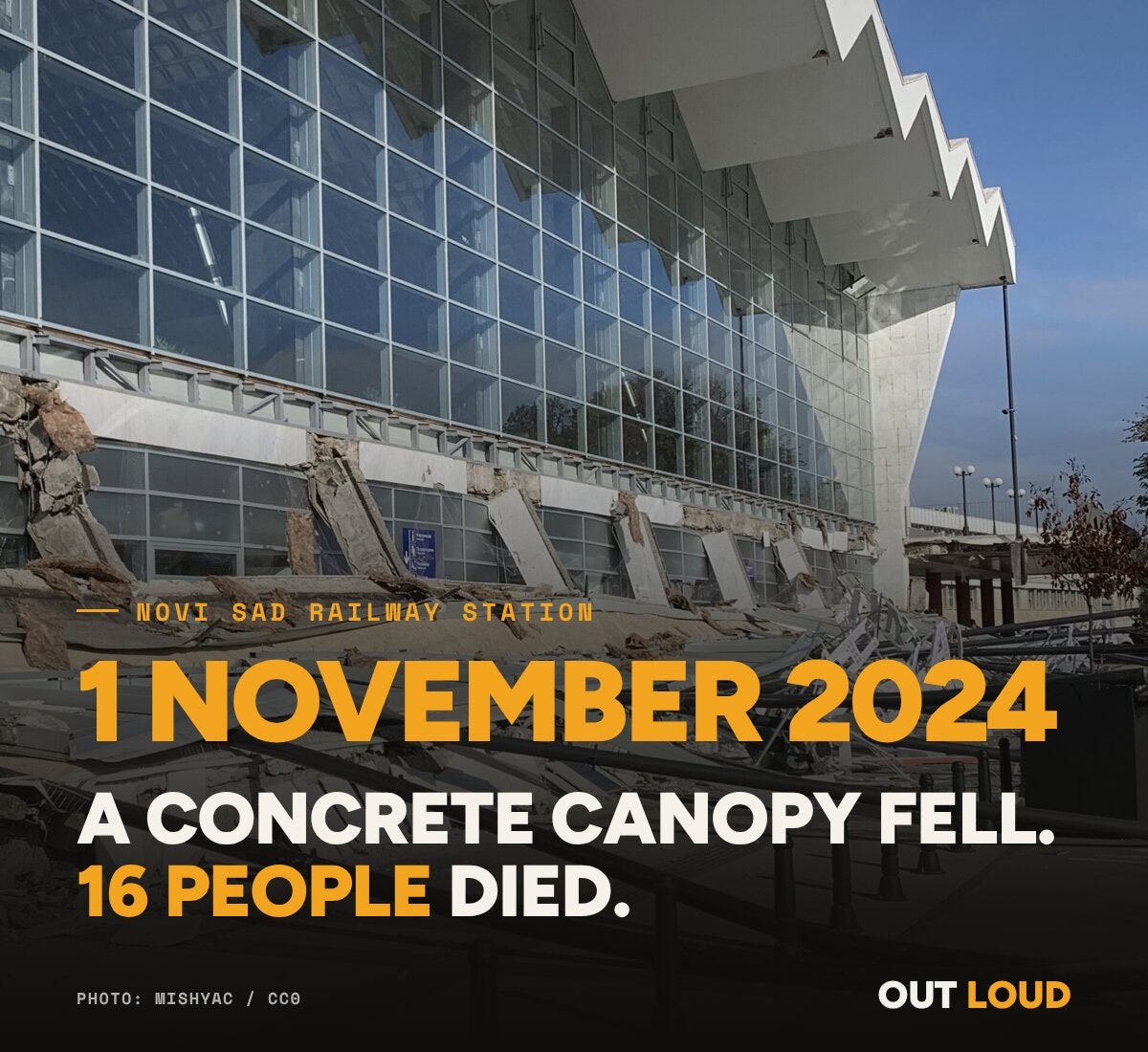
The first lesson is in the street. A young person shows up, looks around, and sees thousands of people who feel what they feel. That discovery mobilizes people faster than any program. Serbia’s students began blockading their universities after the canopy at the Novi Sad railway station collapsed in November 2024, killing sixteen people. High school students soon joined the blockades. In March 2025, about 300,000 people came to Belgrade, and almost 200,000 more came last May. Today, France, Italy and Albania are following in suit and living this lesson out now.
Aleksandar Matković, a researcher at Belgrade’s Institute for Economic Sciences who was nominated as a Student List candidate before taking up a research scholarship in Spain, says Serbia’s students moved through this stage faster than most. Many of the students had probably already been in the streets with the movement against lithium mining, he told me, so “they instantly blockaded the faculties.” Because they were physically present inside their faculties, he said, they could “take time to think through the democratic procedures and link up with other faculties, and that’s how it started.”
The second lesson arrives with the police. Every government that cannot answer its young people tries to break them, with arrests, beatings, expulsions and lies. In Serbia, police and pro-government thugs attacked the students.
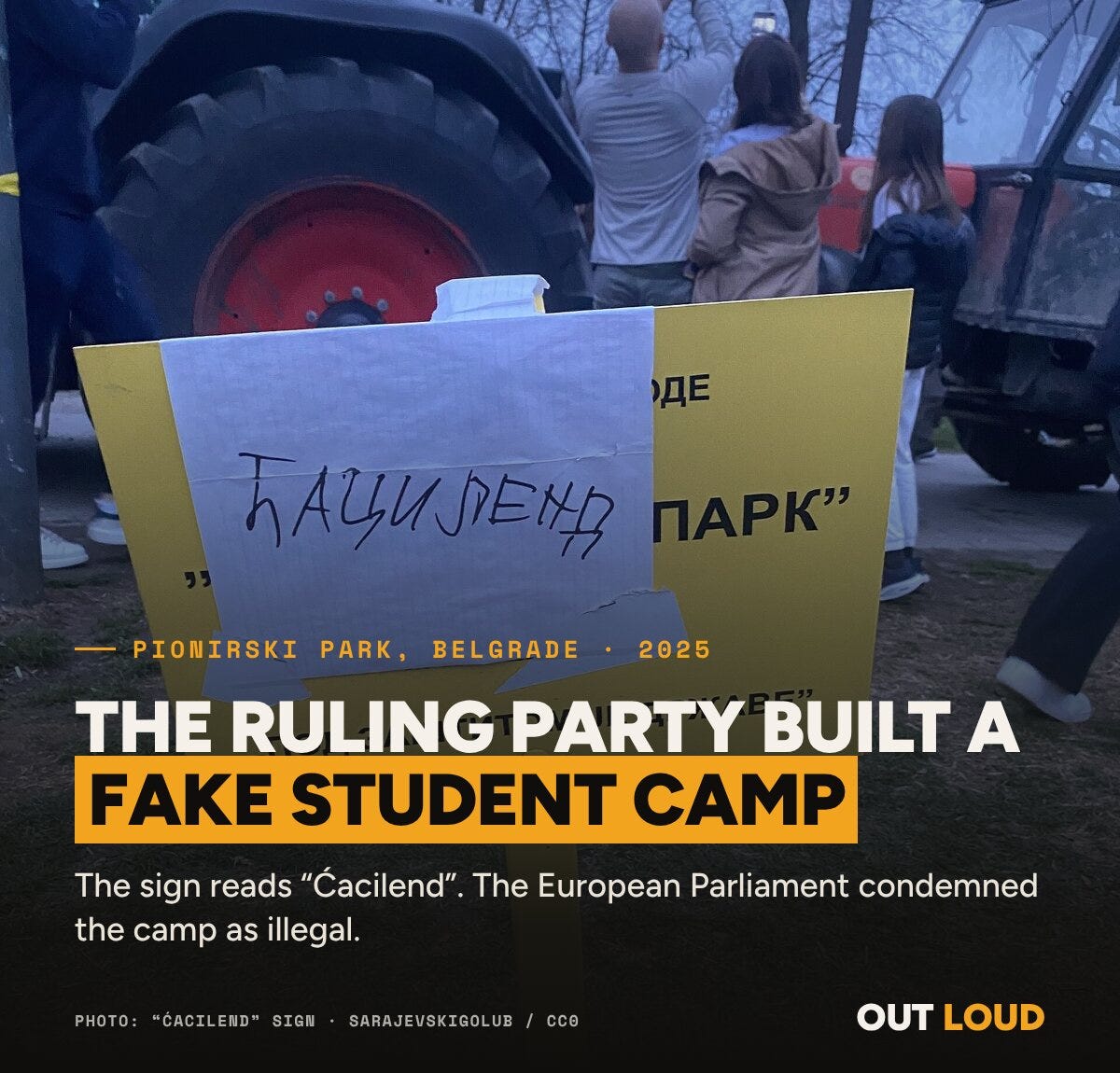
Before the March 2025 protest, the ruling party organized people to pose as students who opposed the blockades, some of them well past student age, and set them up in a camp in central Belgrade. The European Parliament later condemned the encampment as illegal and raised concern about people with criminal backgrounds being mobilized by the ruling party to attack protesters with pyrotechnics. French students suspect police of posing as Arab teenagers on Snapchat. Serbia’s government built a whole fake student body. The pressure has not stopped. On October 20, two days before the final rally, students said police were searching premises used by one of their colleagues, in what Vreme, a liberal independent weekly news magazine, described as a hunt for “terrorists.” A movement survives this stage only if it answers each arrest together, gathers again and again, and refuses to let fear scatter it.
Matković knows this stage from the inside. In August 2024, he received death threats against him and his family over his opposition to Rio Tinto’s lithium mine in the Jadar valley. The government had targeted him since 2020, and he says that on some occasions he broke. What held him together was public support from academics, from intellectuals at home and abroad, and from social movements. “These threats function as long as you internalize them,” he said. He later learned that some 60 other activists had been targeted. Pro-government media branded them ecological terrorists, released their private data and photos, and had them followed.
When they protested together outside Serbia’s state broadcaster, he said, “this gave us all additional strength.” His answer was to make every part of the attack public, through protests, articles and talks, which he believes made the state and Rio Tinto think twice. “When somebody spends so much time and money trying to cause you harm,” he said, “there is something in you that literally decides to resist.”
The third lesson is about demands. Governments in France and Italy can absorb protests in their streets every day and keep governing as usual, because they have police and they hold power. The street pressures a state, it cannot replace one.
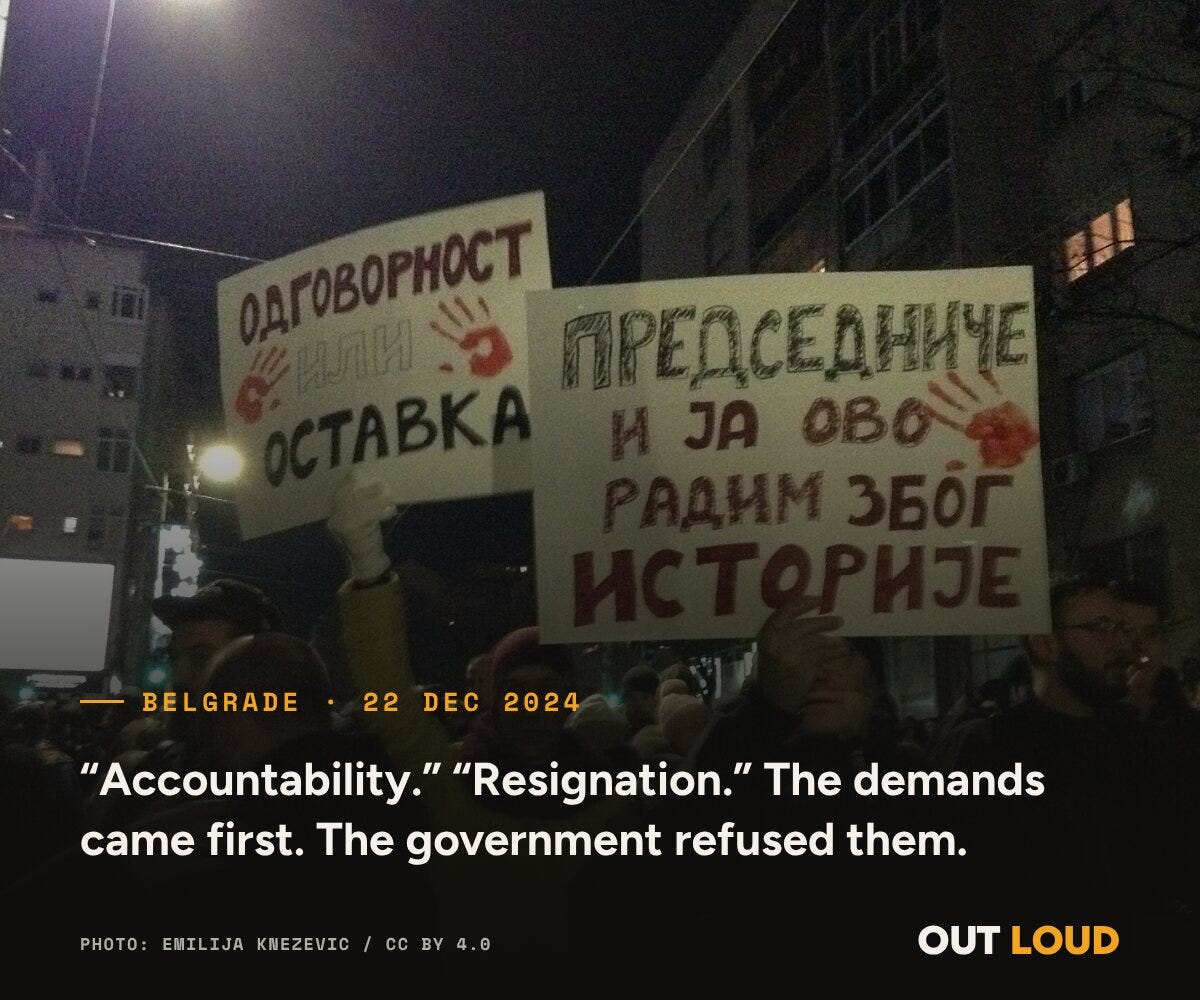
Serbia’s students made concrete demands from the start: publish the documents on the station’s reconstruction, prosecute those who attacked students mourning the victims, drop charges against arrested students, and fund higher education. A government that wanted peace could have met them. This one refused, and the students concluded their demands would never be met, so they added another: early elections.
That move from the blockade to the ballot box is why outsiders struggle to describe the movement, Matković says. “This is much more than a protest and much more than an election,” he said.
The fourth lesson is the hardest. If the political parties are part of what broke the country, a movement cannot hand its demands to them and hope. It needs its own program and its own people, and someone has to build both. In Serbia, the young did it themselves. They held plenaries at their faculties to choose candidates, and none of the students are running for office. The list of 250 names is made up of lawyers, university lecturers and civil society figures, and the students persuaded almost every opposition party to step aside so the vote would gather behind it. They campaign under the slogan “Serbia or Mafia,” naming corruption, para-police gangs and ties between the state and organized crime.

The students set one test for every candidate. Besides expertise, each had to have taken on the government of their own free will, on their own initiative, without parties, business backers or foreign sponsors, and with nothing to gain. Slobodan Bubnjević, a physicist and number 103 on the list, had already been fighting corruption in his workplace and in the citizens’ assembly in Pančevo, where he lives with his wife and two daughters. He took part in one of dozens of expert working groups the students convened to draft their program, and his group alone produced a 218-page action plan. The plan rests on three words, justice, knowledge and development. Its measures run from a prosecutorial police, tax checks on assets, lustration and freeing the media to investment in housing, a doctor in every village, and an end to workers’ dependence on fixed-term contracts. Bubnjević describes it as a medical protocol for a patient on the edge of a heart attack, whose body is being eaten away by corruption.
Matković went through that process himself. About eight faculty plenaries put his name forward, and three approved him. He told each of them that he had applied for a scholarship abroad, in case things in Serbia went downhill. When it came through, he left for Spain, knowing others could carry on the same work. “It’s not about the person, it’s about the idea that they represent,” he said. “Each one of us can be replaceable.” He still campaigns from abroad through his own social media, in coordination with the movement, which he says has enlisted about 900 influencers with a combined 41 million followers to break through the media blackout.


Each faculty invented its own procedure. Any student could nominate anyone, and if other students agreed, the candidate was invited to introduce themselves. At the Faculty of Technical Sciences, one of the country’s largest with about 16,000 students, two students interviewed Matković and then sent him a questionnaire. The Faculty of Political Sciences rented a hall in a Belgrade cultural center and put him on stage with five other candidates, asking each the same questions, such as what they saw as Serbia’s biggest economic problem.
At his own Faculty of Philosophy in Novi Sad, he faced about a hundred students, one candidate at a time, and they could ask him anything. Once a faculty chose its candidates, every other faculty in the country could veto them or demand changes, and the whole process took about a year, meaning the veto had teeth. In September, faculty plenaries voted 43 to 42 to strike the rector of Belgrade University, Vladan Đokić, whom much of the public had expected to lead the list. Matković says many students now think the lack of a single voting system may have been a mistake, since they built the procedures as they went.
That is a long way from how Serbia’s parties choose their people. Matković was a member of the Green-Left Front, the main left-wing opposition party in parliament, where, he said, the party’s leaders drew up the candidate list themselves and traded places with coalition partners.
“We are facing multiple crises in societies which can be solved only through collective intelligence,” he said. “The student model in Serbia comes close to answering that.”
The students also knew that regime-controlled media had never mentioned them in the countryside and small towns, so they went door to door. Their “Student in Every Village” group says it has visited more than 400 communities and 40,000 households in the past year.
This week’s marches carry the same purpose: crossing the heart of the country to win voters one at a time. That work took two years of meetings under pressure, with messages that were sometimes confused and an organization that held anyway. It produced the most advanced experiment of this whole generation of revolt, and the farther you stand from Belgrade, the easier it is to miss.
The risks are real. Vučić resigned the presidency on September 27 to run for prime minister, and the election is unfolding under allegations of irregularities and unfair conditions. Earlier this month, the Student List protested outside the Electoral Commission, alleging fraud. On October 19, Ilija Srdanović, the first name on the list, told reporters the students had called for no tensions anywhere in Serbia and wanted the campaign to end peacefully and with dignity.
Asked by Vreme in September whether the list had a plan if the government refused to accept defeat, Bubnjević answered with one word: yes. The list has also declined to name a candidate for prime minister, which Bubnjević defends as “constitutional patriotism,” arguing that the office belongs to any citizen and that accountability matters more than a name. The list is ideologically diverse, and it remains unclear how it would turn protest energy into changed institutions. Experts warn that winning power would be only the start of the challenge.
Matković, who comes from the left, admits the list is no coherent structure. It inherited many of the positions that divide Serbia, and because it is not a party, he said, it can afford its contradictions for now. The students settled their disagreements by negotiation, and those who lost had to accept compromise, so the program is the product of that bargaining. “We were afraid that this might break up the movement,” he said, “but it managed to hold through.” He hopes the students will one day form a party of their own, which would mean reworking the program, and he is already looking past Sunday.
“We are expecting violence after the elections,” Matković said, and he asked journalists everywhere to research and cover the movement, because attention from English-language media raises the cost of repression.
The old opposition is the other unknown. Matković’s former party, he said, had only about 500 members, and the others are no bigger. Most opposition parties now back the students, but one pro-European party is running against the list, a choice he expects voters to punish as betrayal. Behind the scenes, he said, tension between the parties and the students ran high. It was settled only for now: the parties stepped aside expecting the list to open the way to future elections in which they can run again. He does not know whether that support will hold after Sunday, or give way to “chaos and contestation.”
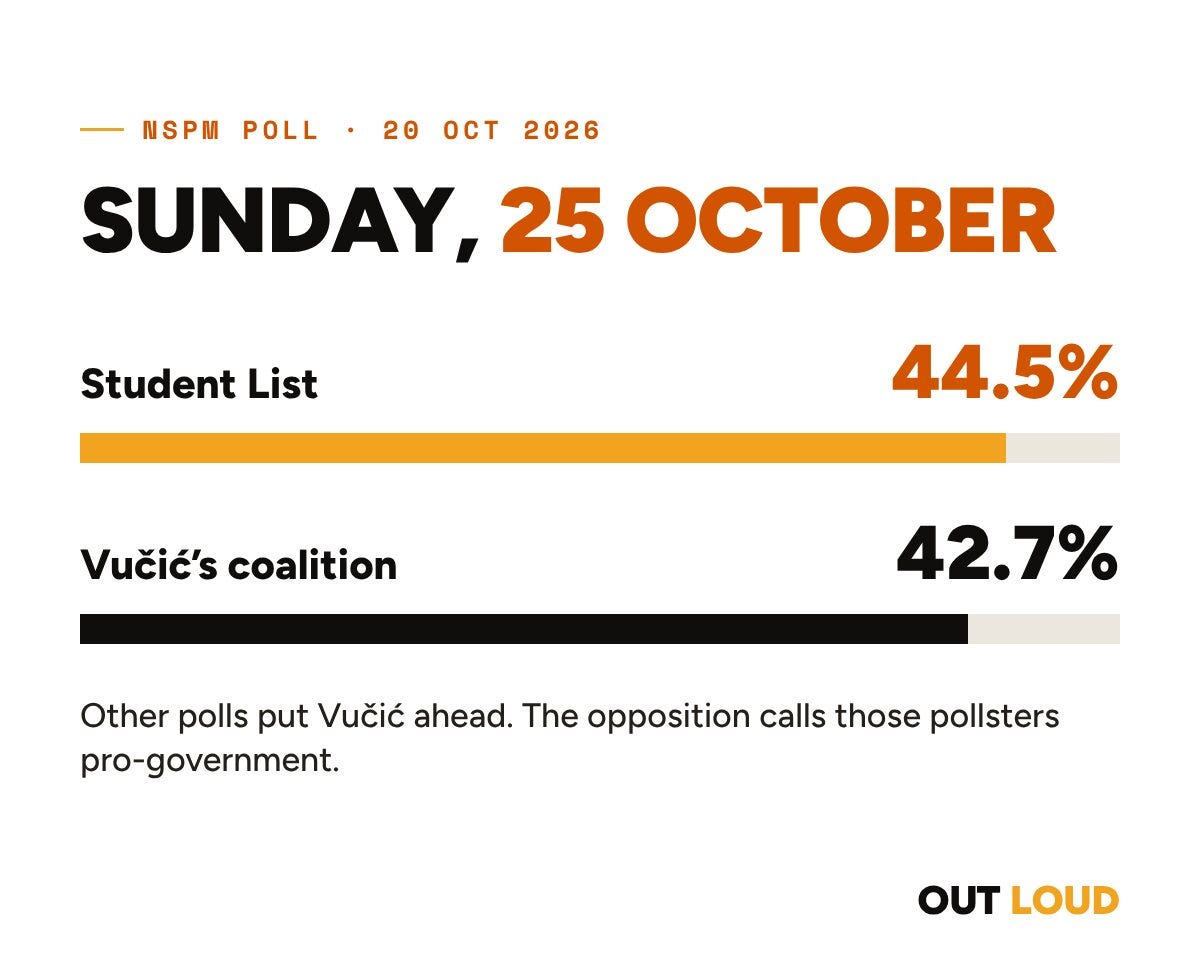
Polls suggest the list could win. If it does, a movement that began with sixteen dead at a train station will have carried its grief into government, and every student blockading a school in Créteil or Turin will have seen where the road can lead. If it loses, the students will still have built what the uprisings of 2011 never managed: an organization that outlived the squares.
Matković has been carrying the story abroad. He recently lectured in Barcelona on Yugoslav and Serbian history, and he says people there are fascinated. He refuses to treat Serbia as a Balkan exception, and he reaches for a line from Julian Assange, who told the daily Blic a decade ago that Serbia is one of the countries “in between,” where the future comes first and whose fate is to be misrepresented. Across Europe, he said, states are run by corporations led by corrupt politicians, “and it’s no wonder that we see self-organization resurging in France, Belgium, Spain and elsewhere.”
His advice to a student blockading a school in Paris, Turin or Tirana is to follow Serbia closely, for Serbia’s sake and their own.
“The moment that you start to challenge corrupt governments, capital, corporations and markets in your own countries,” he said, “this sort of knowledge will be vital.”
Wow! This is really impressive. I hope the students win.
I couldn't disagree more. Serbia is one of those countries on the CIA/MI-6 psyop list scheduled for another "color revolution" designed and fabricated in an intel think tank. This has nothing in common with the student riots in Albania or France. Vucic's crime: he refuses to enter NATO's anti Russian coalition to attack and dismember the Russian federation.
Western infiltrators are trained and given assignments by such intel front organizations as Endowment for Democracy and US Aide. These are the same organizations that pursue official US policy in the Caucuses where they seem to have succeeded in Armenia but were exposed in their attempt to turn Georgia into another Ukraine. Need I add that they are very supportive of US policy in the MidEast.