


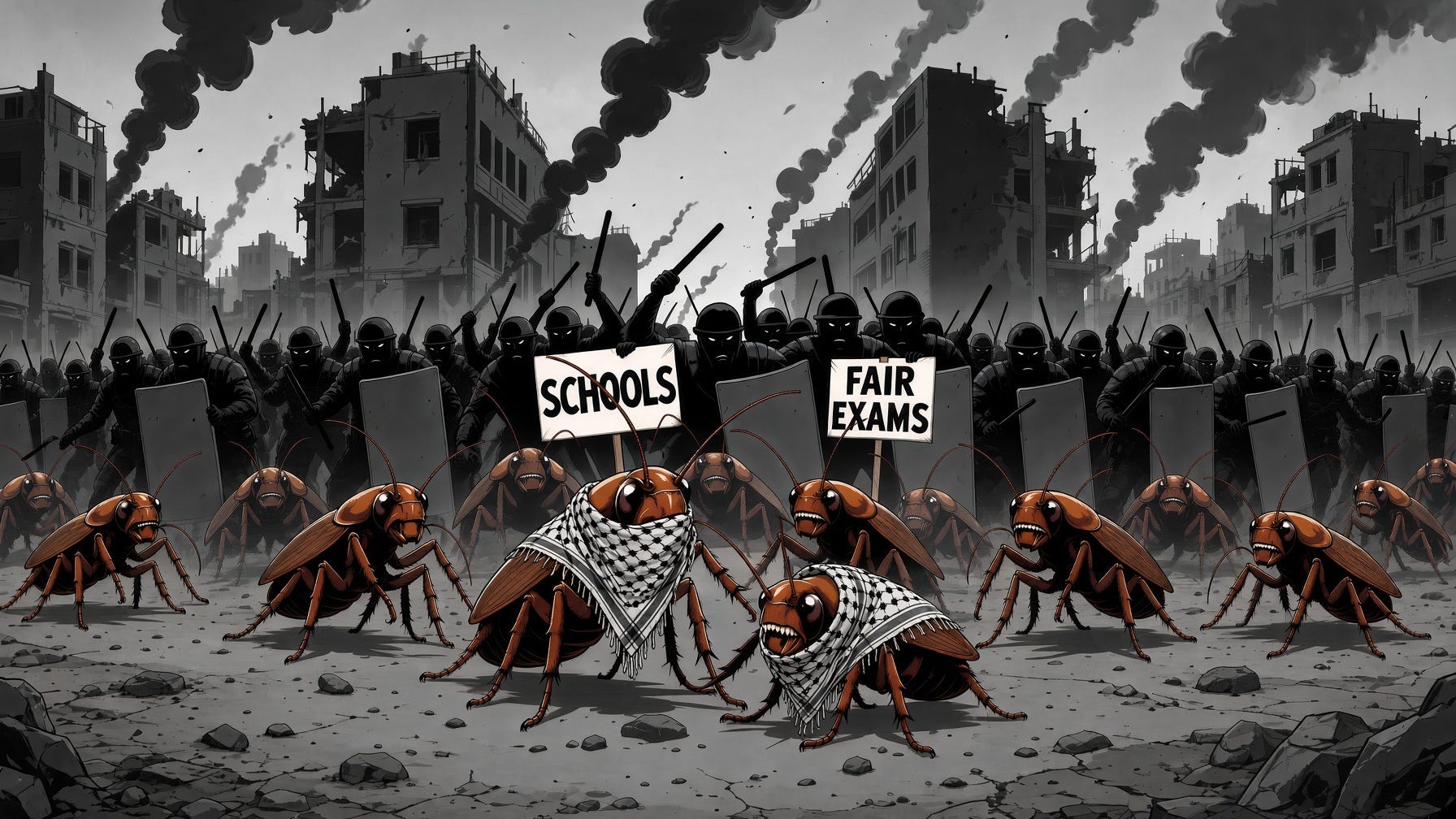
On May 15, India’s Chief Justice Surya Kant sat on the Supreme Court bench and compared unemployed young people to cockroaches and parasites. Those who cannot find work, he said, become journalists, RTI activists and social media users and “attack the system.” The next day he said he had meant people with fake degrees. By then Abhijeet Dipke, a 30-year-old political strategist, had founded the Cockroach Janta Party, a play on the name of Narendra Modi’s BJP. Membership required being “unemployed, lazy, chronically online.” Dipke built the branding and manifesto in 24 hours with AI tools. Within a week the party had more than 19 million Instagram followers, nearly double the government’s.
The joke landed because the choice of animal mattered. A cockroach has no claim on the household. Nobody asks what it needs or why it came. It is managed, kept out of sight, sprayed when it multiplies. The chief justice gave a name to a posture that governments far from Delhi now share. Governments are not treating a generation’s demands as political questions to be settled. They treat the generation itself as a problem to be kept under control at the lowest possible cost. And they will soon learn to regret this approach.
India’s young people are refused the role cast for them. By July the party’s marches over leaked entrance exams had forced the education minister to resign, and this month it is back on the streets over alleged changes to voter rolls.
The same refusal is moving through France, where high school students blockading their schools over missing teachers have been met with mass arrests, 87% of them minors.

It is moving through Spain, where the eviction of an 87-year-old tenant named Maricarmen Abascal by a vulture fund filled the streets with people in their thirties who still cannot leave their parents’ homes. And it is moving through Chile, where students marched on La Moneda under the slogan “Ni un peso menos para la educación” the day after President José Antonio Kast presented his first budget.
Containment
Each of these movements is fighting over a rung of the same ladder: the public things a society builds so that a child born without money can still arrive somewhere. Every one of these governments has looked at that ladder and made the same calculation. A teacher costs a salary for thirty years. A riot officer costs overtime for a week.
In Delhi the young are cockroaches. In Paris the interior minister calls the blockades urban violence and the cameras call them riots. At Columbia, the administration accused Mahmoud Khalil of being a terrorist sympathizer. So the demand is absorbed as a disturbance, the children who voice it are arrested, and a party, a religion or a foreign hand is found to carry the blame. In Paris it is La France Insoumise, and Donald Trump has offered Islam. In Buenos Aires, where Javier Milei has cut university funding to its lowest share of GDP since 1989, his party called a march of hundreds of thousands an opposition stunt. In Delhi, the state cut the internet.
Ideology does not determine who reaches for this method. Emmanuel Macron is a centrist, Kast stands on the far right, Modi governs as a Hindu nationalist, and in Spain a left-wing coalition that tried to protect tenants was overruled by the right in parliament. All of them run the same arithmetic. France’s 2027 budget takes back thousands of teaching posts while giving its armed forces the largest increase of any ministry. Containment always finds the money for the instruments of control, while the future of the young that gets rationed.
Stanford researchers tracking U.S. payroll data found employment for 22- to 25-year-olds in the jobs most exposed to AI running about 19% below where it would otherwise be, because companies are hiring fewer of them.
Automation arrives with an alibi built in. The disappearing first rung gets credited to the machine, and the people who chose to buy it disappear from the story. A shrinking future starts to look like weather, something that happens to a generation and can only be endured. That story is containment’s most efficient tool, because it asks young people to police their own expectations before the police are ever called in.