


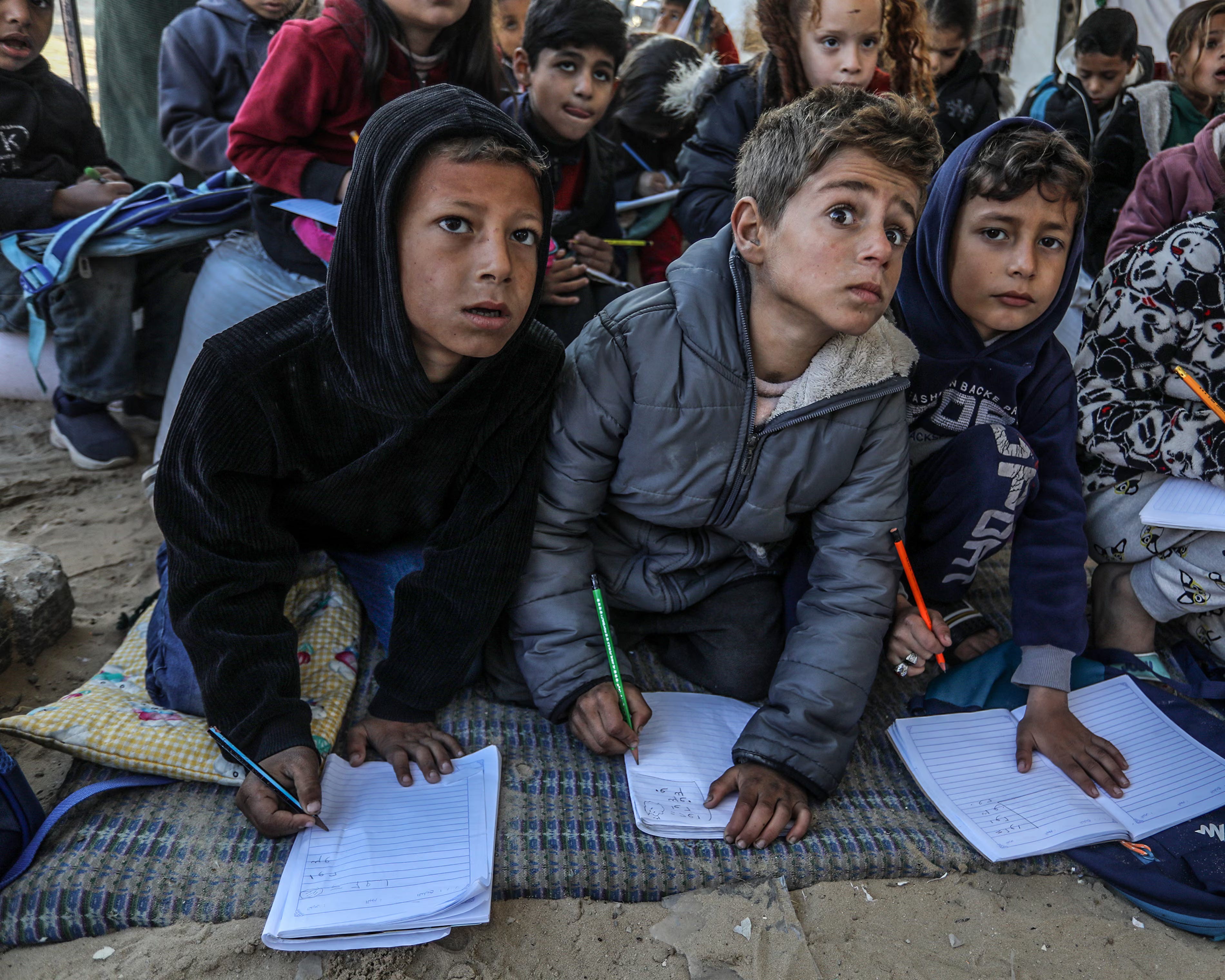
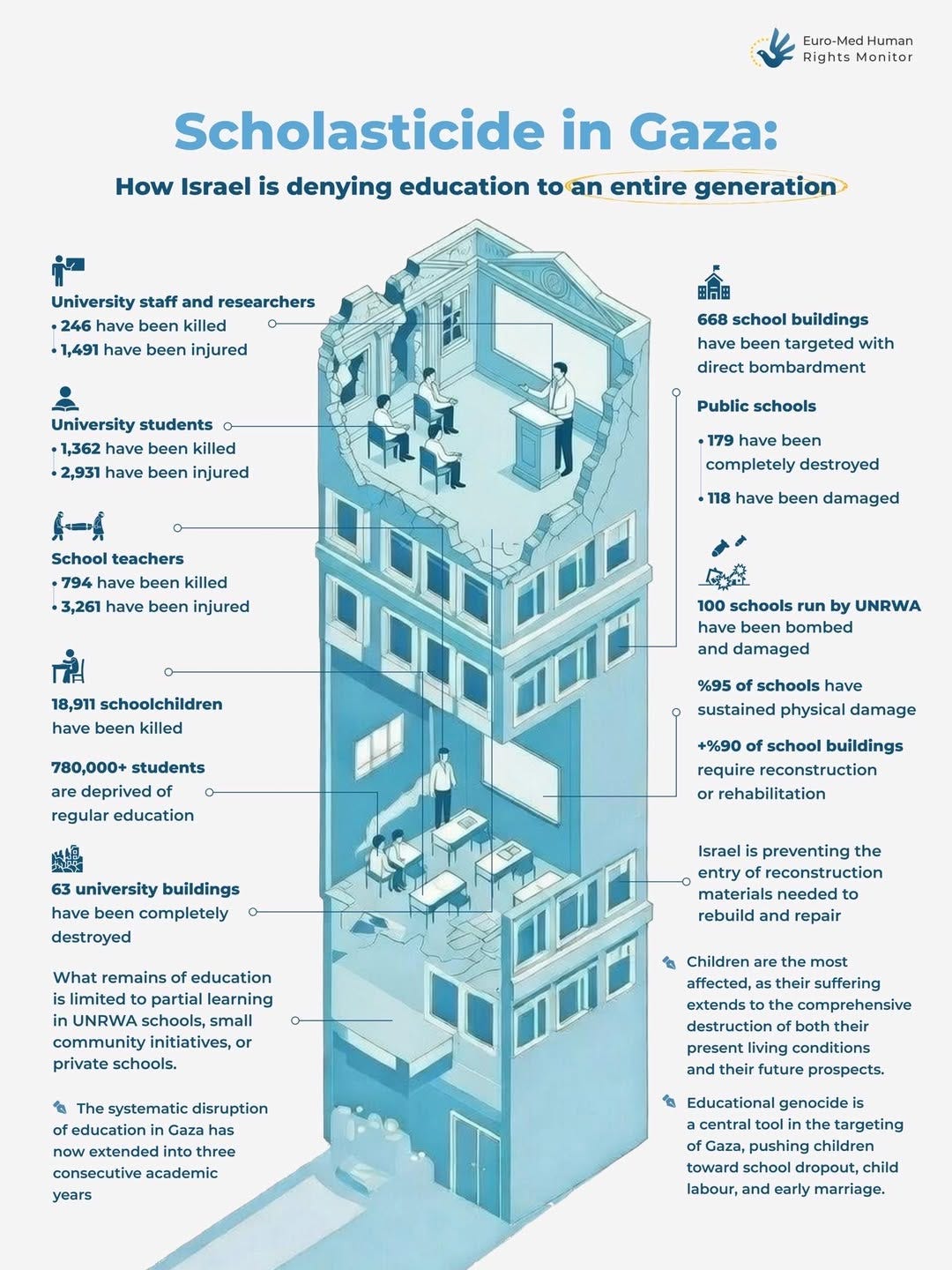
Palestinian children in Gaza went back to school this month for the first time in three years, walking into what little remains. UNICEF says 98 percent of Gaza’s schools were damaged or destroyed, and some of the classrooms they returned to are just tents fixed in rubble. A girl in Gaza now does her lessons inside the physical record of what was done to her, of the genocide she is enduring. Seven thousand miles away, a board of education in Texas has already voted on how the history we are living will be taught.
Israel has been bombing schools for a long time. On the morning of April 8, 1970, Israeli Phantom jets struck a primary school in the Egyptian village of Bahr al-Baqar. Egyptian records report thirty children were killed, other accounts say forty six. Moshe Dayan, then Israel’s defense minister, said the school was a military site. No evidence was ever produced. According to Egyptian accounts, a pilot who flew the raid, captured three years later in the October War, admitted they had known it was a school.
Fifty six years later, on the first morning of the US-Israeli war on Iran, a strike hit a girls’ elementary school in Minab, in the country’s south. Early reports counted fifty dead. By the next day, Iranian state media said 165. Washington said it was looking into the reports. The excuses change with the decade. A weapons depot in 1970. A Hamas command center in Gaza. A promise to look into it in Minab. First the school is given another name, then it is hit, and the other name is what the world is asked to remember.
In Gaza, Israel stopped bothering with excuses school by school. In April 2024, UN experts warned of scholasticide, the systematic destruction of a people’s ability to educate itself. By the start of this school year, around 22,000 students and more than 770 education workers, 532 of them teachers, had been killed, according to Gaza education officials. UNESCO found 22 of 38 campuses completely destroyed. About 660,000 children were cut off from regular schooling. The libraries, the archives, the lecture halls and the professors who carried a people’s scholarship in their heads were among the first things taken.
On September 4, with Gaza’s children still waiting to go back to class, the Texas State Board of Education voted 8 to 4 to rewrite high school social studies. A final amendment requires students to identify 1948 as the year Israel was established “in the ancestral homeland of the Jews,” and Harry Truman as the first world leader to recognize it. By the time they reach high school, Texas children will already have studied the Promised Land and the Ten Commandments in an elementary unit on ancient Israel. The same board deleted a requirement to teach Muslim contributions to algebra and astronomy. In its place, students will learn early Islam through what the standards call Muhammad’s “brutal military campaigns,” slavery and female captives. Proclaiming Justice to the Nations, an evangelical Christian group, claimed credit for several recommendations that made it into the final standards.
The theology behind that influence runs deep. In ‘Til Kingdom Come, the Israeli filmmaker Maya Zinshtein follows a Baptist church in a Kentucky coal town whose members give what little they have to Israel because they believe the Jews are crucial to Jesus’s return, and whose children are raised in the same belief.
The amendment names a Jewish homeland, a year and the American president who blessed the result. It does not name my grandparents or any of the other people already living there. It has nothing to say about the 750,000 Palestinians driven out in 1948, or about Deir Yassin, or about Jaffa, the city my family came from, emptied of most of its Arab people in a matter of weeks. Texas has taken the founding claim of a settler movement and turned it into a fact children will memorize for a test. These new standards begin reaching Texas classrooms in 2030, meaning the children who will be graded on them are already in elementary school today.
The Palestinians who managed to stay in 1948, and their children and grandchildren, now make up about a fifth of Israel’s citizens. Today, Israel’s Central Elections Committee voted 18 to 5 to bar the two main Arab-majority lists, Ra’am and the Joint List, from the October 27 election. The attorney general’s office told the committee the evidence did not meet the legal threshold, yet the committee voted anyway. The Supreme Court may still reverse it, as it has reversed most of these attempts before. For decades American politicians have called Israel the only democracy in the Middle East. Texas is about to teach its founding as settled fact, in the same season its election committee voted to hold an election without the parties of the people who survived that founding, people now watching the genocide of their own in Gaza.
Saudi Arabia is editing history in the other direction. A review of 136 Saudi textbooks found that Palestine has been removed from some maps, that “the Zionist enemy” has become “the Israeli occupation,” and that one sentence in an eleventh grade Arabic exercise, “Muslims will never give up Jerusalem,” has disappeared from every edition printed since 2024. The review was carried out by IMPACT-se, an Israeli-based group that has been grading Saudi textbooks for two decades, and the findings surfaced first in Israeli media, where they were read as a signal that normalization is back on the table. Publicly, Riyadh still says there will be no relations with Israel without a Palestinian state. Its schoolbooks have already moved on.
So in Austin, a claim is written into the record as fact. In Riyadh, a fact is written out, along with the sentence a child might once have used to argue back. In Gaza, the schools, the teachers and the archives, the places where a Palestinian child would learn her own history from the people who lived it, are still being bombed into ruin.
Legislation, omission, two thousand pound bombs. A genocide needs a history that makes it look necessary, and it needs the people who could contradict that history silenced or erased. All of it is being supplied at once, during the killing, while the world continues to watch.
This week I watched Abdul El-Sayed, Michigan’s Democratic nominee for Senate, sit beside Kamala Harris at a roundtable in Detroit. She endorsed him after he won the primary in August, and they spent the afternoon talking about Black maternal health. My first reaction was anger. Harris was vice president for the first fifteen months of the genocide, and she ran for president on a pledge to keep arming Israel. Then I had to be honest with myself. El-Sayed endorsed her in 2024, the day after Biden stepped aside. Anyone who backed him in this summer’s primary backed a man who had already made that choice, back when the anger could have counted for something.
In Detroit, El-Sayed said the election ended where it did because Democrats could not find places of agreement. His own campaign website is plainer. It cites the party’s autopsy finding that Harris’s Israel policy was a significant reason she lost. Last year he called Gaza a Rorschach test on your values. This week the conversation was about mothers and newborns, led by the vice president who spent those fifteen months defending the weapons that killed Gaza’s mothers and newborns. The forgetting that Texas is writing into its standards and Riyadh is printing into its schoolbooks happens on campaign stages too, one convenient silence at a time, and voters are being asked to call it “unity.”
This month a little girl in Gaza opened a notebook in a tent. In a few years a teenager in Texas will open a textbook and learn that the land under that tent was someone else’s ancestral homeland, decided in 1948, as if the old slogan were true: a land without a people. The teenager will be tested on it. The girl already carries the other version, in her family’s names, in the empty lot where her school stood, in the teachers she will never see again. Governments from Austin to Riyadh are working to make sure only one of those records counts as history. Writing hers down, and refusing to let it be renamed, is how the record survives. Art is another way. Annemarie Jacir’s Palestine 36, a film I’m proud to have a small part in, tells the story of the 1936 revolt against British rule, a chapter of this history the Texas amendment skips entirely. There are many ways to survive a genocide that too many people in power insist on supporting, directly or indirectly, even as it deepens. Never again has to mean never again for Palestinians too, or it means nothing at all. It’s not complicated. It’s that simple.
Some day, history books will read:
At one time there was a quasi-nation named “Israel”, a false state constructed on the ethnic cleansing of the Indigenous people.
Eventually the sane world vomited out this abomination and it fortunately ceased to exist.
I have never thought of this in this context before and I have an entire lifetime in curriculum development and education. Of course those in charge will record history in their favor. And I'm profoundly sad.