


It has taken me some time to process Anas’ death. I never met him in person, but I was in touch with him throughout the last two years of a genocide that has seemed endless. When I first heard that Israel had robbed him from us, as they have robbed the best of Palestine’s people, land, food, resources, and culture, I felt a grief that crushed me for days, with a burning fire in every direction in my heart.
I write to honor him, to bear witness to a life that demanded the world see what it refuses to acknowledge: The truth about Israel. The truth about Gaza. The truth about genocide.
Anas moved through the world with a camera and a notebook, but he also carried the weight of every truth Israel tried to bury. He carried the names of children who would never grow up, the echoes of homes reduced to rubble, the faces of friends who had been murdered. He carried Gaza, in the lines of his reporting, in the rare tremor of his tremendous voice, and in the insistence that the world see.
Many people do not know that Anas was part of the Reuters team that won a Pulitzer Prize in 2024, an honor reflecting the relentless courage and rigor of his reporting. I was honored to share a Human Rights Defender award from Amnesty International Australia with him, along with Bisan Owda and Plestia Alaqad. To be honest, at first I didn’t want to accept the award. Frankly, I felt my contribution to telling the story of this genocide was not worthy of the sacrifice, courage and commitment of the Palestinian journalists on the ground.
Anas never stopped reporting, not when Israel killed his father, not when they slaughtered his colleagues and close friends Ismail Alghoul and Hossam Shbat. Even when Israel bombed his family’s home, when they threatened him with death if he did not leave northern Gaza, he continued. He buried his father through tears and returned to his work. So when Israel assassinated him too, in Gaza City, in a targeted airstrike on press tents that killed other journalists alongside him, I didn’t want to believe it. In his final broadcast he showed children starving, and one hour before Israel murdered him he had written a tweet warning the world of Israel’s plans to occupy all of Gaza.
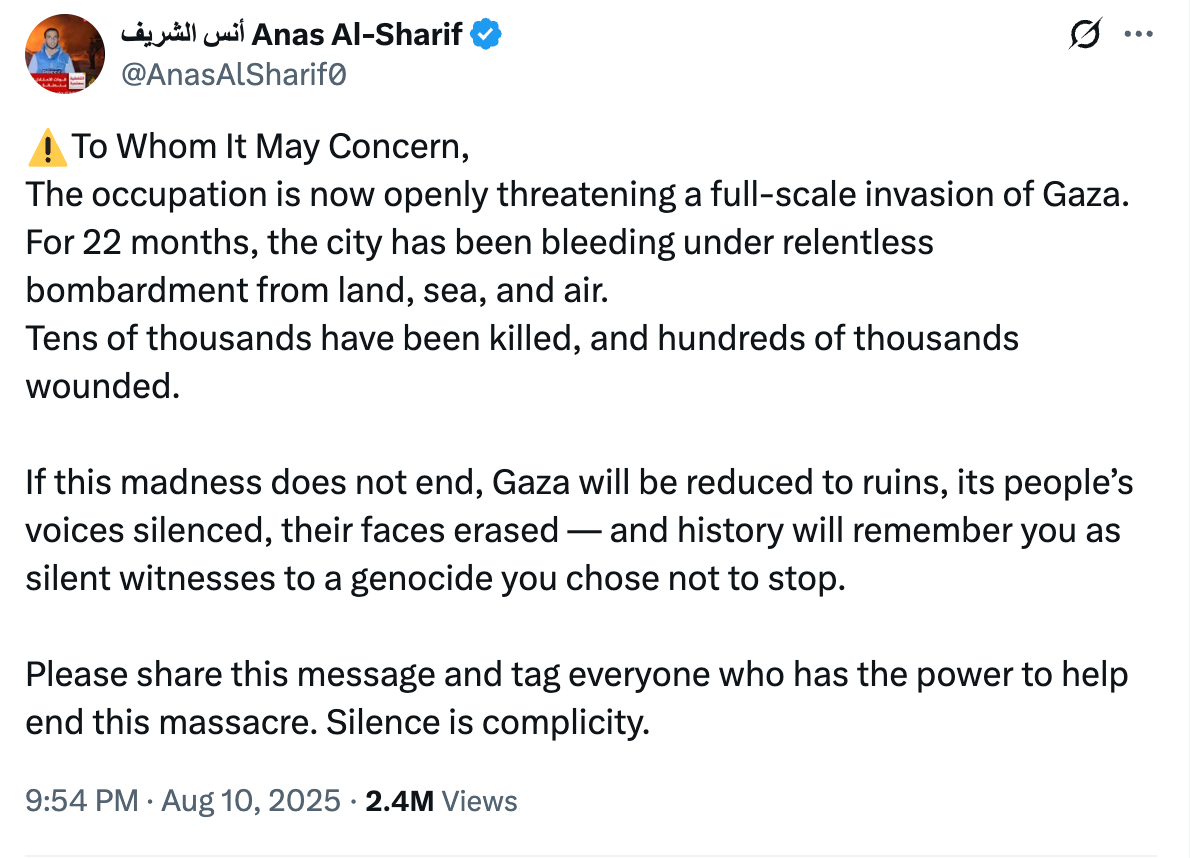
Israel has murdered more than 270 journalists and media workers. Each death is cataloged but rarely mourned in equal measure. Palestinians are parsed into “acceptable” and “unacceptable” victims, even within journalism. Anas was branded “unacceptable” by some corners of Western media. I saw many outlets center Israel’s claims about him, with coverage that at times echoed the state narrative before wider scrutiny. Protesters outside the BBC’s London headquarters unfurled a banner reading, “You killed Anas.” Reporting on the assassination and the protest is here: Drop Site News on the assassination and aftermath.
One day after Israel murdered several Al Jazeera journalists I read a New York Times piece that, to me, carried the tone and ordering of official talking points more readily than it demanded verification. I called it out when I saw it: The way the media choose words decides who we mourn, and who we are taught to doubt. This pattern is not limited to one newspaper. It is a system of choices that normalizes certain claims while casting doubt on others. That is not purely semantic. It is moral, and it has consequences.
At the same time, I watched U.S. press delegations organized and escorted by Israeli officials, hosted at places like the King David Hotel, and I called that what it was: a curated, all-expenses-paid tour. The itinerary included staged sites, stops near the Gaza fence and so-called “aid entry points,” and meetings with high Israeli officials. No visit to Gaza. No meeting with Palestinian victims. Only official talking points. These trips are PR exercises, not journalism. They whitewash and manufacture consent.
Israeli journalist Yuval Abraham rightfully points out that much of the Israeli press, like European and US media normalized mass killing, starvation, and destruction, betraying their profession. The betrayal continues now in headlines reporting Anas’ killing, fully adopting the army spokesperson’s statement.
Any journalist who does not question those claims, after countless documented falsehoods, is betraying their profession. Even if Israel’s claims were true, it changes nothing. By that logic, the vast majority of journalists who once did reserve duty or served in some capacity would become, by extension, legitimate targets. His location had been known for months. So why kill him now, on the eve of plans to occupy Gaza City? I see the answer clearly.
Abraham’s reporting revealed that the Israeli military has operated a unit called the Legitimization Cell, tasked not primarily with security, but with gathering and packaging intelligence that could be used to justify actions internationally. Its work focused on linking Gaza-based journalists to Hamas, portraying reporters as operatives in order to blunt global outrage over the killing of reporters, including Anas. Sources told +972 Magazine and Local Call that the unit’s motivation was public relations: find material that could be declassified and used as hasbara when criticism grew too loud.
The pattern was chilling. Whenever global media attention hardened against Israel on a particular issue, the Legitimization Cell would be instructed to produce intelligence that might discredit the critics. In other cases, sources described how intelligence was misrepresented or misdated to cast journalists as militants, and only later did investigators find the evidence false or irrelevant to current operations.
The process by which a human being is reduced to a “legitimate target” is political, not forensic. The military’s public claims about Anas included allegations of past associations that, even if accurate on paper, would have been historical and not probative of present battlefield participation. Documents cited to justify the strike suggested recruitment years before the current war or injuries that would have removed a person from any active combat role. That is not sufficient to convert a journalist into a lawful assassination target, especially when the evidence has not been independently verified. The Committee to Protect Journalists warned about the smear campaign and called publicly for his protection.
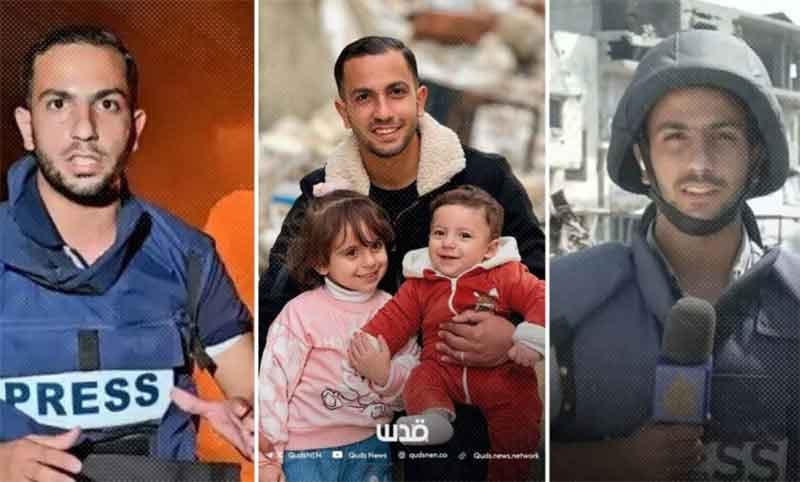
Anas’ life was evidence enough. His work, his witness, his refusal to bow to threats, is testimony. He bore witness to what the rest of the world refused to see. He documented the starvation of children, the targeting of journalists, the destruction of homes. He carried that truth without flinching, without compromise, without fear.
His last messages were tender and terrible. He wrote of Sham, his daughter, “whom I never got the chance to watch grow up as I had dreamed,” and of Salah, his son, “whom I had wished to support and accompany through life until he grew strong enough to carry my burden and continue the mission.” He posted a final note that asked that, if these words reached others, they should know Israel had succeeded in killing him and silencing his voice.
Even in death, he carries forward. His courage unsettles, inspires, and challenges all who witness it. The encampment at Israel’s consulate in Houston, where police on horseback confronted demonstrators and multiple people were arrested as protesters refused to leave while honoring his name, is proof that his life and work cannot be erased. People marched, they sang, they set up tents and called for accountability. Yet where was the mainstream media's outrage? Where were the front-page exposés shaming Israel's systematic slaughter of truth-tellers? Their silence is complicit cowardice, a shameful abdication that props up genocide while Palestinian journalists bleed out in the rubble. This lack of solidarity isn't oversight—it's betrayal, a gutless echo chamber amplifying hasbara over humanity.
We must remember that he chose witnessing over safety. We must remember that he wept for the starving children and thrust his camera into the horrors the world pretends not to see. We must remember the names he carried and the names he gave us.
We must remember, and we must act now, with fury, to escalate against this rogue regime shredding every legal and moral norm. As I mourn Anas, my grief ignites a renewed, unquenchable fire: I vow to expose every Israeli lie, every crime against humanity, and to relentlessly pursue justice and accountability—not just against Israel, but against every enabler, every complicit government, every spineless media outlet that turned away. Their time of impunity ends here; we will drag them into the light, demand trials, sanctions, and reparations, until the truth Anas died for dismantles their empire of deceit.
Anas Al-Sharif insisted on seeing. In seeing, he demanded that the world reckon with its own complicity, and now, so do I, with a vengeance that will not fade. He will not be forgotten. His voice will thunder louder through our collective rage, his vision will scorch the veils of propaganda, and his mission to bear witness to truth and humanity will fuel an unstoppable reckoning through all of us who refuse to let his stories die unfinished.
May God rest his soul.
Brave & Honorable Anas Al-Sharif, Mountain of Jabalia, forever in our hearts ❤️🔥❤️🔥❤️🔥
Thanks for writing this. Every tribute helps me process this tremendous loss and reminds us all to keep going for the people of Palestine. We are stronger knowing the sacrifices he’s made and the wonderful human he was to everyone around him. May God accept him and grant him Jannah. His legacy lives in us all.