


On Friday morning, around 80 masked men came down from a hilltop settlement into an olive grove near Abu Falah, north of Ramallah. Palestinian families were picking olives there. The settlers threw rocks, fired slingshots and gas canisters, and set the trees on fire. Gunfire could also be heard. At least two Palestinian men were wounded, and four more were hurt in attacks nearby. The Palestine Red Crescent treated a 63-year-old Palestinian woman and a 40-year-old man the settlers had beaten. Israeli military vehicles arrived during the violence, Reuters reported, and the attack continued. Soldiers then fired tear gas toward Palestinians who had moved away from the jeeps.


Heidi Levine was in that grove with her cameras. She is 63, an American photographer for the Washington Post with four decades of war coverage behind her, and she wore a helmet and a vest with PRESS across it in bright blue. The settlers knocked her into the dirt and kept kicking her anyway. They tore the cameras off her body, ripped away her bag and her passport pouch, and snapped the cord that held her phone around her neck. The journalist Jasper Nathaniel filmed it. Her colleagues found her lying on her side. In the video she sits bloodied on a dirt road. Asked if she is all right, she says no. “I’m going to die,” she says, and when people urge her to run, she says she can’t. She was taken to the Ramallah Government Hospital and is now stable.
“Luckily I had my flak jacket and helmet; otherwise I probably wouldn’t even be here, because they just kept kicking me and kicking me,” she said afterward. Levine, who was born Jewish, called her attackers Jewish terrorists. Her son Michael has always told her his biggest fear is that settlers will kill his mother. In the same statement she added: “Sadly, none of them will be prosecuted. I am sure of it.”
Levine has covered the occupation for more than thirty years and was attacked once before, about fifteen years ago. She knows the record:
Shireen Abu Akleh, a Palestinian American who reported for Al Jazeera Arabic for more than two decades, was shot in the head in May 2022 outside the Jenin refugee camp, in a helmet and a vest marked PRESS. Within weeks the Associated Press, CNN, the New York Times, the Washington Post and Bellingcat had each traced the fire to Israeli troops, and the UN human rights office agreed. Forensic Architecture and Al-Haq later found that the shooter would have seen her press markings. The army blamed Palestinian gunmen, then conceded a “high possibility” that a soldier had killed her by mistake and opened no criminal case. The FBI opened an inquiry and Israel refused to cooperate. By May 2025 it had run thirty months without a result, and the ICC prosecutor had opened no case. A Zeteo documentary named the soldier it says fired the shot, a sniper who had been killed in Jenin the year before. No one was ever charged.
Between 2001 and 2022, Israeli forces killed at least 20 journalists, 18 of them Palestinian. At least 13 were clearly identified as press or were in marked vehicles. CPJ found that no one was ever charged or held accountable.
In Gaza, CPJ counted at least 189 Palestinian journalists and media workers killed by Israel as of late September, among 241 killed across the region. It calls this the deadliest war for the press it has documented. Israel barred foreign journalists from entering the Strip on their own, which left Palestinian reporters to film the war, and it often announced afterward that the dead were militants. Much of the American press ran the claim in the headline and the doubts in the ninth paragraph.
In the West Bank, the Israeli rights group Yesh Din monitored 1,664 police investigations into Israeli violence against Palestinians between 2005 and 2023. Of the 1,615 that concluded, police closed 93.7 percent without an indictment, and around three percent ended in a conviction. Most of those files died of police failures: suspects never questioned, evidence never collected, cases closed as “assailant unknown.”
Nadav Weiman served as a combat soldier in an elite unit in the West Bank and now runs Breaking the Silence, which has collected thousands of testimonies from Israeli soldiers over two decades. In a post on X he called the IDF spokesperson’s statement on settler violence a lie. “The IDF is not trying to stop Jewish terrorism in the occupied territories,” he wrote. “In fact, it protects Jewish terrorists and arms them with US-made M16 rifles.”

In 2023 the national security minister, Itamar Ben-Gvir, handed out assault rifles to a new civilian guard unit in Ashkelon and set out to build 600 more rapid response squads, in a country where 86 of the 100 towns with the highest share of gun licenses are West Bank settlements. Washington threatened to hold back 20,000 rifles his ministry had bought from American suppliers, and Israel promised they would go through the police or army, which can still pass them to the squads. An investigation by the Israeli state into settler violence means the state examining a policy it built.
The investigation absorbs the first wave of outrage and stretches the timeline until attention moves on. When the evidence leaves no room, it concedes error, blames the fog of a raid, and closes the file. Washington takes the findings and adopts them.
Matt Murray, the Post’s executive editor, followed the script. He said the paper was outraged by an “unwarranted attack” on a journalist doing her job and urged “a thorough investigation and follow-through from authorities.” The authorities in question are Israel’s, and its Prime Minister’s Office answered within hours. It said Levine was “allegedly assaulted” and that the facts “remain unclear.” It cited reports of “some 200 Arabs and far-left activists” confronting “approximately 40 Israeli youths,” and said other footage appears to show Levine knocked down and then helped up at once by an unidentified individual. The investigation, it said, must establish “who initiated the violence,” and those responsible “will be held accountable.”
Eighty masked men burning a grove became forty youths. Palestinian farmers on their own land became a mob of Arabs and leftists. A beating on video became an allegation, and the kicking became a man helping a woman up. The government published that account within hours of the attack, as police opened an investigation.
Murray went back online to restate what he called indisputable: his photographer was clearly marked as press and clearly beaten. He asked again for a thorough investigation and accountability, in a post quoting the office that had just called the facts unclear.


In 2018, after Saudi officials killed its columnist Jamal Khashoggi, the Post’s editorial board said the kingdom should be treated as outlaws. It called on Congress to block arms sales, asked businesses to shun the crown prince and lobbyists to refuse his cash, and urged Congress to impose sanctions on those responsible, Mohammed bin Salman included if the evidence pointed to him. That demand came with a price attached, and the paper kept making it for months.
The requests for Levine go to Israeli authorities and stop there. They name no arms sale to block, no sanction to impose, no official in Washington to call out. The Post is one of the newsrooms that traced Shireen Abu Akleh’s killing to Israeli troops. So are the AP, CNN and the New York Times. More than four years of those findings have produced no charges.
Ten days earlier, armed settlers beat AFP photographer Jaafar Ashtiyeh near the village of Aqraba. AFP said Israeli security forces watched and made no attempt to intervene, and its global news director demanded “a full investigation.”
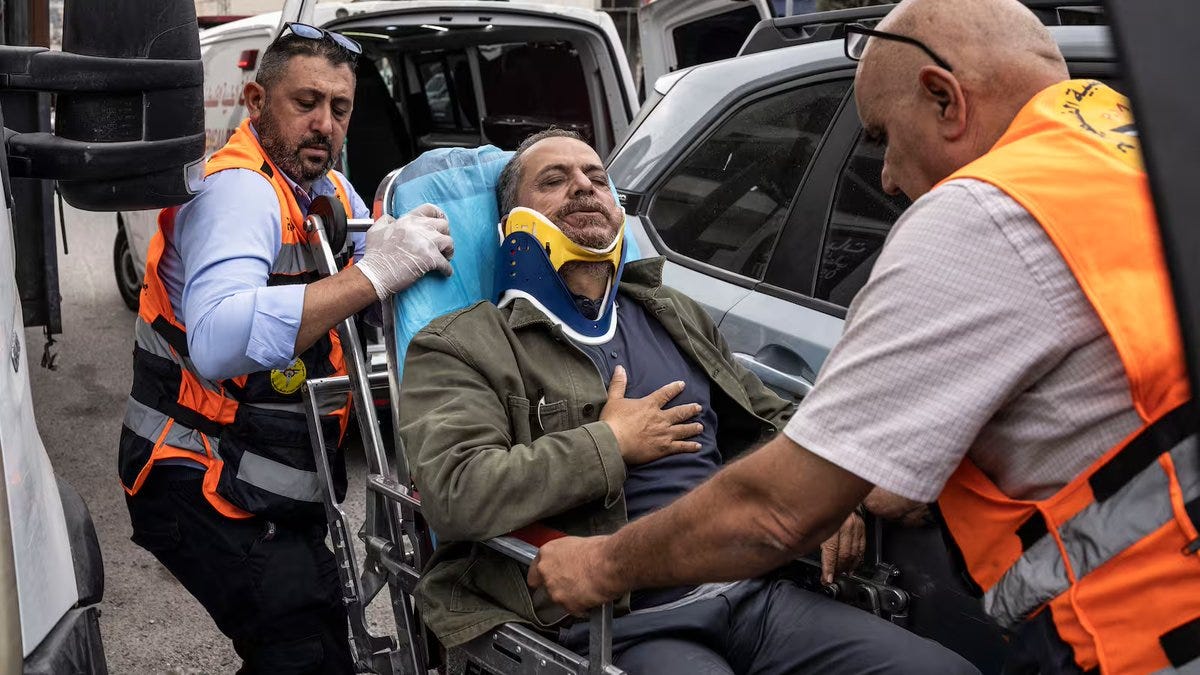
A year before, settlers had thrown stones at Ashtiyeh and set his car on fire. Reporters Without Borders says settler attacks on journalists are carried out with complete impunity and are becoming more frequent. The Post’s request for Levine went to the same authorities.
Heidi Levine is an American citizen, beaten in territory the United States helps Israel hold, by settlers an American-armed army protects. Washington has the tools to act: the Leahy Law bars US aid to foreign security units that commit gross human rights violations, and the White House can restore the sanctions on violent settlers that it lifted in January 2025. The International Criminal Court already has jurisdiction over the West Bank. None of that depends on the goodwill of the Prime Minister’s Office.
The Post knows how to attach a price to a demand. It has reporters, lawyers and a front page. It can ask the White House, by name and every day, what it will do about an American journalist beaten by settlers under the army’s watch. It can call on Congress to enforce the Leahy Law and hold up arms deliveries. It can report on the 63-year-old Palestinian woman and the 40-year-old man beaten in that same grove with the same verbs it used for Levine. It can go back through Shireen Abu Akleh’s file and the 189 names from Gaza and ask why they never drew the outrage Levine’s beating did.
I hope The Post does the right thing. The record reveals to us that it won’t.
Thank you for this reporting. I know Heidi as a longtime colleague with me at the Boston Globe where she worked alongside me and others as a talented and dedicated freelancer for many years through the toughest years of the second intifada. As violent as those years were, they are nothing compared to the violence happening now. And sadly, then as now, settlers seem to feel empowered to threaten and attack journalists and, as Heidi poignantly makes clear, they too often do so with complete impunity. There is a chance here for the Israeli authorities to do the right thing. I hope they do. The Washington Post should demand it.
It will be very interesting to see how that investigation will go - as the whole world saw them beating her. I saw it and thought - that poor soul is done for. What will it take for the whole world to come on side and demand accountability from this barbaric, cruel and criminal state? When will everyone’s moral compass finally kick into gear?