

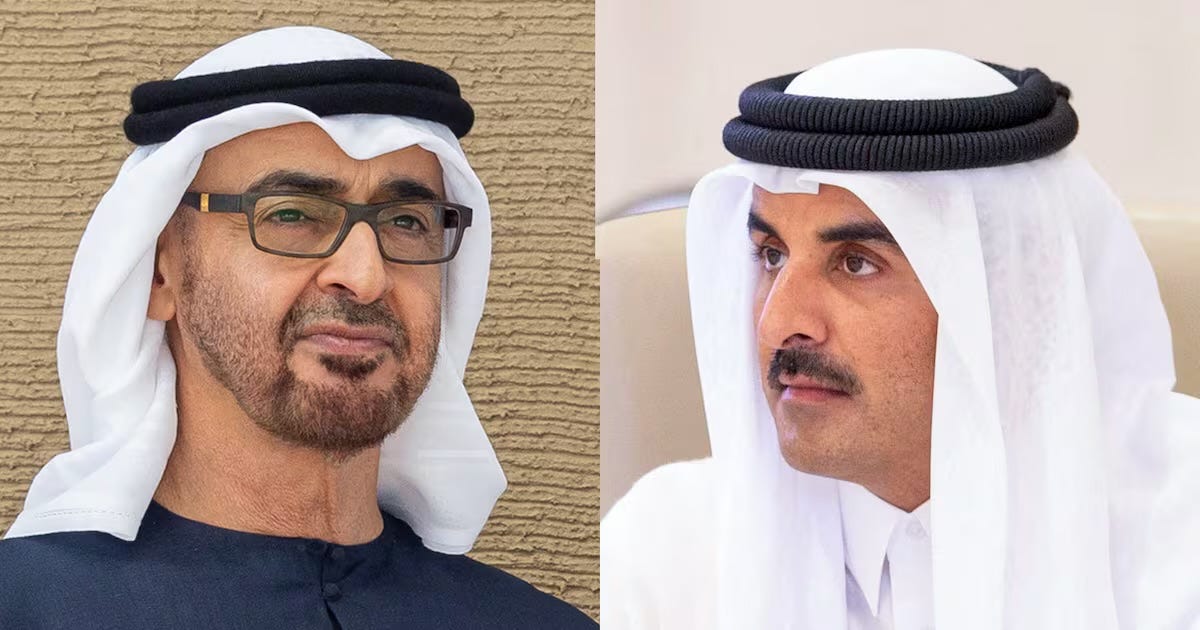
In the sweltering heat of June 2017, the United Arab Emirates, with Saudi Arabia and Bahrain trailing behind, slammed the door on Qatar. They sealed borders, ground flights, and choked sea routes. I remember being there, reporting on the chaos and also remember how the official narrative fed to the world was about it being a noble fight against terrorism financing and Qatar’s alleged embrace of the Muslim Brotherhood. Doha, they insisted, had gone rogue, demanding it shutter Al Jazeera (where I worked at the time), expel Turkish forces, sever ties with Iran, and fall back into line.
But the truth, exposed through leaks and whistleblowers, reveals something far more sinister: a reported and alleged UAE-Israeli coordination to pressure Qatar...because it refused normalization with Tel Aviv and pursued an independent foreign policy. Leaked emails from UAE Ambassador Yousef Al-Otaiba’s hacked inbox, obtained by groups like GlobalLeaks and reported by outlets including Middle East Monitor, lay out all the coordination.
In exchanges with pro-Israel figures like Elliott Abrams and Dennis Ross, Al-Otaiba discussed punishing Qatar for its support of the Boycott, Divestment, and Sanctions (BDS) movement against Israeli apartheid. Abrams even floated the notion that “conquering Qatar would solve everyone’s problems literally.”
Al-Otaiba’s reply? It would be “an easy lift.”
And he was not just fantasizing. Former German Foreign Minister Sigmar Gabriel later confirmed that the UAE and its allies had drawn up serious invasion plans for June 2017, a blueprint to topple Doha’s government and install compliant leadership. Gabriel stated publicly that escalation could have led to military action if the crisis hadn’t de-escalated. What ended up preventing the tanks from rolling in wasn’t any stroke of Trump-era genius—it was then-Secretary of State Rex Tillerson, frantically dialing over 20 calls after Qatari intelligence tipped him off, pleading with Saudi and UAE leaders to stand down and avoid catastrophe at Al-Udeid, America’s largest airbase in the Middle East housing thousands of U.S. troops.
Reporting from The Intercept details how Tillerson urged restraint from King Salman, Mohammed bin Salman, and Foreign Minister Adel al-Jubeir, even looping in Defense Secretary Jim Mattis.
Tillerson’s real obstacle was, perhaps unsurprisingly, his own administration. Hours after his pleas for calm, Trump publicly branded Qatar a high-level terrorism funder and endorsed the blockade. This wasn’t coincidence. Jared Kushner and Steve Bannon had met privately with Saudi and UAE leaders in May 2017 during Trump’s Riyadh visit— a dinner kept completely secret from Tillerson—where the blockade plan was laid out.
