


At sunrise, the border breathes.
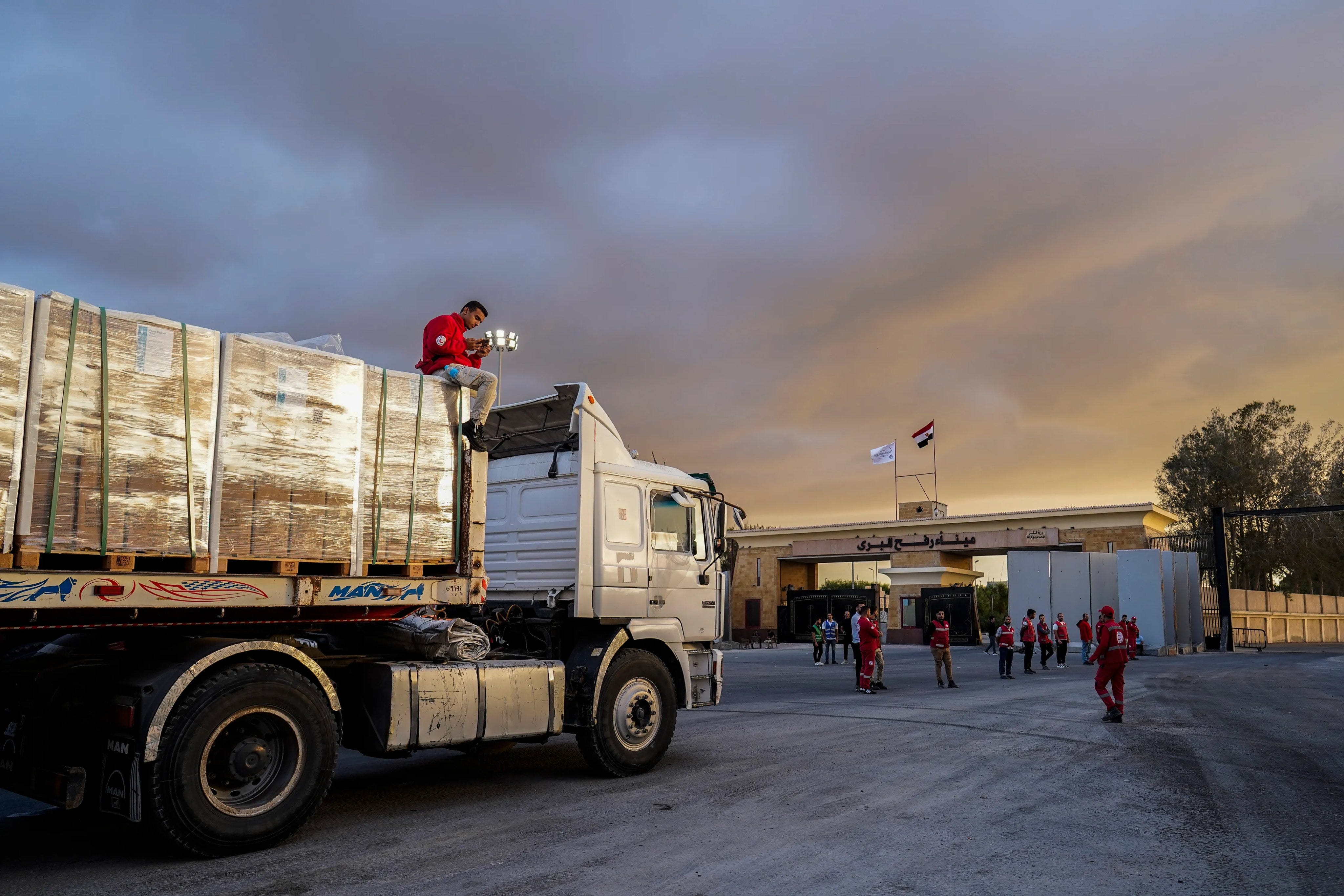
On the Egyptian side of Rafah, trucks line up like penitents at the edge of a wound. Their engines hum with the illusion of mercy: food, fuel, and bandages rumbling toward what’s left of Gaza. Reporters call it a breakthrough, diplomats a “turning point.”
But the people who live behind that gate know better.
Palestinians have seen this play before. We know this pattern well.
Since the so-called Gaza truce began in early October, Israel has violated it 47 times — attacks that have killed 38 Palestinians and injured 143.
Just today, 11 members of the same family were killed when their bus was struck by an Israeli tank shell.
The world calls it a “ceasefire.” Gaza knows it as a continuation of genocide by other means.
Two years into Israel’s genocidal war on Gaza — a campaign that turned neighborhoods into graveyards and dreams into dust — the world is being told it’s time to move on. Time to rebuild. Time to “restore hope.”
Hope for what exactly?
Donald Trump, who months ago mused about transforming Gaza into a “Riviera,” now says he wants to “see a beautiful day rising.” European leaders describe it as “a chance for Gaza’s renewal.”
But what they are really proposing with this so-called peace plan is foreign rule over a fenced-in people, a sanitized continuation of the siege under a new name. They are calling it peace — when it is, in truth, the rebranding of a slow, deliberate genocide.
The Mirage of Reconstruction
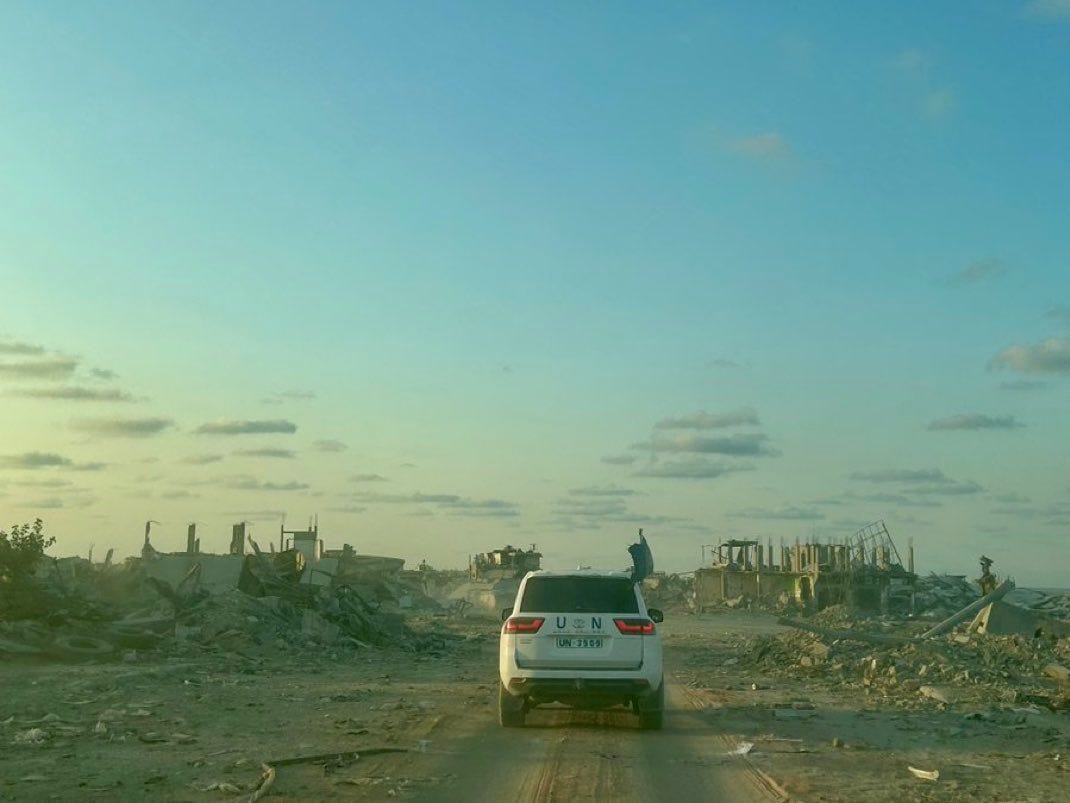
More than 92 percent of Gaza’s homes have been destroyed.
The United Nations Development Programme estimates that rebuilding the strip will cost $70 billion — a figure so staggering it has become a kind of shorthand for hopelessness. The World Bank calculates that just reconstructing the rubble of residential buildings would cost $15 billion. The WHO says $7 billion is needed to resurrect Gaza’s collapsed healthcare system, and another $4 billion to reopen schools for half a million children who have been out of classrooms for two years.
And yet the international fund for the Occupied Palestinian Territories has been financed at only 28 percent.
So when leaders talk about “rebuilding Gaza,” what they really mean is rebuilding just enough — just enough to quiet the outrage, to manage the optics, to stabilize a wasteland they helped create.
They want to rebuild Gaza the way one renovates a prison.
The aid that trickles in is rationed by the same hands that dropped the bombs. Each truck that crosses Rafah is counted, weighed, and approved by Israeli authorities who still decide what can and cannot enter — from fuel and flour down to the type of sewing needles Palestinian women in Gaza can use to mend torn clothes.
This is not reconstruction. It is coercion with cranes.
Control as a Weapon
At the Rafah crossing, even now, every movement of goods and people is filtered through Israel’s military authority.
Dr. Mustafa Barghouthi, a veteran Palestinian politician and physician put it plainly on Al Jazeera: Israel controls 100 percent of Gaza’s crossings — north, east, and south — and retains total authority over airspace, sea, and electromagnetic fields. The siege, in other words, never ended. It only adapted.
Since 2006, Gaza has been deprived of clean water, reliable electricity, and freedom of movement. Even before October 7, Israel controlled who could enter or leave, what food could be imported, what fuel could be burned, what medicine could reach hospitals.
And now, after flattening the strip, Israel is being rewarded with even more control — this time under the banner of “foreign administration.”
When Israeli officials speak about “maintaining a security presence” along the Philadelphi Corridor — the strip of land between Gaza and Egypt — they are resurrecting a plan they have nursed since the so-called “disengagement” of 2005.
Back then, Israel claimed it had “withdrawn” from Gaza, but its own legal advisers admitted that as long as it controlled borders, sea, and air, it remained the occupying power.
Two decades later, that fiction has simply been globalized: the world now wants to help manage Israel’s occupation, not end it.
The Colonial Continuum
The proposal for foreign governance of Gaza — whether by an international coalition, Arab states, or the Palestinian Authority “under reform” — echoes a familiar colonial playbook.
“Any foreign rule of Gaza is unacceptable,” Barghouthi said recently. “It reminds us of the colonial system of discrimination we were subjected to under British rule — and now under Israeli rule.”
The idea that Palestinians must be “supervised,” that they cannot be trusted to govern themselves, is the same racist logic that underpinned British mandates and French protectorates across the Arab world. Back then, the colonizers called it “civilization.” Today, they call it “peace.”
And then there’s the suggestion — so tone-deaf it borders on parody — that Tony Blair might play a role in overseeing this transition. Blair, the man who sold the Iraq war to the world, now repackaged as a midwife of Palestinian democracy.
“They want to change our story,” Barghouthi said. “They want to change our narrative, our curriculum. They want to stop us from supporting the families of those who died and struggled. This is not reform. This is subjugation.”
Reform as Subjugation
When Western officials speak of “reforming” the Palestinian Authority, they are not talking about elections, accountability, or separation of powers. They are talking about building a more efficient security subcontractor — one that polices Palestinians on behalf of their occupier.
The “reform” envisioned by Washington and Brussels does not include ending the occupation, holding war criminals accountable, or granting Palestinians the right to self-determination. It includes training new police forces, standardizing intelligence-sharing, and suppressing resistance.
In internal documents leaked earlier this year, the most detailed post-war planning wasn’t about rebuilding schools or hospitals — it was about constructing a “newly devised policing force.” The numbers were crunched not for education, but for surveillance.
It is a incidious inversion: the colonized are asked to reform themselves, while the colonizer is rewarded with security guarantees.
Occupation Upgraded
Let’s be clear: Israel never stopped occupying Gaza.
It only shifted the methods of control.
Before this war, the occupation was electronic, economic, aerial — enforced through drones, naval blockades, and data surveillance. After this war, it is literal again: Israeli troops occupy over half of Gaza’s land, its skies hum with reconnaissance aircraft, and its coast remains off-limits to fishermen who can’t sail even three kilometers into the sea.
Israel now calls this a “buffer zone.”
Palestinians call it what it is: theft, once more legitimized by the language of security.
Meanwhile, over 17,000 wounded Palestinians in Gaza remain trapped, unable to leave for medical care. Thousands of cancer patients, the elderly, the chronically ill — all are prisoners of a border that pretends to be humanitarian while operating as a weapon.
Every delay in aid, every withheld permit, every missing anesthetic in a bombed hospital is part of the same machinery. The world calls it logistics. Palestinians know it as siege.
The Economics of Erasure
Behind every diplomatic phrase — “stability,” “reconstruction,” “regional security architecture” — there’s an economic subtext: Gaza as an investment zone.
Trump’s grotesque fantasy of a “Gaza Riviera” wasn’t just rhetoric; it was a preview of a neoliberal apartheid in which the survivors of genocide are turned into cheap labor for foreign developers.
Already, Western think tanks speak of “public-private partnerships” for Gaza’s reconstruction. Gulf states are being courted to fund projects that will be administered not by Palestinians but by “international authorities.”
The logic is painfully clear:
Let Palestinians clear their own rubble, rebuild their own prisons, and call it progress.
Humanitarian Blackmail
Israel continues to weaponize every lifeline into Gaza — food, water, electricity — as bargaining chips. The number of trucks allowed in is dictated not by need but by negotiation.
When COGAT, the Israeli military body that administers the occupation, announced it would cut the number of aid trucks in half as “punishment” for supposed violations by Hamas, it was a confession: that even hunger and disease are tools of policy.
This is what the UN calls “collective punishment.”
It’s also what the world keeps funding.
For years, international donors have poured billions into “stabilizing Gaza,” only to see it bombed again. The rubble is never cleared; it’s recycled — in policy papers, in conference halls, in the moral evasions of those who equate neutrality with virtue.
And now, we are told to believe that the same governments arming Israel will guarantee Gaza’s peace.
The moral absurdity is complete.
The Theater of Ceasefire
This “ceasefire” is not a step toward peace. It is a pause for the occupier to reload — and to rebrand.
Israeli politicians have already said they intend to resume the assault. The ambiguity built into the current deal ensures that any accusation, any incident, can be used to justify a return to war. The question isn’t if — it’s when.
What we are witnessing is the institutionalization of Gaza’s suffering: a system that cycles between destruction and reconstruction, each phase profitable to someone, each tragedy monetized.
This is not the end of genocide.
It’s the bureaucratization of it.
Freedom, Not Foreign Rule
For Palestinians, the struggle has never been about crossings alone — not Rafah, not Erez, not Allenby. It has always been about the right to move and live freely in one’s own land.
The short-term goal is obvious: immediate humanitarian relief, open borders, hospitals restored, schools rebuilt. But the long-term goal — the one Israel and its allies keep erasing from every communiqué — is freedom.
Not managed autonomy. Not economic corridors. Freedom from occupation.
The world’s newfound solidarity, if it is to mean anything, must refuse the seduction of “pragmatism.” It must insist that the only just peace is one rooted in accountability — for war crimes, for apartheid, for ethnic cleansing.
Anything less is complicity dressed as diplomacy.
A Reckoning Deferred
Each time the world talks about Gaza, it reaches for metaphors of light: dawn, sunrise, new beginnings. But there is no light in a cell. There is only reflection — the flicker of what’s been stolen.
When they say “Gaza will rise again,” ask them: Who will rise, and who will rule?
When they say “reform,” ask them: For whom, and at whose mercy?
And when they say “peace,” remember that it is being signed with the same hands that hold the keys to Gaza’s gates.
Gaza does not need foreign rulers. It needs the world to stop rewarding its jailer. The people of Gaza have shown a resilience that defies the limits of language — a faith in life itself, even as the world calculates how much their survival should cost.
The real reconstruction begins not with cement or cranes, but with accountability and justice — with the end of occupation, with the dismantling of apartheid, with accountability for genocide and ethnic cleansing.
Until then, every proposal for “peace” is just another draft of the same script.
What they’re doing - and celebrating- is obscene. And you’re right, Ahmed. It won’t last this ceasefire. Hamas will not (quite rightly) agree to disarm, and that is the only excuse Israel needs to block aid and begin again. Trump we know follows Netanyahu, but Europe is pathetic in its failure to uphold the principles upon which the EU was founded. ECJ? UN? Anti-apartheid? What a joke! We know them now for what they truly are.
The worst thing is to revert to status quo till the next volatile and eruption that will lead to something even bigger than this current genocide. Where is the accountability for genocide perpetrators and the demand by western and Arab states for an end to illegal occupation as per ICJ ruling. Where’s the dismantling of illegal settlements and reparations? What peace is this ?!