


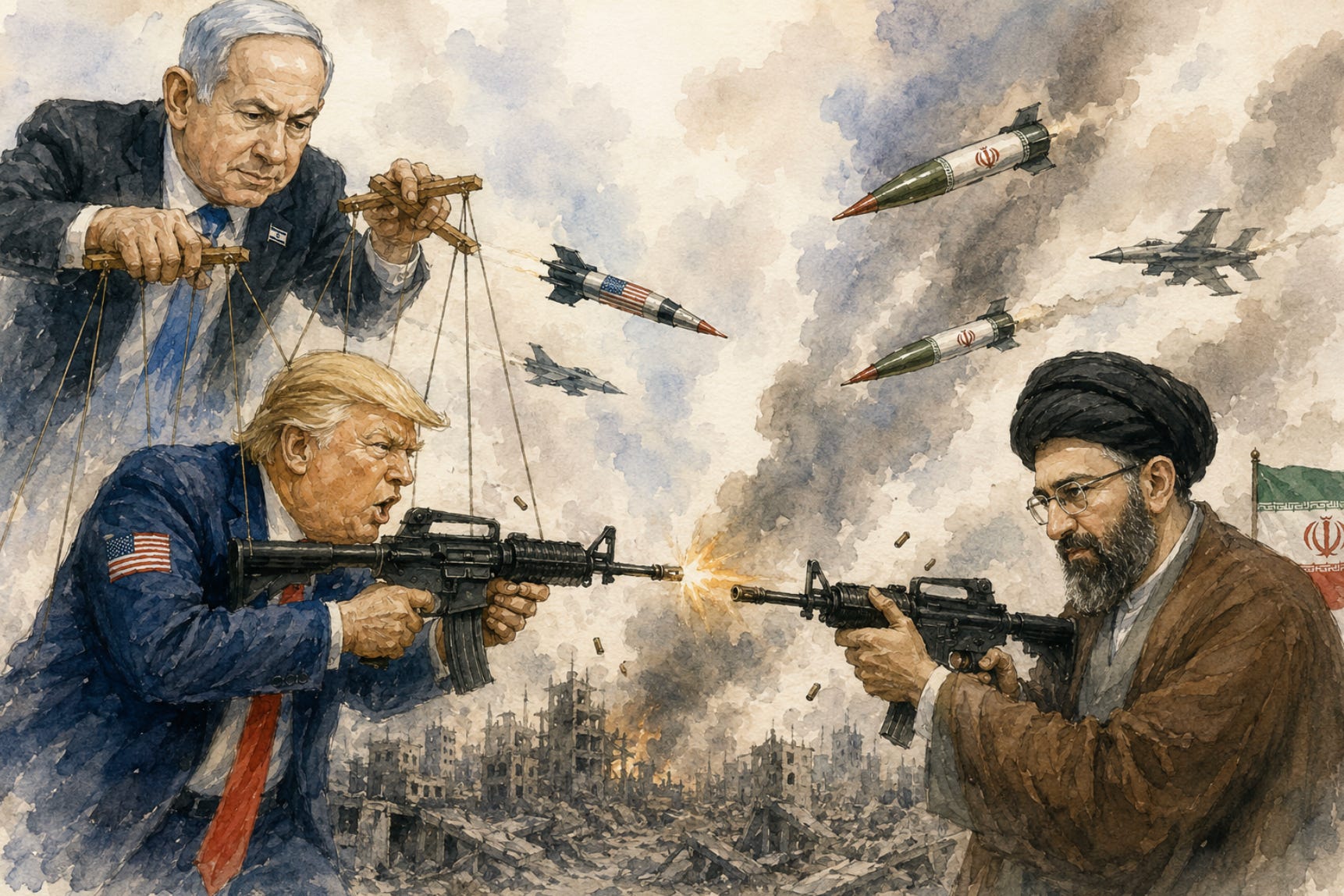
American forces struck two Iranian rocket launchers on Larak Island Sunday, a small spit of land guarding the mouth of the Strait of Hormuz. Iran says soldiers and civilians were killed in the strike. The Revolutionary Guard, in the language the powerful always reach for right before they hit back, promised “punishment of the aggressor.” By the time I sat down to write this, unconfirmed reports had missiles flying over Qatar reportedly headed towards the UAE again, tankers scrambling out of Al Udeid. Iran's own military said it hit two bases in Jordan, King Hussein and Al Azraq; neither Jordan nor CENTCOM had confirmed that.
I don’t think people outside the region understand how close we are tonight to the real thing. This does not feel like another strike-and-statement cycle. A war that stops pretending to have rules. The pause that followed Trump calling off his threatened bombing campaign in early August held for nearly four weeks. It just ended.
Shahryar Pasandideh, who has been tracking the region’s military posture closely, flagged this exact dynamic days before Sunday’s strike even happened: American aerial refueling aircraft drifting back to Al Udeid, American diplomats trickling back into the Gulf, interceptor stocks drawn down to levels that matter again. Put together, his argument is that Iran may soon have better targets for a first strike than it had on February 28, the night this war opened.


Read against tonight’s reports, that argument looks less like a hot take and more like a premonition.
So let me tell you what’s actually happening, stripped of the press-release language both governments would prefer. Washington says the Larak strike stopped Iran from mining the strait again. Sure, I believe that part. Iran has spent this whole year treating Hormuz like a leash it gets to yank whenever it wants the world’s attention: closed to shipping, then mined, then cracked open when Tehran needed something from the talks, then slammed shut again the moment it didn’t. Washington, meanwhile, has spent months quietly building a workaround through the southern channel, which Iran reads correctly as an attempt to strip it of the only leverage it has left. A fresh load of mines isn’t erratic. It’s Tehran telling Washington: you don’t get to route around us. And Washington, whatever language it uses about “protecting the free flow of commerce,” has been trying to do exactly that.
The truth is unsurprisingly that both governments are lying, a little, in the same direction, and anyone covering this war closely knows it. Iran says the strait is closed. The U.S. says it’s open. Iran says it’s “defining” the waterway on its own terms. Washington says it wants every mine gone, permanently. Both of them describe themselves as fully in control of a stretch of water where ships still don’t move without getting shot at or boarded. Iran points to the vessels it stops without permission as proof of its authority. Washington points to the blockade strangling Iran’s entire economy as proof that Tehran’s defiance is theater staged over a country being slowly starved. I’d say both of those things are true at once.
By the way, that alone should embarrass most of what passes for American media coverage of this war.
There’s also an election sitting under all of it, if we’re being honest. Trump needs cheap gas and quiet inflation numbers before the midterms, so every time his people announce that oil is moving safely under American protection, we should understand that as a domestic pitch masquerading as a foreign-policy point needing to be made. Iran knows this. Its whole approach, was never really about beating the American military. It was about outlasting Trump at home. Keep the war ugly and visible enough that the gap between what he claims and what’s actually happening in the strait becomes impossible to paper over. The footage released after every strike, the running count of ships hit, the messaging built for an American audience rather than an Iranian one, none of it is subtle, once you’re looking for it.
And none of it is new. Iran has been getting ready for a fight like this one for decades, long before Khamenei was killed (and replaced by another Khamenei) in February, long before anyone in the Pentagon drew up a target list with Larak Island on it. Which is probably exactly why the U.S. hit Larak. The island sits right where what’s left of Iran’s ability to watch and strike ships in the strait is concentrated, the radar, the surveillance posts, the launchers dug into the southern coast. Take that out and you’re not just denying Iran a weapon. You’re blinding it in water it insists on calling its own. American aircraft ran the same play up and down Iran’s southern shoreline back in July, hitting the same kind of infrastructure for the same reason. You don’t win a war like this in one night. You just make the other side’s claim to control a little more theoretical every time you hit them.
So this is where we are: A strike Washington can call reasonable. A retaliation Tehran can call necessary. And a decision that now belongs entirely to the United States: hit back and start the ladder climbing again, or let this pass as one more line in a ledger both governments seem happy to keep running forever, so long as neither one has to be the side that blinks first.
There’s a theory going around tonight that Iran spent the first months of this war sticking to Gulf military bases and is only now, six months in, confident enough to hit something outside the GCC. It’s a clean story, and yet it doesn’t match the actual record. Muwaffaq Salti got hit on the opening night of this war, February 28, the same night Iranian fire landed in the UAE, Bahrain, and Qatar. By mid-March, Jordan’s own government said Iran had already fired more than two hundred missiles and drones at the kingdom. Satellite photos from that same month showed a U.S. radar system at that base already damaged. Jordan hasn’t been spared at any point in this war. It was never a new frontier. Whoever’s telling you otherwise hasn’t been paying attention, or prefers a story that’s more satisfying than the facts.
What did actually change is how many people die now, and the sanitized language around this war works hard to obscure exactly that. The early pattern, in both the Gulf and Jordan, mirrored Iran’s 2025 strike on Al Udeid: warn first, kill nobody, send the message anyway. July broke that pattern for good. The strike on Muwaffaq Salti that month killed two American soldiers outright and left a third missing, with no warning at all. The real escalation shows up in the casualty count, not on any map.
Jordan and Iran have carried a grudge for decades that has nothing to do with the GCC. Relations broke after Iran’s 1979 revolution. Amman backed Saddam against Tehran through the war that followed. Jordan cut ties again in 2016, standing with Saudi Arabia after Iranian mobs burned its embassy. King Abdullah has been warning about Iranian-backed networks since he coined the phrase “Shia crescent” back in 2004. Underneath all of it sits Jordan’s peace treaty with Israel, signed in 1994, three decades older than anything the Gulf states have done with Israel, and still, as far as Tehran is concerned, an open wound. Jordan’s own government said as recently as March that ties with Iran had soured badly since this war began. I don’t doubt it.
The Gulf states are running an entirely different play. Qatar is positioning itself as mediator between Washington and Tehran, the UAE is quietly moving toward de-escalation with Iran despite getting hammered in the war’s opening days, and Saudi Arabia keeping its 2023 rapprochement with Iran alive rather than letting six months of war bury it. Call it pragmatism: Iran and its Gulf neighbors are stuck next to each other no matter what Washington decides, and neither side gains much from burning that relationship down. Jordan gets hit because it’s hosted the American war effort more openly than almost anywhere else in the region, and because Tehran has carried this particular grudge since before most of the soldiers who died at Muwaffaq Salti were even born.
None of this gets decided by the people paying for it. Whatever Washington does about tonight, somewhere in Hormozgan a family is sifting through what used to be a house, because a launcher sat too close to it. Somewhere on the flight line at Al Udeid, a young airman is repacking a bag for a base she was told a month ago was safe. Somewhere in Amman, another family is doing what Jordanian families have done for six months straight: counting the seconds between the siren and the sound, hoping the number comes out the same as it did last time. They don’t get a vote on what counts as proportionate, only the aftermath of whatever the US and Iranian governments decide.
Some people keep insisting this war has hinges, clean moments after which everything changes, so that until we reach one we’re free to keep calling all of it managed and calibrated and contained. Tonight looks more like the night in February when this started than any night since, and less like the peace this region has spent six months begging for. Whatever the US chooses to do next, we are that much closer to the war both governments swear they don’t want. Someday, everyone will say they saw this coming. Tonight, most of the world is only watching, the way it always does, until it can’t anymore.
Of course, IMO what is really happening is the Trump cabal are probably gaming the markets yet again.
"War is a Racket" Smedley Butler. https://en.wikipedia.org/wiki/Smedley_Butler
I am from Vancouver,Canada and i want to say : I said before the Yankee Gov't can't be trusted and this proves it. All Yankee Bases in West Asia needs to be destroyed without further ado. The US Gov't needs a crippling response that will take years to recover from.
Israel is an American Base and needs to be destroyed also. All of Iran's Enemies in West Asia need to be destroyed and that includes Israel.
The Yankees are a big Problem in West Asia,Latin America. It is time to get rid of that Problem for good.