

Israel has run out of lies that work. This week, lashing out at Britain, it told the truth by accident: the settlements are the state.
On Tuesday, Britain announced it would stop importing goods made in Israel’s colonies in the occupied West Bank. By any honest measure, it was a cautious step and it won’t take effect for six to nine months. Meanwhile, F-35 parts will keep flowing. Before it was even announced, British diplomats privately assured Washington it was largely symbolic.
Israel answered as if it had been attacked. Within hours, it ordered Britain to shut its consulate in occupied East Jerusalem within thirty days, the office that handles Britain’s relations with Palestinians, and insisted the whole city is its own. It threw British staff out of the American-led Gaza coordination center and ended British training of Palestinian Authority security forces. It banned eleven British MPs from entering the country, Jeremy Corbyn and Zarah Sultana among them, for the crime of their opinions. Foreign Minister Gideon Saar blamed “Islamists, antisemites, jihadists, woke people” and the far left. President Isaac Herzog called the sanctions “a gross interference” in Israel’s elections, which are next month. Finance Minister Bezalel Smotrich even declared the Oslo Accords null and void and demanded that Britain’s ambassador be expelled.
That is how a cornered and cruel state behaves. A government sure of its case would have shrugged off a ban on settlement produce. Israel treated it as an attack on the state itself, and in doing so it gave the game away.
Britain’s steps touch only the settlements, the colonies that nearly every government on earth calls illegal. For decades, Western diplomats have clung to the idea that the settlements are a problem on Israel’s edges, something that could be trimmed away while the state itself stays respectable. Israel had every chance to play along. It chose to punish Britain as a whole for a measure aimed at the colonies, and so declared the colonies and the state one body. Britain drew a line around the settlements, and Israel stepped over it to stand with them.
Israel is reaching for punishment because persuasion stopped working. Since October 2023, Israel has spent more than a billion dollars trying to win the argument abroad. It paid lobbyists, PR firms and influencers. It flew a thousand evangelical pastors to Israel and bankrolled a campaign against American students. And the world still watched it kill more than 73,000 people in Gaza, more than 21,000 of them children, and drew its own conclusions. No amount of airtime buys back a public that has seen the dismembered bodies of children, hospitals in rubble, as Israel continues to level hospitals in Lebanon, drunk on impunity.
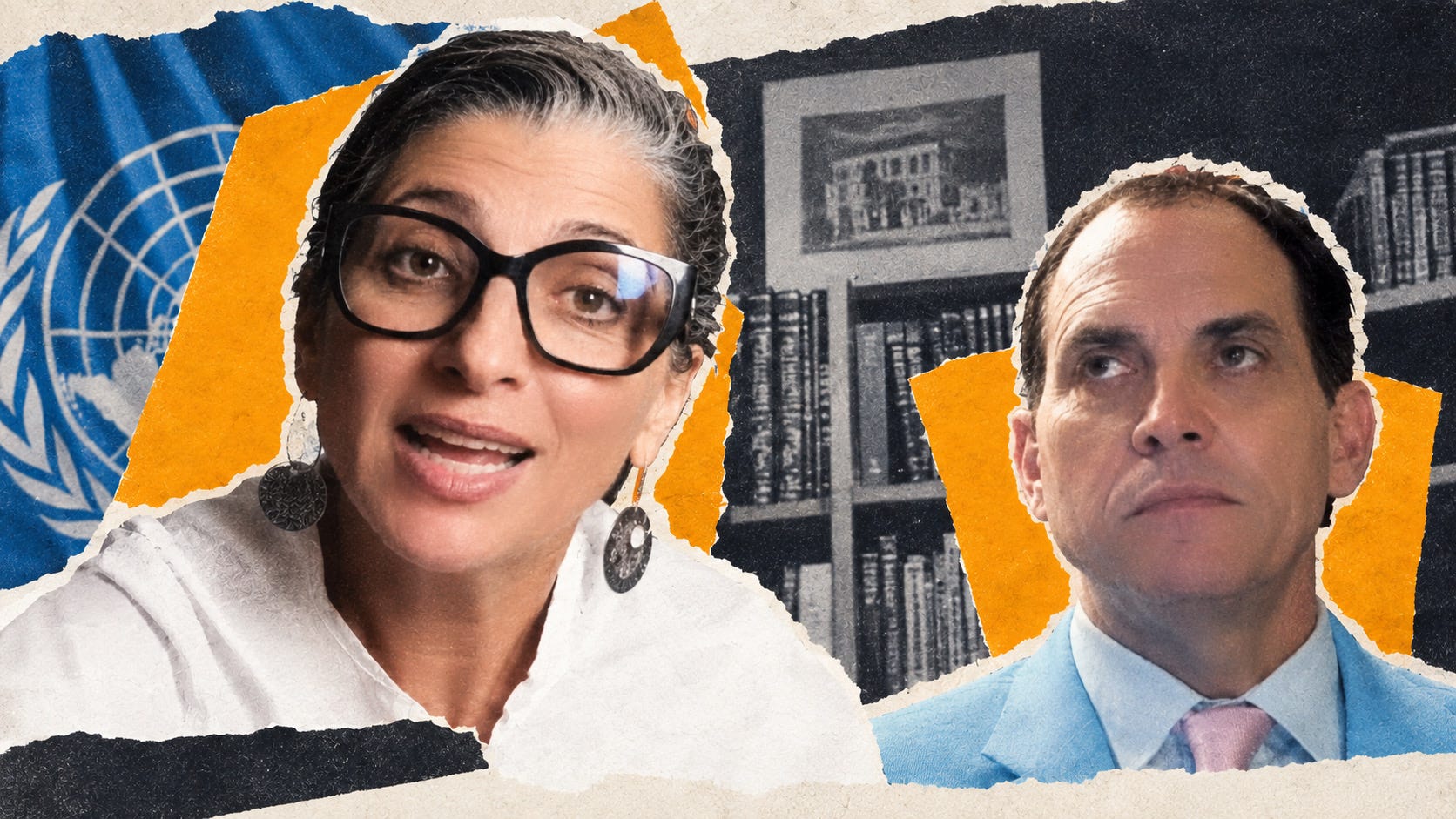
This week Francesca Albanese, the UN Special Rapporteur on the occupied Palestinian Territory, went on Al Jazeera and was talking about the children. Twenty thousand of them, killed by the Israeli army in Gaza. Children who, in her words, “scream for justice.”
Mitchell Barak had no answer, so clung desperately to a question of his own.
“How many terrorists were killed?” he asked. “Give us the numbers.”
She repeated the word … CHILDREN. He asked again. Then he wanted to know whether she considers Hamas a terrorist organization, and he asked it again, and again, and again, as though the dead little boys and girls might be recounted if only he could get a UN official to say the magic words on live television.
Barak is the founder of KEEVOON Research Strategy and Communications and a former aide to Israeli Prime Minister Benjamin Netanyahu. I’ve watched a lot of Israeli spokesmen on air, and I know the routine by heart. Barak ran nearly all of it, and it collapsed in front of the camera. By the end, the third guest, Alan Duncan, a former UK foreign minister, said nothing had convinced him the sanctions were right more than Barak’s own performance.
I should say up front that Francesca Albanese is a friend of mine. So don’t take my word for what happened on that panel. The clips are below, and the sources are linked throughout.
What Britain Actually Did
In the House of Commons, Foreign Secretary Ed Miliband said what Palestinians have been saying for generations. Settlers in the West Bank are carrying out ethnic cleansing. He called them “settler terrorists.” He said Britain now considers the occupation itself illegal, a genuine break with the old British position.
Then came the measures: a ban on settlement goods, sanctions on the companies and people who finance, build and sell property in the settlements, and a ban on advertising the colonies to British buyers. Miliband also said Britain would refuse export licenses for arms and goods that materially contribute to the occupation, for as long as the occupation lasts.
Eleven other governments, France and Canada among them, signed a joint statement pledging to restrict settlement trade. What finally moved them was E1, the colony Israel is bulldozing into the hills east of Jerusalem. Last month Israel put more than 1,200 homes there out to tender even though Milliband called it a red line.
On air, Albanese cut through Israel’s claims to the land. Israel has “zero sovereignty” over the West Bank, Gaza and East Jerusalem, she said. The International Court of Justice settled it, and the court “has more value than my opinion and your opinion.”
Albanese on the “potentially seismic” shift & Israel’s “zero sovereignty”
So Does It Matter?
Albanese called the shift potentially seismic. On language, she’s right. A British foreign secretary said ethnic cleansing, out loud, in Parliament, and said the occupation has to end. From the country that wrote the Balfour Declaration, that lands. Words draw the borders of what can be done next, and these ones make the old dodges harder to return to.
That said, the part with teeth is the money. Banning settlement dates and wine was never going to break a colonial project the Israeli state pays for. Miliband told Parliament himself that the settler population has nearly tripled since 1993, from 270,000 to 770,000. That growth runs on state subsidies. The sanctions on financing and construction could bite. Enforced seriously, they would force Israel’s major banks and insurers to choose between the City of London and the settlements.
Now the rest, which reflects a business as usual, and profits over people political calculus.
The private message to Washington that Bloomberg reported called the package “largely symbolic” and promised it would not touch the wider relationship with Israel on trade or security. It may be the most honest sentence anyone in the British government has produced this week. Britain keeps trading with Israel. The arms restrictions still carve out F-35 parts.
And then there is Newcastle. Declassified UK revealed that the Ministry of Defence handed a £10 million contract, with no competition at all, to Pearson Engineering. Pearson is owned by Rafael, Israel’s state arms company, and Israel’s finance ministry holds significant control over it. The finance minister is Bezalel Smotrich. Britain sanctioned Smotrich personally last year and left the ministry he runs untouched, so the man is frozen out while the ministry he commands collects British public money. The Foreign Office has said those personal sanctions were “carefully designed to minimise unintended consequences.” Newcastle shows you whose consequences it actually had in mind.
Then there’s Gaza. Britain managed to name ethnic cleansing in the West Bank and said nothing of the kind about Gaza, where Israel has killed more than 73,000 people and is still dropping bombs almost a year into a supposed ceasefire.
Let’s compare this to Russia. The UN has verified 820 children killed in Ukraine since February 2022. UNICEF counted more than 21,000 children killed in Gaza by this February. Russia got asset freezes, bank sanctions and sanctions on Putin himself within days of the invasion. Israel gets a settlement ban that begins sometime next year, and a whispered reassurance to Washington that none of it is serious.
Mike Huckabee, the US ambassador to Israel, went on the BBC to ask where the sanctions on North Korea, China and Russia were. Britain has been sanctioning Russia for years. He knows that. He just can’t picture those tools pointed at Israel, and he was honest enough to say so on the radio.
The “Kangaroo Court”
Which brings me back to Barak who profession is messaging, so let’s see what it has been reduced to: a lame and tired script that is as credible as it is sloppy.
When Albanese cited the International Court of Justice, which ruled in 2024 that the occupation is unlawful and must end, Barak called it a “kangaroo court” that nobody cares about. His evidence? That the United States has sanctioned Albanese, and sanctioned the court too.
Except the court Washington has been sanctioning is the International Criminal Court. Different institution. Also in The Hague, which appears to be as far as the research went. That’s the court that issued an arrest warrant for Netanyahu, and the Trump administration has now blacklisted more than a dozen of its judges and prosecutors, including its president in August.
The court Albanese was actually citing, the ICJ, is the United Nations’ highest court. Israel sent its own lawyers to stand in front of it in January 2024 to answer South Africa’s genocide case.
A paid propagandist/communications professional went on international television, dismissed one court as a joke, and offered a different court’s punishment as proof. Strip it down and his argument is that a court loses its standing the moment Washington punishes it.
As for Albanese, yes, Washington sanctioned her last summer for urging the ICC to pursue Israeli officials. In May, a federal judge in Washington, appointed by George W. Bush, blocked those sanctions, writing that “Albanese has done nothing more than speak!” An appeals court has since allowed the administration to put her back on the list while it appeals. The evidence Barak brought against her is a punishment an American federal judge found likely unconstitutional. He held it up like a diploma.
Then came the golden oldie from Barak: “Israel left Gaza in 2005.” The ICJ dealt with that in the very opinion he waved away. It found that after 2005 Israel kept key powers over Gaza, including control of its land, sea and air borders, and so kept an occupier’s obligations there. Last October, in a second opinion, the court went further and treated Israel as an occupying power in Gaza outright. And since October 2023 the Israeli army has been physically inside the Strip, still carrying out airstrikes. Left, he says.
Barak called E1 “a little piece of land” that “everyone agreed” would be part of Israel. E1 is in the occupied West Bank. The everyone who agreed consists of the people building on it. Smotrich has said plainly that building there will bury the idea of a Palestinian state, and that’s the entire point: it cuts East Jerusalem off from the West Bank and nearly splits the territory in two. That little piece of land is why twelve countries finally decided to move ever so slightly this week.
“Zero Dollars”
The moment that should follow Barak around came when Albanese asked how much Israel has spent fighting the boycott movement in the United States.
“Zero dollars,” he said. According to the Justice Department, he added, as if naming a source somehow made it true.
The Justice Department keeps the registry where people working for foreign governments have to declare what they’re paid, under the Foreign Agents Registration Act. If Barak searched it for Israeli money spent on state anti-boycott laws and found nothing, there’s a reason. Israel spent years making sure he would.
Start with the laws. In 2014, according to a Harvard Law Review study, Netanyahu’s government put 25.5 million dollars into an anti-BDS task force, and his officials discussed turning the American pro-Israel lobby loose to push legislation. The next year South Carolina passed the first state law barring contracts with companies that boycott Israel, with help from the Israel Allies Foundation, a Washington group that organizes pro-Israel legislators. Thirty-eight states now have laws or executive orders punishing boycotts of Israel. In Texas, a speech pathologist named Bahia Amawi, nine years with her school district, lost her job because she wouldn’t sign a pledge not to boycott a foreign country. Those laws didn’t fall from the sky.
Then the big one. In late 2017 the Israeli cabinet approved a 72 million dollar plan to fight BDS, run by the Ministry of Strategic Affairs, with the government’s money to be matched by donors abroad. The money moved through a public-benefit company first called Kela Shlomo, Hebrew for Solomon’s Sling, and later renamed Concert. The Forward called it a front company.
Why a company and not the ministry? The ministry’s director general, Ronen Manelis, explained it at a Knesset oversight hearing in 2020. American groups would find it easier to take money from a public-benefit company than from the Israeli government, he said, because the bank transfer they see comes from a nonprofit. “That’s the idea.”
Israel’s lawyers wrote the same thing down. Leaked documents from a hack of Israel’s justice ministry, reported by the Guardian with journalists Lee Fang and Jack Poulson, show officials feared FARA could catch the American groups Israel was funding and directing. A July 2018 memo warned that registering would damage those groups and bury them in disclosure rules. Officials proposed a new American nonprofit to keep the work going beyond the law’s reach. Israel retained the Washington firm Sandler Reiff to study the risk, and a ministry legal adviser, Liat Glazer, pushed to keep the firm’s name secret. “Exposing the name of the law firm could thwart the entire relationship,” she wrote.
Then the money actually went out. Israeli records obtained by the Forward show the ministry and Concert gave at least 6.6 million dollars to eleven American groups from 2018 on. One of them was the Israel Allies Foundation, the group behind the state laws. In January 2019, Concert’s board praised the foundation’s record on pro-Israel legislation, named the anti-BDS state laws specifically, and approved 118,000 dollars for a conference in Israel with its top lobbyists. That December the foundation brought lawmakers to Jerusalem, among them Alan Clemmons, the South Carolina legislator who sponsored the original anti-boycott law and they met Netanyahu.
Within two months, bills equating anti-Zionism with antisemitism had been introduced in eight statehouses. The Forward found the foundation had never disclosed its Israeli grants to the US government.
Concert never raised everything it promised. In the end it handed out about 10.5 million dollars, a little more than half of it to American groups. That’s at least 10.5 million dollars more than zero.
In fact, +972 Magazine documented the same ministry paying news outlets directly to run anti-BDS material aimed at foreign readers: 120,000 shekels to the Jerusalem Post, 95,000 to the Times of Israel, more to an American publishing group. The ministry also paid for a Jerusalem Post supplement on the subject, and the supplement never plainly told readers who had paid for it.
Concert later became Voices of Israel, and after October 7 it was reactivated to go after American students protesting the war, under Israel’s diaspora minister, Amichai Chikli. Last September Israel’s Foreign Ministry paid Eagles’ Wings, a New York evangelical ministry, 700,000 dollars, Drop Site reported in May. The contract says the aim is to stop churchgoers and priests from adopting “pro-BDS and anti-Israeli positions.” About 245,000 dollars was set aside for lobbying this year, and the campaign planned more than 100 meetings on Capitol Hill. One of its co-hosts was the Israel Allies Foundation. Eagles’ Wings hadn’t registered as a foreign agent when the story broke.
Israeli clients have reported more than 100 million dollars there since 2023, and Israel is on track to outspend every country in it this year, Qatar included. The Quincy Institute puts Israel’s public diplomacy spending since October 2023 above a billion dollars. One filing from last September shows a 900,000 dollar influencer operation paying American social media personalities to post for Israel, and Public Citizen and the Quincy Institute have asked the Justice Department to investigate whether those influencers are acting as unregistered agents. Israel knows how to use the registry when it wants a paper trail. The fight against the boycott movement is the part it built to stay off the books.
So when Barak says the Justice Department shows zero, believe him about the paperwork. Then ask who kept it blank. Israel’s government did, with legal memos, a Washington law firm it wanted hidden, and a company its own official admitted was set up so the money wouldn’t arrive from the state. They manufactured the zero just so he could sit there, dangerously exposed, and still read it back to you.
The line also does a second job. “Zero dollars” implies nobody is persuaded by the boycott movement. If that were true, no government would spend tens of millions fighting it, and no state would bother passing laws against it.
He also complained that Palestinians “haven’t had an election in eighteen years.” It’s been twenty, and he skipped the part that matters. The government that decides who builds, who moves, who gets water and who gets shot at in the West Bank is one Palestinians there have never been allowed to vote for.
The “kangaroo court” exchange and “how many terrorists”
About Those Numbers
Back to Barak’s opening demand, because it deserves an answer.
Israel keeps the count he was asking for. A classified Israeli military intelligence database, revealed by +972 Magazine, Local Call and the Guardian, listed roughly 8,900 named Hamas and Islamic Jihad fighters as dead or probably dead as of May 2025. Gaza’s health authorities had counted 53,000 killed by then. Five out of every six people killed were civilians. When Local Call and +972 asked, the military didn’t dispute that the database exists. When the Guardian asked, a spokesperson called the figures incorrect without saying which ones.
Then in January, Israeli military officials told reporters they now accept about 70,000 Gazans were killed. Israel had known for two years. In early 2024, Israeli intelligence officers told Local Call they had checked the Health Ministry’s methods, found its numbers reliable, and were using them in internal briefings. The whole time, Israeli officials were dismissing those same numbers in public as Hamas propaganda. The state’s own intelligence said one thing and its spokesmen said another. That’s lying, and every politician and pundit who repeated it owes somebody an apology they will never give.
He wanted numbers his own genocidal military had all along.
When the numbers ran out he reached for the loyalty oath. Say Hamas is a terrorist organization. Say it. Say it again. As if 21,000 dead children were an argument about Hamas. The whole purpose of that question is to swing the camera off the bodies and onto the person counting them, to put the witness on trial.
Albanese refused. “Sir, we are talking of children.”
The Script Stopped Working
Every line Barak used has been standard equipment on Western television for two decades, and for most of those decades it worked. Say Hamas, say 2005, say kangaroo court, say antisemitism, and the anchor nods and goes to a break.
This time the anchor, Dareen Abughaida, told him he was making wild allegations that couldn’t go unchallenged and handed the floor back. Then came the part he clearly didn’t see coming. Alan Duncan, the former UK foreign minister and a Conservative, speaking from Dubai, said nothing had convinced him more that the sanctions were right than Barak’s “absurd and self-discrediting defence of the indefensible,” and that Barak evidently believes Palestine can be “trampled over and stolen violently and turned into Greater Israel.”
When a former Tory minister tells you that you’re the best argument for the sanctions, you should just hang your head in shame.
Their enemies list is getting crowded as it now has to make room for rabbis. Britain’s Chief Rabbi called Tuesday a dark day for British Jews and the Board of Deputies condemned the measures, but senior rabbis broke publicly with them. Jonathan Wittenberg of Masorti Judaism was standing in the Palestinian village of Umm al-Khair while Miliband spoke, and said he had seen the results of settler violence with his own eyes. He called it a chillul HaShem, a desecration of God’s name. Lev Taylor of Kingston Liberal Synagogue told the Guardian that some of his Israeli congregants had campaigned for exactly these sanctions. The co-leaders of Progressive Judaism called the sanctions a clumsy tool, and said measures aimed at settlements shouldn’t be confused with an attack on Jews.
Albanese said his talking points, “sounded already rubbish” years ago, and after 70,000 dead “they sound just preposterous.”
She’s right. Israel still has the weapons, the money and Washington’s veto. What it has lost is the ability to explain itself to anyone outside its own camp. A state that answers a ban on settlement wine by closing a consulate and blacklisting MPs, and answers 21,000 dead children by demanding a statement about Hamas, has simply run out of arguments.
Albanese on “no good Israel and bad Israel,” then Alan Duncan’s closing
Where We Go From Here
Albanese saved her sharpest point for the end. There is no good Israel and bad Israel. Israel spent the week proving her right. The colonies are planned by Israeli ministries, guarded by the Israeli army, financed by Israeli banks, plugged into Israeli water and power, and filled with Israeli citizens who vote in Israeli elections. The state accused of genocide in Gaza is the same state building E1. The line Europe has drawn around the settlements exists on paper and nowhere on the ground.
My grandfather was from Jaffa. Under this policy, anything produced in Jaffa today is an ordinary Israeli export, welcome on any British shelf, and the taking of that city is treated as old news. The sanctions start the clock in 1967. For families like mine, 1967 was the second chapter. Albanese put it in four words on live television: Israel is inside Palestine.
Well, this is still far too little far too late from the UK and other governments. Perhaps Francesca is right that it gives us a tiny bit of momentum. Movements win in steps, and people forced this one. Hundreds of thousands have marched in Britain for almost three years, through arrests and smears and a proscription order, and they are the reason a foreign secretary finally said ethnic cleansing in Parliament. We all know that nobody in Whitehall got here out of conscience.
Here is what we should hold them to:
Make the financial sanctions real. Name the Israeli banks and insurers underwriting settlement construction and make them choose between London and the colonies. This is the only part of the package that can change behavior, which is exactly why it’s the part most likely to be quietly watered down over the next nine months while nobody is watching.
Close the carve-outs. A sanctioned minister’s arms company has no business on the Ministry of Defence’s supplier list, and British-made F-35 components shouldn’t keep flying in Israeli jets. Britain now concedes that some exports materially contribute to the occupation. It knows exactly which other ones do too.
We must also apply the law where it applies. The ICJ found the occupation covers East Jerusalem and Gaza, and that every state has a duty not to help sustain it. The General Assembly gave Israel until September 2025 to end it. That deadline passed a year ago. Britain cannot accept the court in Hebron and ignore it in Gaza, where it still won’t use the words it used on Tuesday.
We must also movr faster. More than 2,500 Palestinians have been driven from their homes this year by settler attacks and the restrictions that follow them, according to the UN. Six to nine months is a long time to leave men your own government calls terrorists to finish the job.
We should now double our efforts, in the streets, on the ground, online, and in the courts. This exists because people marched, boycotted, organized and refused to shut up, against a foreign government that has spent more than a billion dollars trying to win the argument. It will grow only if they keep at it.
Mitchell Barak wanted numbers, so here are a few more I want to end with: Twelve countries. More than 73,000 dead in Gaza, more than 21,000 of them children. A settler population of 770,000 on occupied land. A 25.5 million dollar task force, a 72 million dollar plan run through a front company, more than a billion dollars on hasbara. And zero sovereignty.
Albanese asked him one question directly. Twenty thousand children. When will it be enough? He answered with Hamas.
Britain has begun, slowly, half-heartedly, with one eye on Washington, to answer for itself. Our job is to make sure it doesn’t stop at the settlements, and accelerates into actions that demand accountability.
Thanks Ahmed 💯
I had just watched the Al Jazeera interview when I saw your article
I was still raging 😡 at Barak 🤮🤬 and my blood was boiling
You broke it all down in exquisite pieces
For those who may not have seen it
Prepare to yell
👇🏽👇🏽👇🏽
https://www.aljazeera.com/video/inside-story/2026/9/9/how-significant-are-new-european-sanctions-on-illegal-israeli-settlements
The fact that you so calmly and respectfully describe the insanity coming out of Barak's mouth is absurd in its own right. Just like Palestinians mourning their own genocide is "ideological" and might hurt the feelings of Zionists, we report on these evil clowns making the most ridiculous arguments as if they are even "arguments". I really hope this bare-minimum, empty UK ruling steadily leads towards decolonization. I suppose we are still a ways out from that... devastating.