


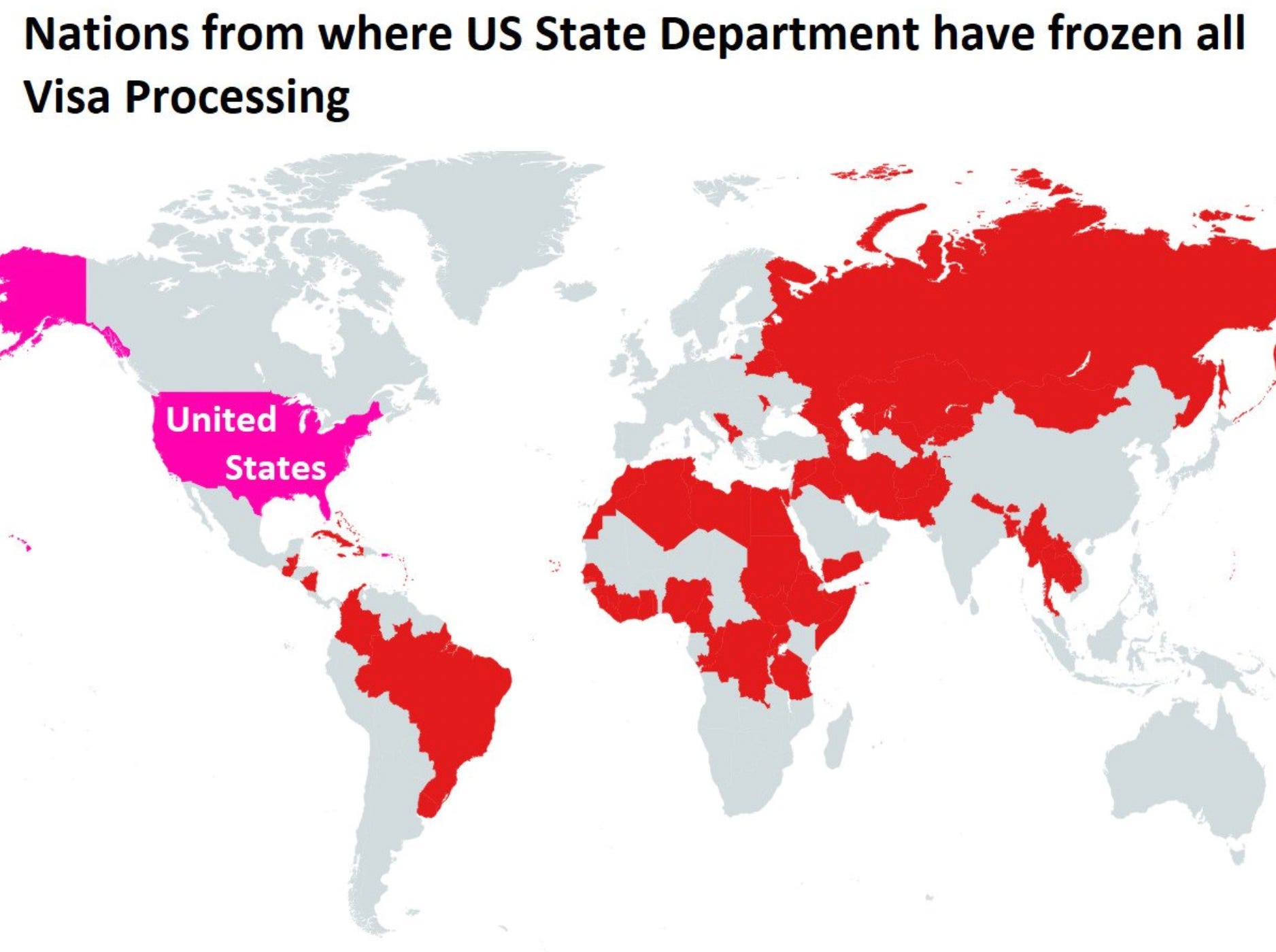
When I heard that the United States had frozen visa processing for dozens of countries, indefinitely, I did what anyone does when power pretends to be arbitrary: I read the list. Afghanistan. Egypt. Morocco. Pakistan. Jordan. Nigeria. Colombia. Haiti. Lebanon. Tunisia.
I gave it a moment, the way you give a magician a moment, even when you already know how the trick works. Why these countries? The answer arrived almost immediately. Palestine.
Trump did not need to say the word out loud because the message travels without being named. And even if it is not singularly supporting Palestine that lands you on the list, the pattern is undeniable.
Palestine has always had a way of revealing power structures by how quickly consequences follow those who refuse silence. Support does not need to be loud to be recorded. It only needs to exist. Visa policy is particularly effective for this kind of discipline because it reaches into ordinary life. It touches students holding acceptance letters, families waiting on reunification, doctors, artists, researchers, workers. No accusation is required. No justification offered. The lesson arrives intact: compliance is rewarded, dissent is priced.
With Trump, dignity is always transactional. In this case, the transaction is simple. Palestine sits at its center, not as a bargaining chip, but as the line itself. The red line is not extremism or violence. It is the insistence that Palestinians are human beings, entitled to life, dignity, and political rights. Believing this has consequences.
Look closely at the list and the pattern sharpens.


Jordan appears, a state that carries the demographic and political weight of Palestinian dispossession every day, and that still somehow refuses the fiction that occupation dissolves responsibility.
Egypt appears, a country whose civil society, journalists, and labor movements have kept Palestine present in public life despite repression and censorship, whose geography alone refuses the fantasy that Gaza is an isolated problem rather than a regional wound.
Morocco, Tunisia, Senegal, Pakistan, Bangladesh, countries that voted for ceasefires, investigations, and accountability even when doing so invited diplomatic punishment. Countries that declined to internalize the idea that Palestinian life must always be negotiated downward in the name of “stability.”
Morocco appears on the list not because it rejected normalization, (it normalized through the Abraham Accords), but because normalization did not produce silence. Since Gaza, Morocco has allowed some of the largest pro-Palestine demonstrations in the region, voted for ceasefires and humanitarian access at the United Nations, and declined to fully discipline public solidarity. In a moment when even procedural support for Palestinian life is treated as deviation, partial compliance is no longer enough. Normalization without erasure has become unacceptable.
Colombia appears too, because like other governments, it recalled its ambassador, and publicly named what powerful states insist on blurring. These were not radical acts. They were gestures firmly rooted in international law. That, perhaps, is what made them intolerable.
It is hardly surprising that Vivian Nereim, the Gulf bureau chief for The New York Times asked publicly on Twitter, “I am so curious to understand how Kuwait — an oil-rich country where the average citizen income exceeds $60k a year — ended up on this list.”


The answer is neither mysterious nor economic.
Kuwait is one of the few U.S. partners in the Gulf that has refused, consistently and publicly, to normalize relations with Israel. It has no embassies, no trade ties, and enforces strict entry restrictions linked to Israeli travel. While neighboring states recalibrated their positions through the Abraham Accords or quiet engagement, Kuwait stated plainly that it would be the last to normalize, and only if Palestinians themselves accepted a just settlement.
In an era where Palestinian rights are treated as an inconvenience to be managed, Kuwait’s refusal to decouple relations with Israel from Palestinian statehood places it outside the acceptable consensus.
That refusal is not accidental. Support for Palestine is woven into Kuwaiti political life, expressed through parliamentary votes, public protest, and diplomacy at the United Nations. Even the rupture after the 1991 Gulf War did not translate into abandoning Palestinian rights as a principle of foreign policy. Instead, it hardened a cautious, morally framed position resistant to transactional pressure.
Kuwait’s inclusion on this list reflects the same logic applied elsewhere. This policy does not respond to danger. It responds to defiance.
What these countries share is not ideology or religion. They share experience. They know how empire speaks the language of order while practicing disorder. They recognize how legality, stripped of morality, becomes an instrument rather than a safeguard. They refuse, sometimes quietly, sometimes explicitly, to accept that Palestinian suffering is the price of entry into a so-called rules-based world.
This policy reaches beyond Palestine itself. Its aim is to thin the ranks around it. To make solidarity costly. To turn principle into inconvenience. To teach others that standing on the wrong side of this injustice carries penalties.
It is a strategy born of insecurity. Confident power persuades. Anxious power coerces. When borders are used to regulate moral positions, persuasion has failed. Solidarity has traveled further than anticipated. Erasure has become harder to manage.
There is a deeper miscalculation here. Policies like this do not merely inconvenience governments; they wound populations. They clarify hierarchies. They remind people how conditional their humanity is. That lesson will only generate more distance, more resentment, and more alternatives.
In a world no longer organized around a single axis of power, coercion ages quickly. Students look elsewhere. Partnerships shift. Influence stalls. Soft power erodes quietly, then decisively.
Palestine has endured a century of policies designed to exhaust it into disappearance. Borders narrowed. Language policed. Archives erased. Generations eliminated. Each iteration promises finality. Each one misunderstands how memory behaves under pressure.
Pressure can slow movement. It cannot rewrite conscience. History is unsparing on this point: when states try to isolate a cause by isolating its witnesses, they amplify the very truth they hope to contain.
Palestine’s liberation is not delayed by measures like these. It draws nearer, carried by the clarity that this sort of repression produces.
Palestinians will be free.
What is happening nowadays in terms of international politics is nothing but embarrassing.
And the worst of all is that people or institutions, governments, etc just don’t give a toss. They are too busy earning/making money.
I genuinely admire your writing, Ahmed, but I disagree with the implication here, at least when it comes to Pakistan.
As a Pakistani, I need to be clear: Pakistan’s inclusion on that list cannot be read as evidence of a state that “refused silence” on Palestine. The reality is almost the opposite. Our current government is widely seen as illegitimate, having come to power through a rigged election in 2024, and it has actively suppressed pro-Palestine voices at home. Peaceful protests were banned, and hundreds of protesters were killed during Palestinian demonstrations in October 2025, (as reported by DropSite News). This is not a state being punished for moral courage. It is a state punishing its own citizens for it.
Internationally, the record is even more damning. On November 17, 2025, Pakistan voted in favor of Trump’s so-called “peace plan” at the UNSC, a proposal Palestinians themselves reject because it offers no credible path to statehood. That vote was not an act of solidarity. It was a betrayal of the country’s stated foreign policy and the principles articulated by its founding leaders. Officially, Pakistan has long maintained a policy of non-recognition of Israel and unwavering support for an independent, sovereign Palestinian state. It has consistently endorsed a two-state solution based on pre-1967 borders, with Al-Quds Al-Sharif (East Jerusalem) as the capital of Palestine. That vote directly contradicted this position.
Worse still, there are reports that the Pakistani state is willing to send 3,500 troops to assist the IDF in dismantling Hamas, a decision taken without parliamentary debate or public consent. At the same time, the same leadership floated the idea of nominating Donald Trump, a man widely regarded by Palestinians as the butcher of Gaza, for a Nobel Peace Prize. All of this has unfolded alongside brutal repression at home: the jailing of Imran Khan, the most popular leader in the country, under more than 200 fabricated cases despite his victory in the 2024 election, and constitutional maneuvers allowing the military chief to grant himself lifetime legal immunity and an extension of power.
The Pakistani public, however, stands firmly with Palestine. People are boycotting Israeli-linked brands, raising their voices online and offline, and showing solidarity despite fear, censorship, and violence. If visa bans are meant to discipline dissent, they are disciplining the wrong actor. The state is compliant. The people are not.
So while I agree with your broader point about how empire enforces silence through everyday mechanisms like visas, Pakistan’s case complicates the pattern. Sometimes the punishment does not fall on governments that resist power, but on populations already held hostage by regimes that eagerly align with it.
In Pakistan, silence is not rewarded. It is enforced. And solidarity with Palestine exists not because of the state, but in spite of it.
Finally, it is hard to ignore the likelihood of a quiet back-channel deal between Pakistan and the United States. Once broader interests are settled, Pakistan may well be removed from this list. The authoritarian regime here derives its power from Washington and remains fully compliant with its demands. Any temporary friction should not be mistaken for resistance.
You can read my article, “How Pakistan and the Muslim World Betrayed Palestine: Power, Fear, and Silence Reshape Pakistan’s Foreign Policy, Erasing Palestine from the Moral Map,” if you want a fuller understanding of my argument and the specific case of Pakistan.
https://open.substack.com/pub/hifzasyed/p/how-pakistan-and-the-muslim-world?r=6j6wwr&utm_campaign=post&utm_medium=web