

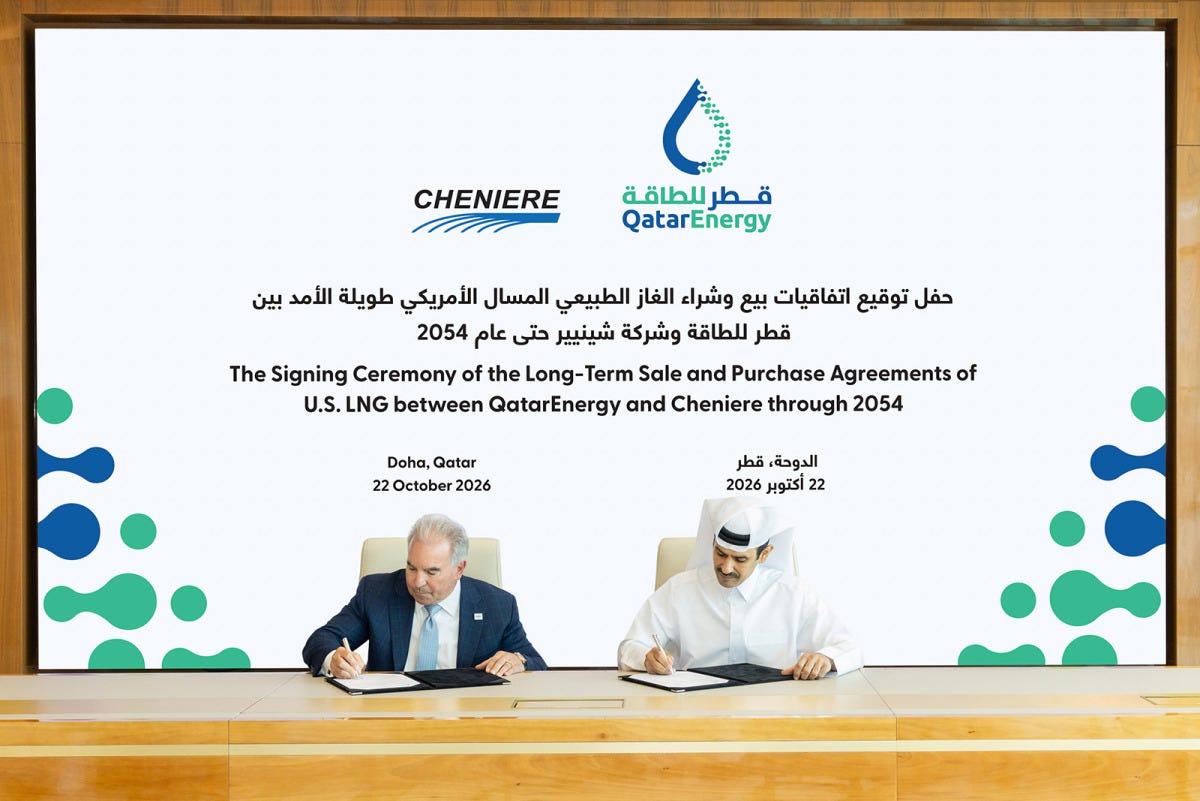
On October 22, Qatar, one of the largest gas exporters on earth, signed a deal to buy gas. The buyer was QatarEnergy, and the seller Cheniere Energy, the largest exporter of LNG in the United States: up to four million tonnes annually, two from Sabine Pass in Louisiana and two from Corpus Christi in Texas, deliveries beginning in 2031 and running through 2054. Deliveries will be on an FOB basis, meaning Qatar lifts the cargoes itself. It is the country’s first such American offtake deal.
The timing carried its own context. The same day, the International Monetary Fund’s regional outlook put Qatar’s economy on course for a 15.6 percent contraction this year, the damage of a war that has choked off a fifth of global LNG supply. Qatar, among the biggest winners of the global gas trade for two decades, is now a buyer, on a twenty-three-year contract, from the industry of the government whose war emptied its tanks.
What the purchase actually buys depends on the reader. An energy analyst reads the deal as insurance: a producer state that lost liquefaction capacity secures alternative supply on the Gulf of Mexico for a generation, with FOB terms preserving discretion over how cargoes are traded. The 2031 start date fits that reading; QatarEnergy expects the damaged trains back within three to five years, by 2031 at the latest.
A political analyst reads the same signature differently. The state whose export facilities were damaged in a war launched by its protector is purchasing supply from the protector’s merchants, and the contract formalizes the dependency the earlier documents only implied. The twenty-three-year term is the strongest evidence for the second reading: insurance covers a gap, and this contract covers a generation.
The Cheniere deal also has company. QatarEnergy is in advanced talks with Venture Global for at least three million additional tonnes a year, discussions reported a day after the Cheniere signing, and Venture Global was already the supplier of necessity: after Hormuz closed in the war’s first days, QatarEnergy bought 33 spot cargoes of American LNG to keep its customers supplied, most of them from Venture Global.
Beneath both contracts sits equity. QatarEnergy owns 70 percent of Golden Pass LNG on the Texas coast, where the first train has been ramping since spring 2026; its first cargo sailed in April aboard the Al Qaiyyah, a tanker QatarEnergy owns, and the train now ships American gas that Qatar largely controls. The portfolio Qatar spent two decades assembling spread its exposure across rivals; the one it is assembling now concentrates it inside the patron’s economy, contracts on the patron’s coast, equity in the patron’s terminals, cargoes that never need to pass Hormuz at all.
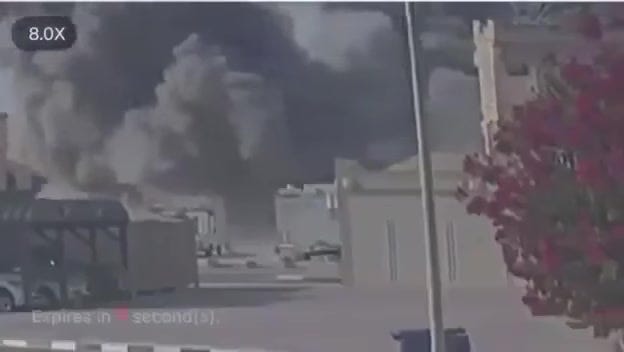
On September 9, 2025, senior Hamas officials gathered in a residential compound in Doha’s Leqtaifiya district to consider a ceasefire proposal the United States had backed. Qatar was hosting, as it had hosted for the Taliban, for Hamas, and at various moments for Tehran, because hosting those conversations was the service it performed inside the American alliance. At 3:46 in the afternoon, Israeli missiles struck the compound in an operation the Israeli military called Summit of Fire. Six people were killed: Humam al-Hayya, the son of chief negotiator Khalil al-Hayya, his father’s office director, three bodyguards, and a member of Qatar’s Internal Security Force. The leaders the strike targeted survived.
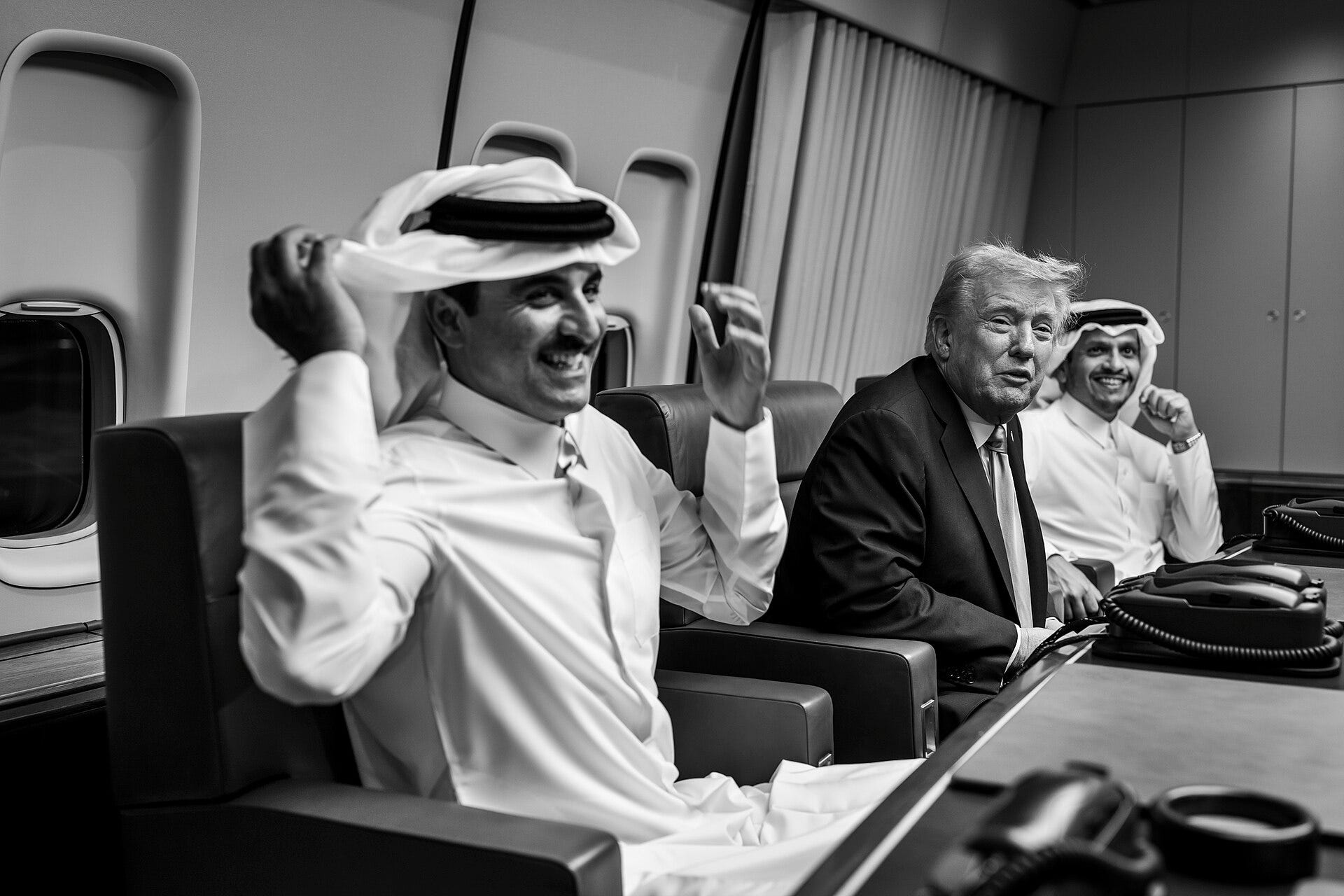
Three weeks later, on September 29, President Trump signed an executive order pledging to guarantee “the security and territorial integrity of the State of Qatar against external attack.” The order raises the question its authors avoided: protect Qatar from whom? Iran’s one strike on Qatari soil, a missile barrage at Al Udeid in June 2025, had come with hours of warning and was almost entirely intercepted. The order followed an attack from the arsenal of the American government’s closest regional ally, delivered against a negotiating session built around a US proposal, in a country that hosts the largest American air base in the region. Neither government has explained what the guarantee is meant to protect against. No Qatari official has publicly named Israel in connection with it. The omission is consistent across both capitals, and the timeline does the explanatory work the governments decline to do.
The war arrived five months after the guarantee and tested it from inside. On February 28, 2026, the United States and Israel opened the campaign against Iran, killing Supreme Leader Ali Khamenei on the first day; one strike hit a girls’ school in Minab, near Bandar Abbas, where Iranian authorities reported more than 170 dead. Iran retaliated across the Gulf. In mid-March, after Israel struck the South Pars gas field, Iranian missiles hit energy targets in Saudi Arabia and Qatar, and QatarEnergy reported significant damage at Ras Laffan, the industrial city through which nearly all Qatari LNG passes.
The company’s chief executive, Saad al-Kaabi, put the accounting on record: LNG Trains 4 and 6 down, 12.8 million tonnes of annual capacity, roughly a sixth of what Qatar sells the world, close to twenty billion dollars a year in revenue, three to five years of repair work, force majeure declared and renewed month by month. At Pearl GTL, the Shell-QatarEnergy complex that converts about 1.6 billion cubic feet of gas a day into roughly 140,000 barrels of synthetic fuels, a direct hit disabled one of the complex’s two trains. Shell partially restarted the plant this month and expects repairs to the damaged train to finish in the first quarter of 2027.
Analysts at Wood Mackenzie estimated the plant contributed around 750 million dollars to Shell’s revenues last year, which gives a sense of what the strike put at risk. The Strait of Hormuz has been largely closed since the war’s first days, cutting off the route for a fifth of the world’s oil and gas trade.
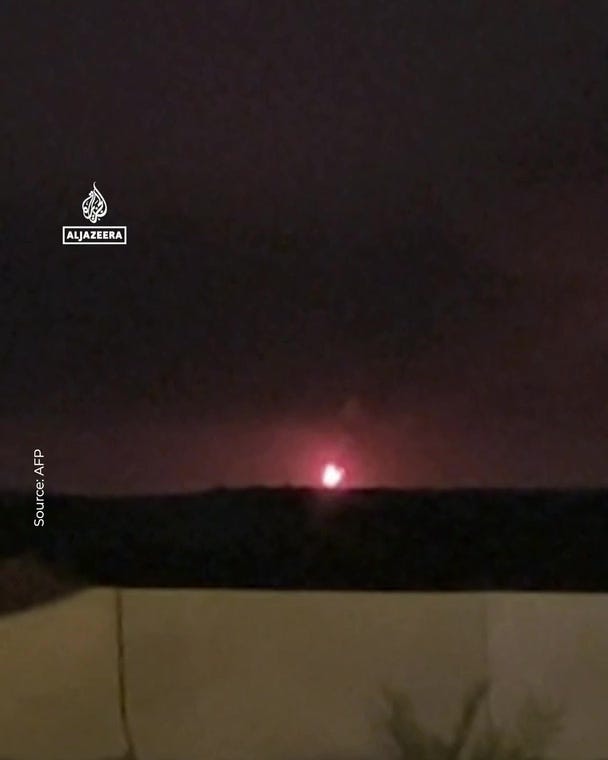
Qatar expelled the Iranian military attachés after the Ras Laffan strike, and its intelligence chief said at Doha’s Global Security Forum in October that the entire defense posture had to be re-arrayed within six hours of the first attacks.
American producers captured the margin the war created: in the war’s first week, feed gas priced near three dollars per MMBtu was selling for sixteen to nineteen in Asia and Europe, March set a record for US exports, and Venture Global, the second-largest American exporter, reported a 69 percent jump in its average liquefaction fee in a single quarter. The shock was absorbed in the Gulf and monetized in Louisiana; and in Doha it was converted into a twenty-three-year purchase agreement.
The Trump administration declared an energy emergency it cannot fix, its officials have failed to articulate a stabilizing strategy for the region, and by August the vice president was calling lower gas prices “goal No. 1” of the war, an objective that sits badly with engineered scarcity.
In 2017, Trump called Qatar “a funder of terrorism at a very high level.” In 2025 his administration announced that Qatar would build a facility for its air force on American soil, at Mountain Home Air Force Base in Idaho. The Boeing 747 worth a reported 400 million dollars sits between the two statements, a jet the Qatari government had been trying to sell since 2020, as Forbes first reported, which Trump toured in Palm Beach in February 2025 and the Pentagon formally accepted as a gift that May. It had flown 1,069 hours in the five years before it went on the market, and found no buyer in five years of trying. Eight years separate the accusation from the base in Idaho; the plane sits between them, and since October, the gas follows them.
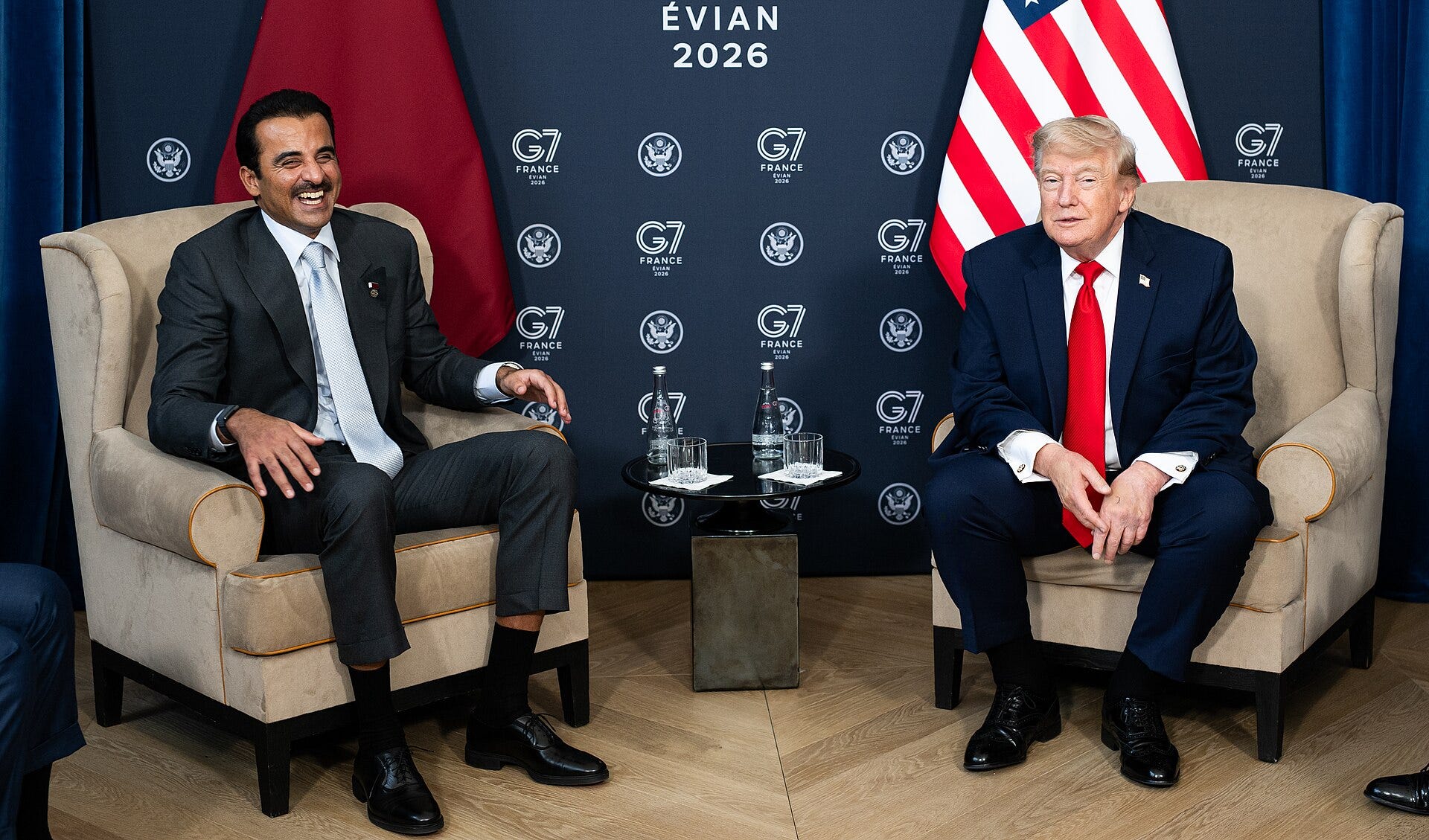
At a June bilateral meeting with the emir on the margins of the G7 summit in Evian, France, Trump offered the geography: “Qatar is the closest to Iran, physically,” he said, adding that other countries’ leaders had to travel forty-five minutes while “you could walk right across the border.” Qatar and Iran share no land border; a maritime boundary runs through the Persian Gulf between them, and Ras Laffan lies roughly 120 miles from the Iranian coast across it. The man issuing the guarantee placed his client within walking distance of the neighbor whose missiles had burned its export plants three months earlier.
For two decades Doha ran a portfolio state: the Taliban’s political office and Hamas’s office in the capital, Al Udeid air base in the desert outside it, Iranian gas in the shared waters, a sovereign wealth fund with positions on three continents. Each relationship hedged the next. Washington described the arrangement as adventurism in moments of tension and indispensable plumbing in moments of negotiation, and both descriptions were accurate: the back channels the United States could not publicly maintain ran through a partner that could.
The strike of September 2025 broke that division of labor. Israel attacked a mediation infrastructure its own patron depended on, and the attack demonstrated something every Gulf capital noted: the patron responded to the bombing of its partner by selling the partner protection. Within the region, the question quickly became what the hedger actually owned.
Qatar, meanwhile, kept mediating. A negotiating team traveled to Tehran in May; through the autumn, Doha has coordinated with other mediators on bridging proposals, and its foreign ministry spokesman confirmed engagement from both Washington and Tehran as recently as October 20, in the same news cycle in which the US defense secretary warned Iran of “destruction.” The emir’s formula, playing on a loop in Doha’s Pathway to Peace museum, has not changed: “We will never regret to be a mediator.”
The sentence is sincere, and it is also the only one of its kind Doha has left. Mediation is the one role in the Gulf that runs on trust rather than on bases and contracts, and its counterparties include the patron’s enemies. That may be why it survives everything else. But its terms have changed underneath.
Qatar now mediates between the state whose war wrecked its gas exports and the state whose missiles did the wrecking, while its signature dries on a purchase agreement with the first state’s industry.
No official in Washington or Doha will state in public what the documents state in sequence: that the guarantee took shape against a threat the guarantor’s ally posed, and that the gas purchase functions as the premium on it. Saying it aloud would require both capitals to concede that what they call an alliance has the structure of something older, a protector collecting rent from a protected. The hedge is ending because the war demonstrated that diversification in this region stops at the edge of the American security umbrella, and that the umbrella’s price is now quoted in molecules, annually, through 2054.
Serbia supplies the control case, and it is running on a much faster clock. The country’s gas contract with Russia was due to expire on September 30, 2026; that day it was extended by three months, on the same terms, through the end of the year, and no long-term successor has been signed since the previous three-year deal lapsed in the summer of 2025.
The American alternative is already under construction: a pipeline connection south through North Macedonia toward the Greek coast, where American LNG comes ashore, is being pushed on an accelerated schedule, and Vučić has pitched Serbia’s energy sector, long dominated by Russia, as an opening for American investment.
The price of conversion is legible in the tariff schedule: Washington suspended its 35 percent tariff on Serbian goods in July, against the threat of tariffs running as high as 100 percent if the Russian purchases continue.


Serbian arms sales to Israel grew from about three million euros in 2023 to 114 million euros in 2025, a nearly fortyfold increase carried on airlifts from Belgrade to Israel’s Nevatim airbase. In August 2025, Elbit Systems signed a five-year, 1.63 billion dollar contract with a customer it initially withheld from disclosure, who turned out to be Serbia. On September 17, five weeks before the snap election and ten days before his own resignation from the presidency, Aleksandar Vučić opened a drone-assembly plant that BIRN and Haaretz tied to Elbit, saying it would build “state-of-the-art equipment” for the Serbian military and the armies of other countries, and announced plans for at least three more plants.
In June 2025, a day after students marched in Belgrade against the arms trade, Vučić announced a halt to all military exports. But the trade did not stop: Haaretz and the Balkan Investigative Reporting Network established that Serbia shipped more to Israel in the first half of 2025 than in all of 2024, and the year closed at its record. The student movement that produced the announcement, organized originally around the Novi Sad railway canopy collapse of November 2024, entered the October 25 election as a single list, three days after the Cheniere signature dried in Doha.
The patron’s family has already been in the country: Jared Kushner’s Affinity Partners planned a hotel on the site of the bombed former army headquarters in Belgrade until it withdrew in December 2025, after prosecutors charged the culture minister over how the site lost its protected status; that trial opened in February. The umbrella’s price is quoted in molecules in Doha, and in tariffs, pipelines and property in Belgrade; but the umbrella is the same.
A state expecting a short war buys its way through the disruption on the spot market, the way Qatar bought thirty-three cargoes through the Hormuz closure, roughly a billion dollars, cargo by cargo, for as long as the strait stayed shut. A state expecting its fields back signs for the repair window, three to five years at Ras Laffan, and stops there. Qatar signed for twenty-three years: deliveries beginning in 2031, at the far end of the repair window, the tail running a generation beyond it.
However the war ends, the buyer has told the market how long it expects the destabilization to last, in the most binding language available to a state, and both capitals have let the term stand as the closest either has come to saying it aloud.
" . . . Neither government has explained what the guarantee is meant to protect against. No Qatari official has publicly named Israel in connection with it. The omission is consistent across both capitals, and the timeline does the explanatory work the governments decline to do. . . "
So Qatar fund the US, who in turn fund Israel, and Israel claim anyone funded by Qatar is discredited! Meanwhile Israel also fund Hamas via Qatar.
Make this make sense.