


The Silence Was Deafening
They came with a sound that could tear the sky apart—a weapon designed not to wound flesh but to rattle bones. In the streets of Belgrade, where hundreds of thousands stood in silent defiance, the Serbian police delivered their message.
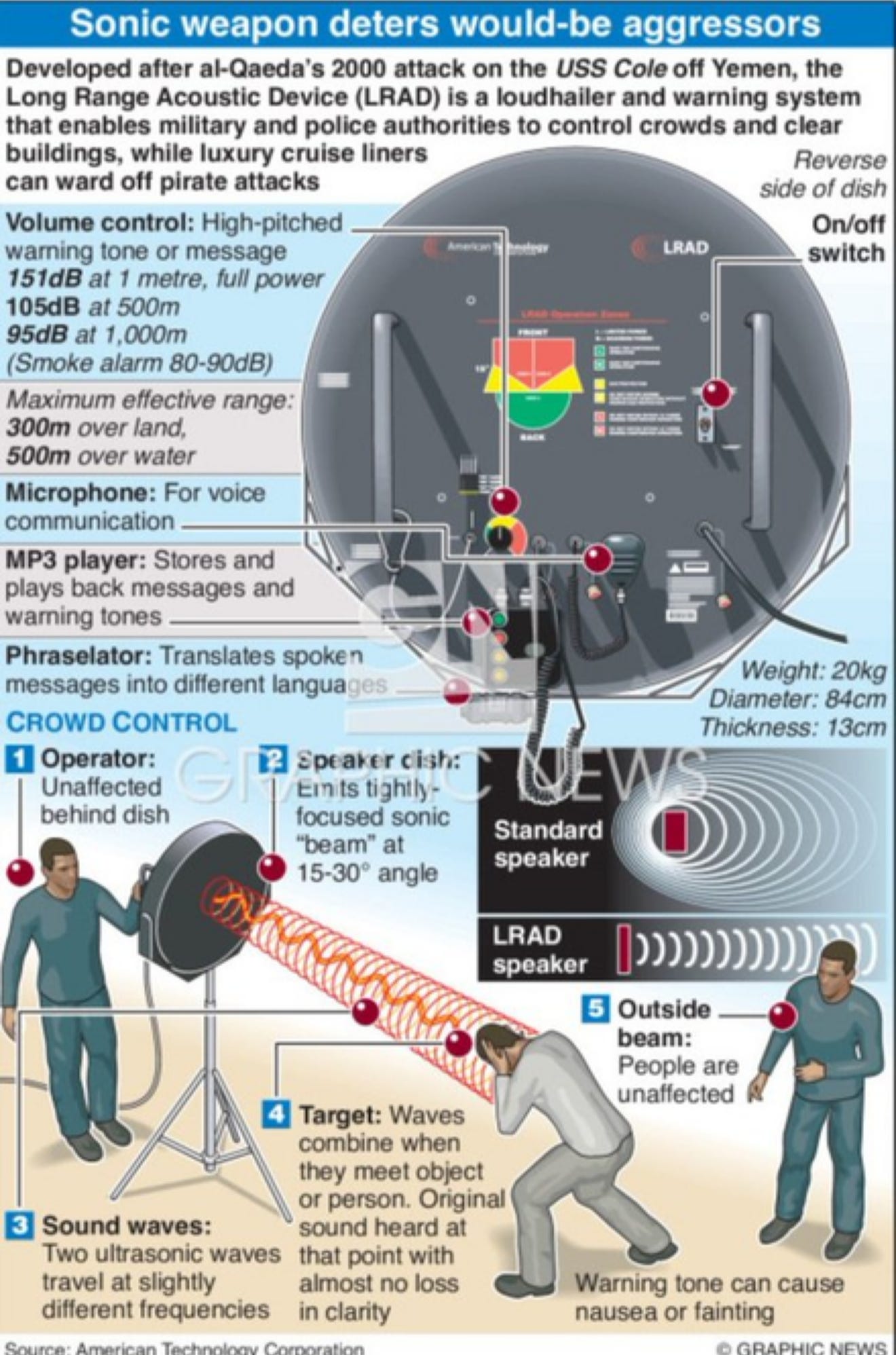
They didn’t fire bullets, but they fired something else: an LRAD sonic cannon. This acoustic weapon unleashed a focused blast of sound—reaching up to 160 decibels, louder than a jet engine, as deafening as a shotgun—against student protesters during their 15 minutes of silence.
Protesters say it sounded like an airplane taking off next to them. The message was clear: You will listen. Even if we have to break your ears to make you do it.
The LRAD is a sound that doesn’t just pass through the ears but drills into them, vibrating the skull, shaking balance, distorting thought. At close range, it is capable of permanently damaging hearing. It is not a tool of dialogue. It is not a warning. It is a weapon of control.
This weapon was designed for war, for repelling pirates off the coast of Somalia, for military checkpoints where words alone might not stop a suicide bomber. But here, in the center of a European capital, it was used against students—unarmed, unthreatening, standing in protest against the slow rot of authoritarianism.
Serbia’s student-led but leaderless movement has become a force that both frustrates and unsettles the government. Unlike traditional opposition movements, it has no single figurehead to discredit, imprison, or co-opt—only a swelling tide of discontent that refuses to be silenced.
The crowd moved as one, fanning out toward predetermined meeting points. Some held banners that declared, “He’s Finished.” Others chanted, “Pump it Up,” a borrowed battle cry that, over months of student-led protests, had transformed into something more than just words.
It was, by all accounts, the largest uprising the country had seen in a generation.
“I expect this will shake his authority,” said Milenko Kovacevic, standing among the thousands. “That Vucic will realize the people are no longer for him.”
Born out of frustration with President Aleksandar Vučić’s tightening grip on power, the protests have evolved beyond any one issue, embodying a broader resistance to corruption, media control, and democratic backsliding. Their leaderless nature is both a strength and a challenge: without centralized leadership, they are harder to dismantle, but also harder to steer toward a singular political outcome.
What remains undeniable, however, is that this movement has shattered the illusion of passivity, proving that even in a country accustomed to strongman rule, power can still tremble before the will of the people.
Deploying an LRAD against a peaceful protest is not just an act of suppression—it is a declaration of war against dissent itself. It is an admission of fear, of a government that knows it cannot control its people through argument, through reason, through legitimacy. So it turns to volume. It turns to violence. It turns to a machine that does not need to distinguish between the guilty and the innocent, between the loud and the silent. It simply screams.
But here’s the thing about sound: It fades. The air swallows it. The moment it stops, the silence rushes back in, stronger than before.
What Happens When the State Brings a Sonic Cannon to Silence?
The students had gathered for fifteen minutes of stillness. Not marching, not chanting—just standing. The kind of protest that forces the world to listen, to wonder what could be so wrong that so many people would choose silence as their weapon.
And so, silence was made into a crime.
Videos circulating on social media show people suddenly splitting apart in panic in the middle of the street. Witnesses describe a sharp, unbearable noise, a pressure in their heads that felt like their skulls were vibrating from the inside. Within hours, speculation spread: a sonic weapon had been deployed, something banned under domestic law. Something that can cause pain, dizziness, disorientation, permanent hearing damage.
The Ministry of Internal Affairs “strongly denied” the claims. The Ministry of Defense went further, dismissing the reports as “notorious lies and falsehoods.” A familiar pattern, one that plays out in capitals across the world: the event happened, but it did not happen. The panic was real, but its cause was not. The students must have imagined the ringing in their ears, the nausea, the loss of balance. The world must believe not its eyes, not its ears, but the state’s version of reality.
What This Means for the Movement
The Serbian student protests are a battle for the future, not just of their country but of every place where power clings to corruption. Across the world, authoritarianism, whether in Serbia or Columbia’s campus in NYC, is not enforced solely by military force or political maneuvering—it is enforced by exhaustion. Governments do not always need to imprison their critics. They only need to make speaking too costly, too painful. They need to make protest feel like they’re screaming into a void.
This is what the LRAD was meant to accomplish. Not just to disperse the students, but to deter them. To make them question whether they can withstand the next escalation, and the next. To seed doubt in their movement, to fracture their will.
But if history teaches anything, it is that every failed attempt to silence a movement only gives it a new sound.
In the coming days, the world will watch Serbia. The students will return to the streets. The government may bring its weapons again—perhaps the same unbearable noise, perhaps rubber bullets, tear gas, the more traditional tools of suppression. But something irreversible has already happened: The authorities have admitted that silence terrifies them.
And that means the students have already won something. Not the war, not yet. But the knowledge that their resistance is being heard—so clearly, so powerfully—that the state had no choice but to scream back.
In the streets of Belgrade, where students refuse to bow to corruption, the echoes of another struggle resound—one fought not just in universities and city squares, but under siege, beneath rubble, in exile. Serbia’s student movement does not fight in isolation; they understand that authoritarianism does not stop at borders.
The same forces that seek to exhaust their resistance fuel the machinery of occupation in Palestine. To stand against one is to stand against the other. And so, in their chants and banners, in the unyielding press of bodies refusing to be silenced, there is a message not just to their own rulers, but to every power that believes oppression can outlast the human will to be free. The streets of Belgrade echo with the same defiance as the rubble of Rafah: a refusal to disappear.
'The LRAD is a sound that doesn’t just pass through the ears but drills into them, vibrating the skull, shaking balance, distorting thought.'
That's just pure evil.
Straight up scenes from stories I would have read in books like 1984.