


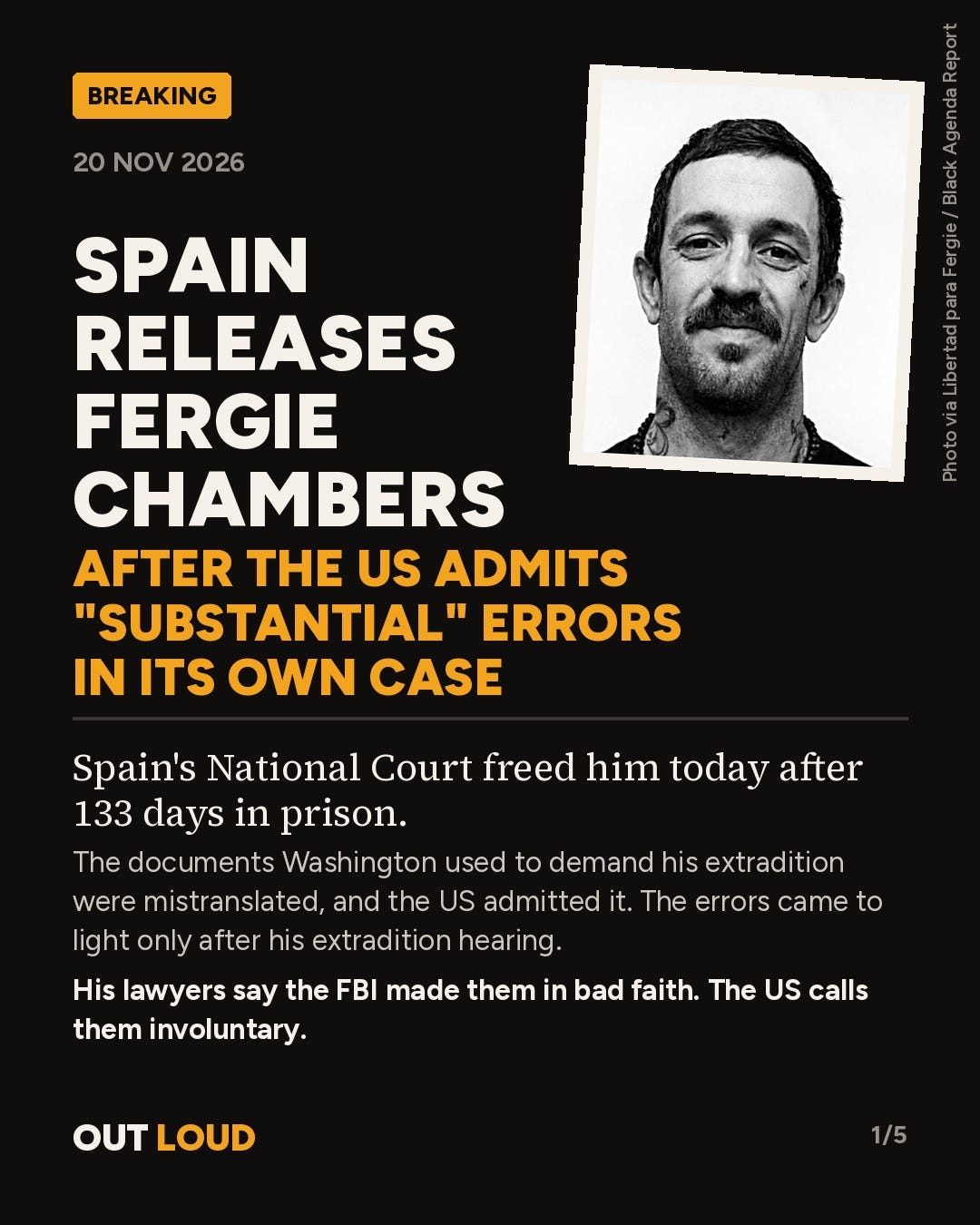
Fergie Chambers walked out of a Spanish prison today. He spent 133 days inside, held at the request of the United States while the Trump administration worked to bring him back to face charges carrying up to 30 years.
Read past the translation and the case is plain: Washington wants to imprison a man for paying protesters’ legal bills, funding aid and bailing out a football club in Tunisia, and it has dressed that up as support for Hamas. The real charge against Fergie Chambers is funding solidarity with Palestine.
Spain's National Court ordered his provisional release on Friday after US authorities admitted "substantial and involuntary" errors in the translation of their documents. Those documents were the basis of the extradition request. The admission reached the court on November 13, after his extradition hearing had already taken place that day. His defense says the FBI made the errors in bad faith.
His lawyers told the court the Spanish version of the US complaint turned "direct action" into "direct violence," and described fires that the original never mentions. A protest became an attack on paper, in the language of the country being asked to hand him over.
He has to surrender his passport, report to a court every Monday, stay in Spain at an address he gives the court, and appear before the National Court whenever he is called. The judges still have to decide whether to send him to Washington.
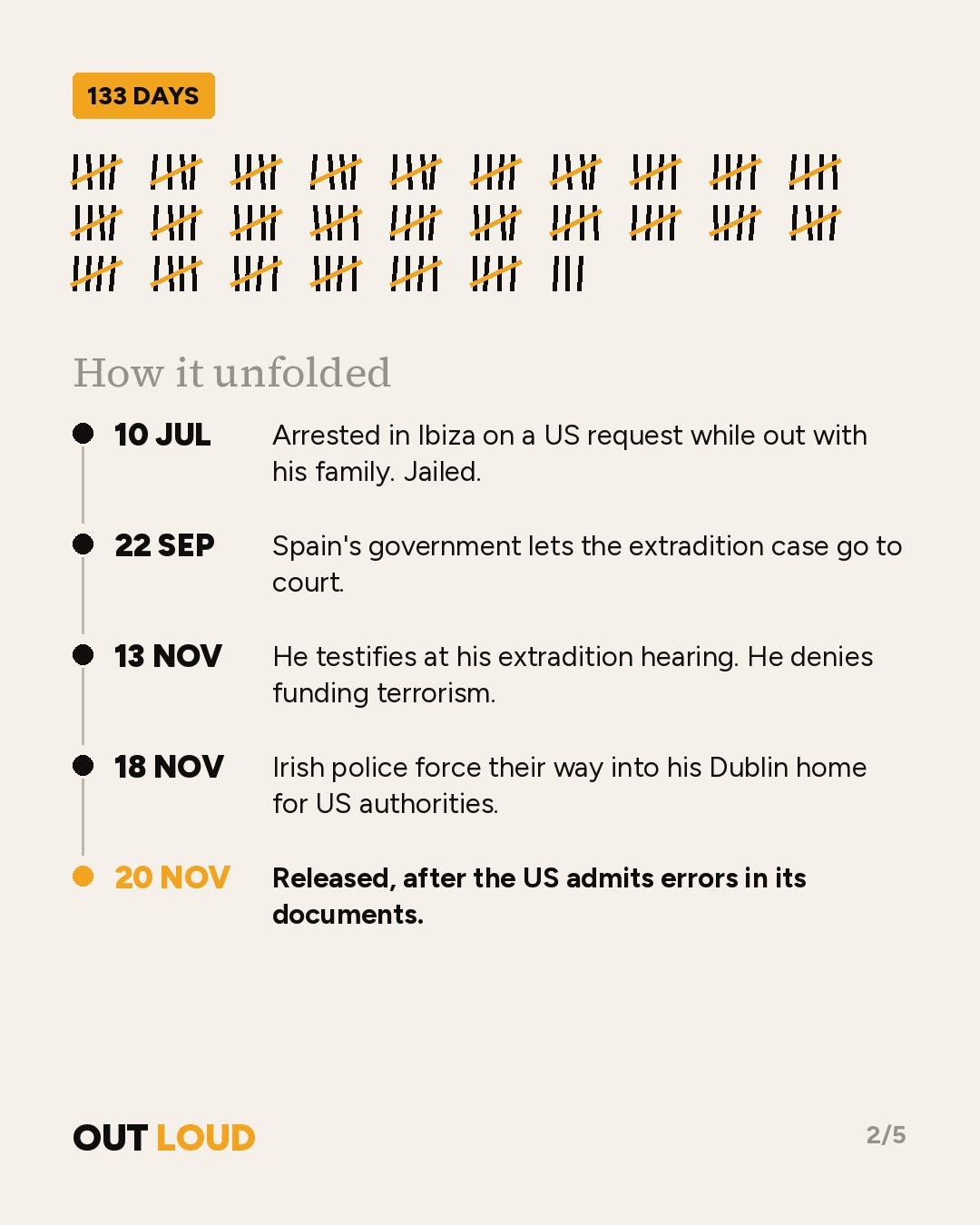
Chambers, 41, is an heir to the Cox media fortune who has spent much of his wealth on Palestinian causes. Spanish police arrested him in Ibiza on July 10, as he drove with his partner and their son to look at schools. He has been in prison ever since.
The US request lists riot, conspiracy to commit riot and international money laundering. He is not charged with terrorism. The riot counts rest on money he allegedly gave to cover legal fees for activists arrested at 2023 protests at US sites of the Israeli arms maker Elbit Systems. The laundering count centers on $7.5 million wired to Tunisia, where he lived, which the US says went to support Hamas.
He denies it. He told the court his foundation funded Palestinian aid groups providing medical care for children, food, water and transport to safety, and that he paid $4 million to Club Africain, a Tunisian football club, to clear its debts and support its youth and women's teams. He said he blocked entrances at two Elbit protests, caused no damage and paid bail for people who were arrested.
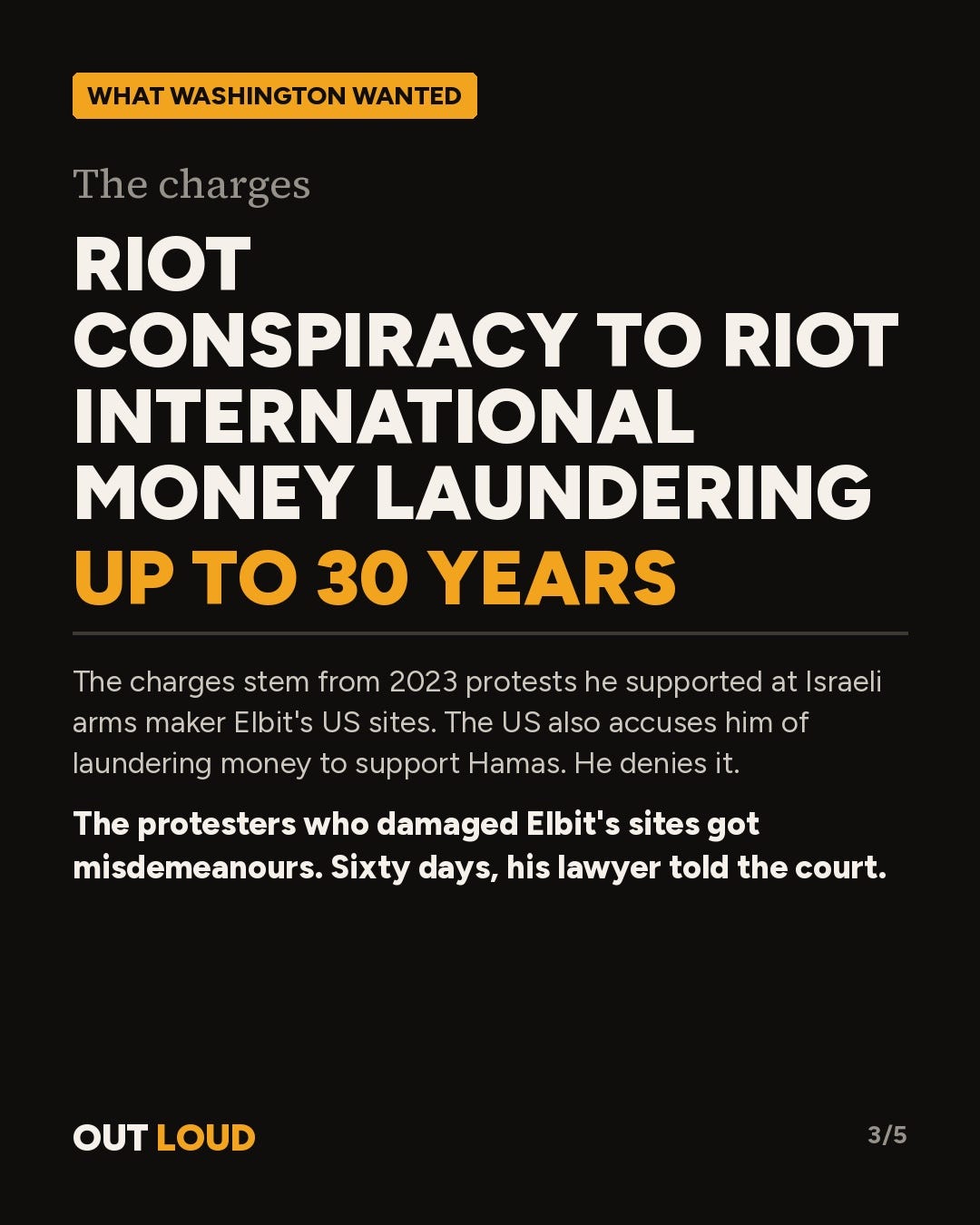
His lawyer, Aitor Martínez, told the court that the people who actually damaged property in New Hampshire were convicted of misdemeanours carrying 60 days. That falls below the one-year threshold in the US-Spain extradition treaty. Washington wanted three decades for the man who paid their bail.
Two days before his release, Irish police made the reach of this case plain. On Wednesday, the Garda's Special Detective Unit forced entry into his home in Dublin at the request of US authorities and broke the doors of the house.
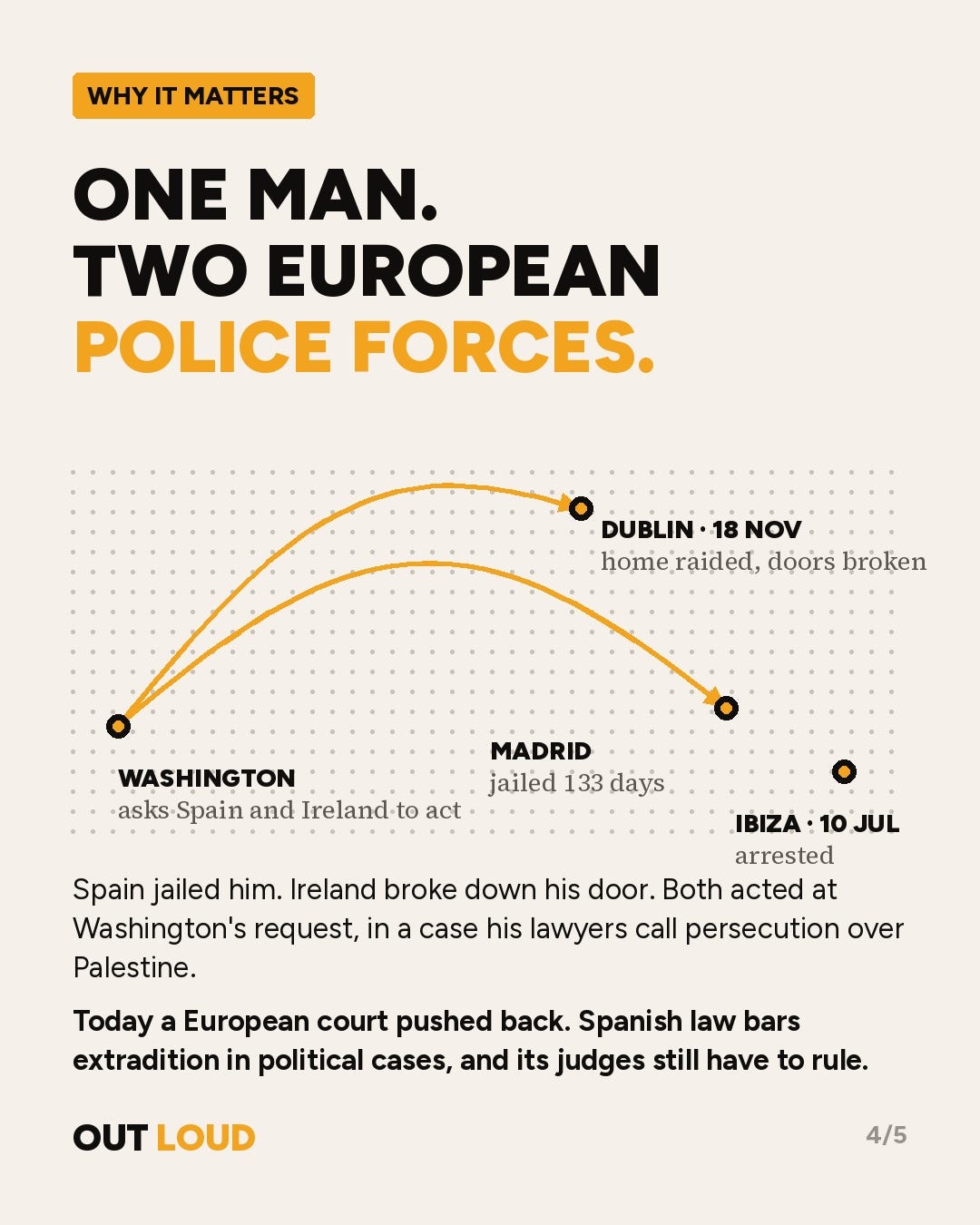
Two European police forces have now acted on Washington's behalf against one man, over his support for Palestinians. His detention marked the first time anyone has faced extradition from Spain to the US over support for the Palestinian cause, according to the journalists who first reported his arrest. Thirteen Spanish political parties and more than 200 rights groups urged Madrid to stop it. Ione Belarra, who leads Podemos, called him the first political prisoner in Spanish history jailed for supporting Palestine.
The case has drawn attention far beyond Spain. The former British ambassador Craig Murray, who travelled to Madrid to follow the case, reported that the US Justice Department did not even send anyone to argue for it. This week, activists occupied the Spanish embassy in London in solidarity with him.
This is how the crackdown on Palestine solidarity in the United States now travels. It moves through extradition treaties, international arrest warrants and the police of allied governments. It turns bail money, aid and a football club's debts into terror financing, and when the evidence reads too mild, the translation does the rest. Then it asks European courts to sign off.
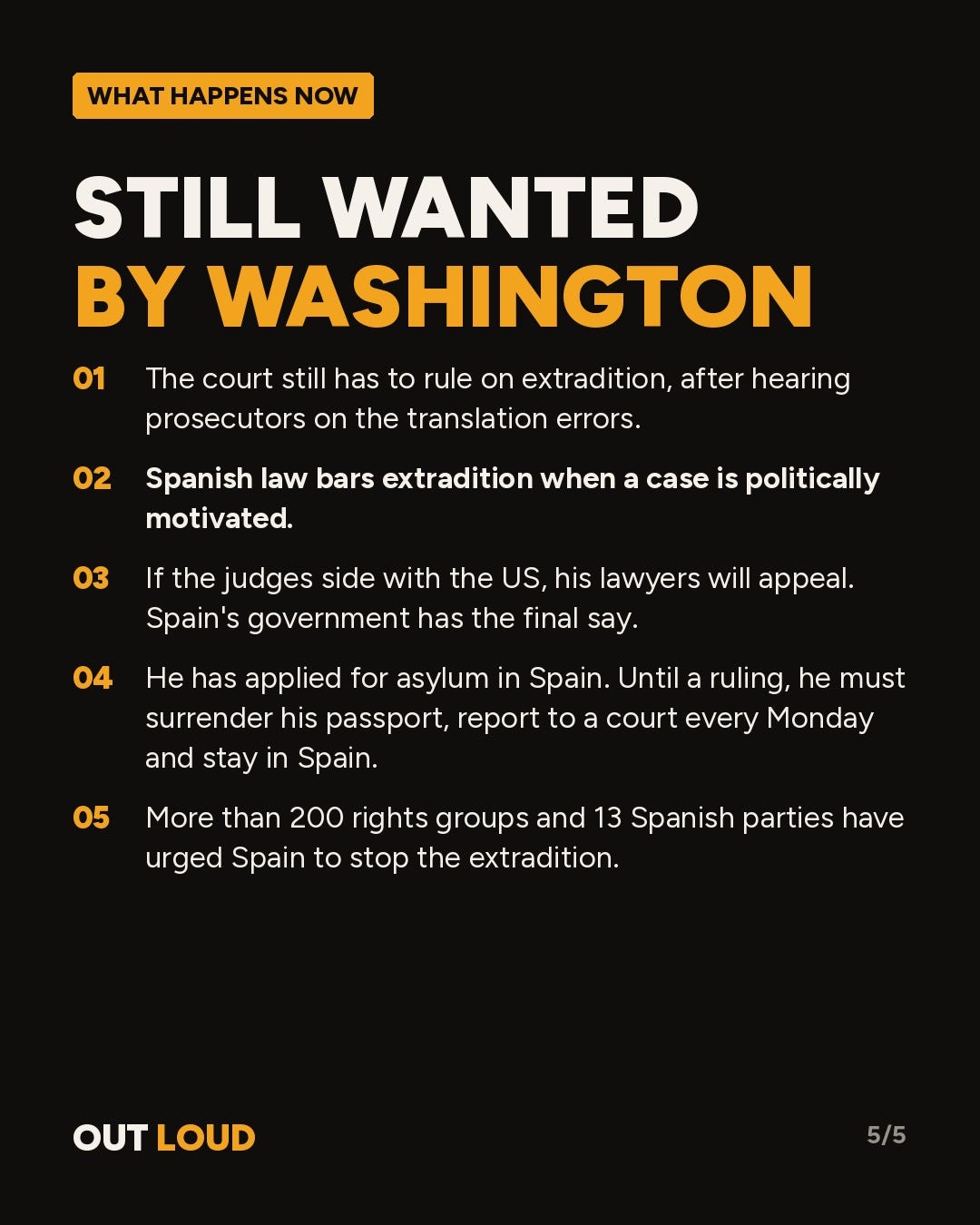
Spanish law forbids extradition when a case is politically motivated, and that is now the question in front of the judges. If they back the US request, his lawyers will appeal. He cannot be extradited while his asylum claim is pending, and Spain's government holds the final say. Spain votes in an early election on November 29, and the parties polling to replace Pedro Sánchez's government may be more inclined to hand him over.
For now he is out of a cell and back with his family, inside a country he is not allowed to leave.
When the evidence said protest, the translation said violence. Whatever the judges decide, the case Washington built against Fergie Chambers is a case against funding solidarity with Palestine, and Europe is being asked to enforce it.
Photo via Libertad para Fergie / Black Agenda Report
A personal note: I’ve had the greatest loss of my life. I’m taking time to honor my mother, Bana Abdul Rahman. I won’t be posting for a while, but I’ll be back soon. Thank you for the outpouring of love and condolences, and for being here.
So sorry for your loss and you still showing up to support others 🤲🏻
No words can make the pain disappear, but may you find the peace and strength to carry on after such terrible loss. May your sweet mother Bana Abdul Rahman rest in eternal power and peace 🕊️