


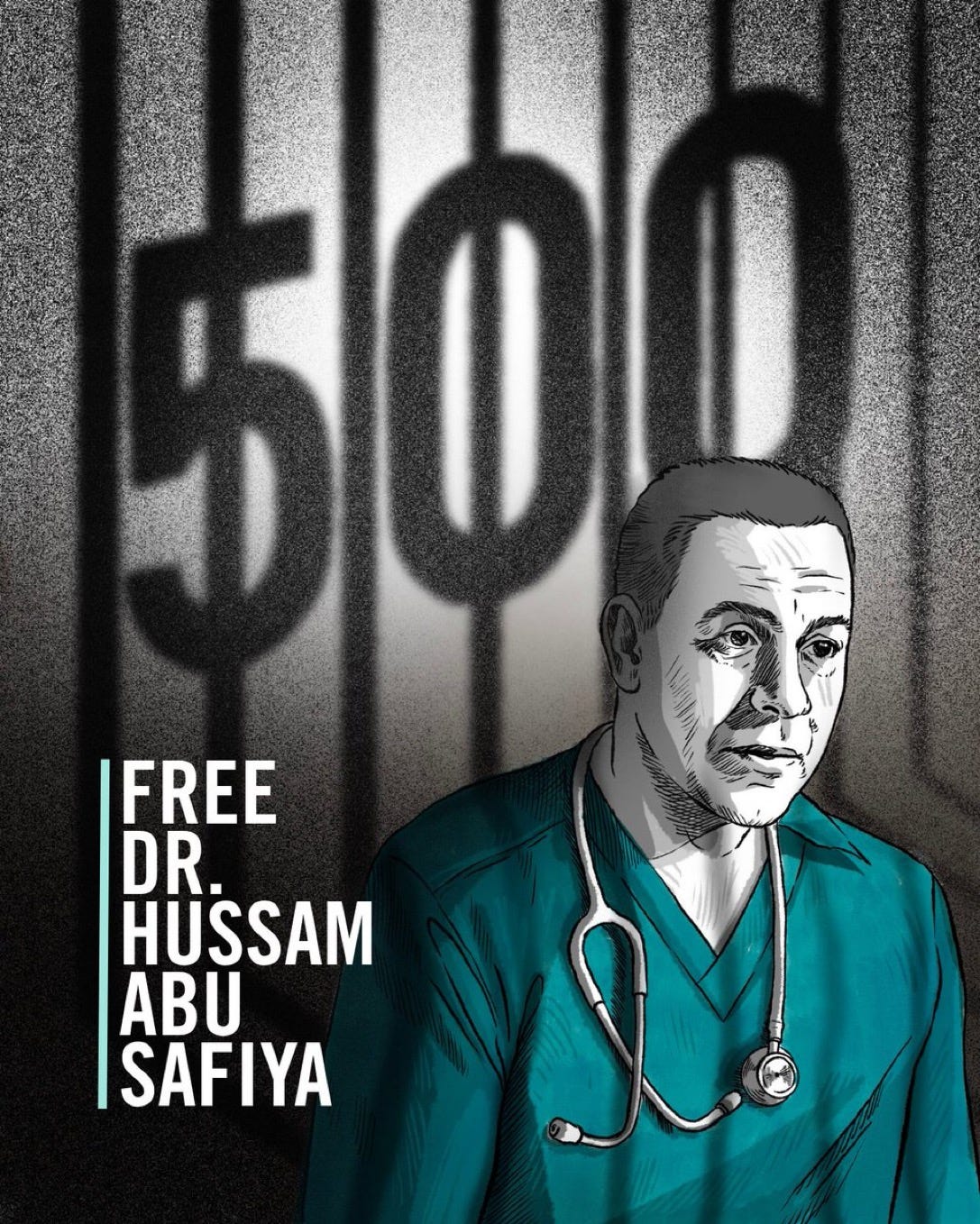
What crime does a man commit when he chooses to heal children?
What sin does a father bear when he refuses to abandon his patients even after his own son is taken from him?
What transgression deserves being shackled, tortured, and disappeared for 500 days?
These are the questions that haunt me as I sit with the story of Dr. Hussam Abu Safiya, a pediatrician who became, through sheer force of moral character, the unwilling face of Palestinian resistance in Gaza. They dragged him from Kamal Adwan Hospital 500 days ago—a place where he had dedicated his life to saving children, only to be snatched away while doing his work.
When they came for him, they weren’t just arresting a doctor. They were stealing a human being, and in doing so, burying another piece of what makes us human.
The Crime of Healing
Before he became “the voice of Gaza’s decimated health sector,” Dr. Abu Safiya was just a man who made a simple choice. As others fled the relentless bombing of northern Gaza, he remained. His colleagues remember not just his medical skill, but his humanity. The way he knelt to speak to small patients at eye level. The songs he sang to frightened children during procedures. The hours he spent comforting grieving families long after medical emergencies ended.
“He treated every child as if they were his own,” one nurse recalled [1].
What crime did Hussam commit? What societal transgression deserves being targeted for choosing to heal?
The answer, I’m coming to understand, is that in systems built on domination, healing itself becomes an act of resistance. When your infrastructure is being systematically destroyed, when your people are being systematically dehumanized, the simple act of keeping someone alive becomes an act of defiance.
And the punishers cannot abide defiance.
The Day They Killed His Son Twice
October 25, 2024: A day that would break any parent.
While Dr. Abu Safiya worked in Kamal Adwan Hospital’s operating room, an Israeli drone struck the facility. His son Ibrahim, who had been sheltering there with the family, was killed instantly.
“I saw him die at the entrance gate — it was a great shock,” Dr. Abu Safiya later told Frontline Defenders. “I found a grave for him near one of the hospital’s walls, so that he could stay close to me.” [1]
Most human beings would have collapsed. Most would have walked away from the carnage of it all.
Dr. Abu Safiya returned to work the next day.
“I have to save the children who are still alive,” he told a colleague, his voice raw with grief but steady with purpose [3].
What does it say about a society that forces its healers to make this choice—between mourning their own dead and saving the living? What does it say about a world that would allow a man to be punished for making the moral choice to continue healing?
They killed his son once with a drone strike. And then they killed him again, when they took his father away.
One Among Thousands
Dr. Abu Safiya’s story is tragically unique only in its details. It is the story of every healthcare worker in Gaza who has chosen to stay.
Since October 7, 2023:
1,057 Palestinian health and medical professionals have been killed [3]
110+ healthcare workers have been abducted by Israeli forces [8]
400+ healthcare workers have been killed since the beginning of the war [9]
These are not just statistics. These are human beings. People like Dr. Omar Ferwana, the former dean of Dr. Abu Safiya’s medical school, who was killed [9]. People like Dr. Israa Al-Ashqar, a kind anaesthesiology resident, and Dr. Ibtihal Al-Astal, an outstanding intern, who were also killed [9]. People like Dr. Khaled Alserr, a 33-year-old surgeon who was arrested along with other healthcare workers at Nasser Hospital and endured six months of torture, including being forced to “make the sound of a donkey” and being told “we will cut off your fingers because you are a dentist” [7].
“Thousands of medical students will not be able to continue their studies in Gaza and cancer patients have lost their already limited access to cancer care for the foreseeable future,” wrote one American doctor who watched from afar as his former students in Gaza endured these attacks [9].
What crime did these healers commit? What sin deserved their deaths, their abductions, their torture?
The Siege That Lasted 80 Days
By late 2024, Kamal Adwan Hospital had become both sanctuary and target. Israeli forces surrounded it for 80 days, cutting off power, water, and medical supplies. When Dr. Abu Safiya refused evacuation orders, the punishment was swift.
“The Israeli army does not know what it wants,” he explained during brief detention. “They interrogated me about whether there were fighters inside the hospital, and demanded that I evacuate the hospital completely, but I refused.” [1]
His defiance was captured in a now-iconic 10-second video: a lone pediatrician in a white coat walking through rubble toward Israeli forces. To the world, it symbolized resistance. To his family, it simply reflected who he always was [2].
When Israeli forces finally raided the hospital on December 27, 2024, they made a promise. An Israeli officer named Wael assured Dr. Abu Safiya that staff would be relocated to the Indonesian Hospital to continue their work.
“It was a lie,” his wife Albina told Al Jazeera. “We got on the bus with all our daughters and sons. That was the last time I saw him.” [8]
What kind of system operates on broken promises? What kind of military targets healers and then lies to them about their fate?
The Torture Behind Bars
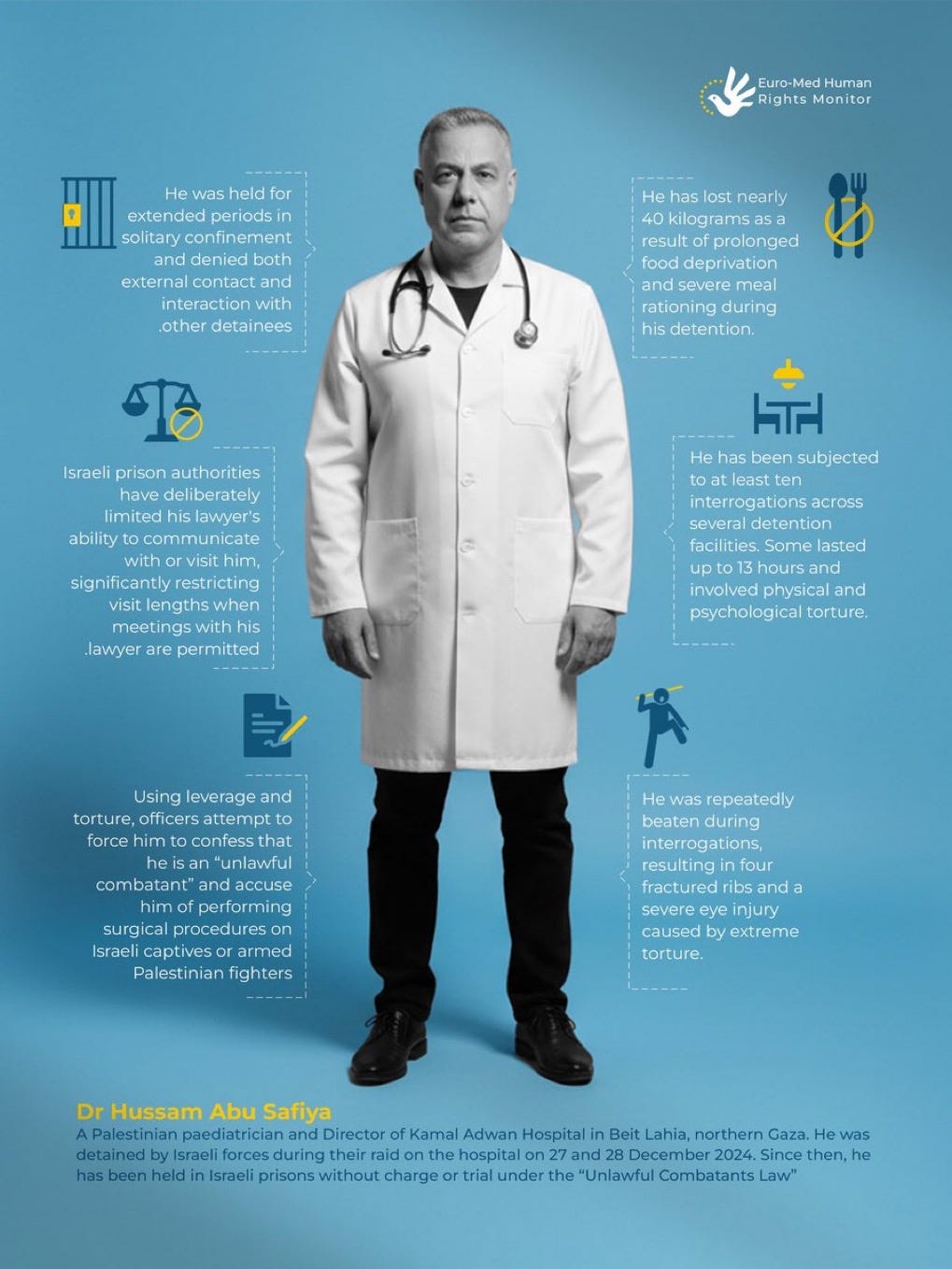
Since his abduction, Dr. Abu Safiya has been subjected to conditions that defy basic human decency.
His lawyer, Ghaid Kassem, paints a grim picture: “He has endured torture and multiple beatings at Sde Teiman,” she told Al Jazeera. “He has lost an alarming amount of weight. He has high blood pressure. He has tachycardia. He is suffering from shrapnel that is still in his leg and his right thigh.” [8]
When his mother died in prison, it was Kassem who had to deliver the news.
How does a medical professional—someone whose life’s work is healing—end up in conditions that destroy both body and spirit?
The answer, I’m coming to understand, is that this is not about individual crimes. This is about systemic punishment. This is about making an example of those who choose humanity when the system demands inhumanity.
The Architecture of Oppression
What Dr. Abu Safiya endured is part of a pattern.
As Physicians for Human Rights - Israel documented in their report “Torture of Medical Workers in Israel,” the abuse and starvation that Israel inflicted on healthcare workers is “a moral and legal outrage,” but “seemed a matter of policy” [7].
“None of [the healthcare workers] were accused of anything or formally charged,” said Najji Abbas from PHRI. “Many of the people we spoke to talked about being victim to sexual violence and humiliation, the use of dogs either to attack or pee on prisoners seemed to reoccur a lot. The idea is for the soldiers to rob Palestinian men – and doctors specifically – of their dignity. That kind of torture also leaves scars; ones that take a long time to heal.” [7]
Dr. Alserr, the surgeon tortured for six months, put it this way: “I hurt deeply. I know I will not heal completely. I just hide it with work and by keeping busy.” [7]
What does it say about a system that must torture healers to maintain its control? What does it say about a military that must humiliate doctors to assert its dominance?
The answer, I’m afraid, is that this is how domination works. It must break the human spirit to maintain its power. It must make examples of those who choose compassion to deter others from doing the same.
The Questions We Cannot Ignore
Five hundred days. Five hundred days since a pediatrician was taken from his hospital. Five hundred days since a father was separated from his remaining children. Five hundred days since the world lost one of its most compelling voices for medical ethics in war.
We have to ask:
What crime deserves being tortured for 500 days?
What sin deserves having your son killed and then being taken away from your remaining children?
What transgression deserves being targeted for choosing to heal children when others flee?
What makes someone deserving of this?
The answer, it is clear to me, is nothing.
The only thing that makes someone deserving of this, it would appear, is being Palestinian. The only thing that makes someone deserving of this is refusing to be broken.
Dr. Hussam Abu Safiya chose humanity. He chose his patients. He chose to stay when others fled. He chose to heal when he could have retreated into grief.
It is our turn to choose him. Not just for his freedom. But for the principle that some lines should never be crossed. That medical neutrality must be respected. That healers should never be targets.
That human dignity is non-negotiable.
The crime is not in healing. The crime is in the system that punishes healing. The crime is in the world that stands by and watches.
And our answer, written in our actions and our voices, must be equally clear: we will not stand by. We will not look away. We will not let the punishers win.
For in choosing Dr. Abu Safiya, we are not just choosing one man’s freedom. We are choosing the humanity that he refused to abandon. We are choosing the principle that healing is never a crime. We are choosing the world that Dr. Abu Safiya fought to create—one where children are healed, not harmed, where healers are protected, not punished, and where human dignity remains, always, non-negotiable.
We are choosing the world Dr. Rachel reminds us is possible and we are deserving of. A world in which people like Hannah Einbinder remind us “People in Hollywood, unfortunately, need these issues to affect a white person for them to see it as relating to them,” she noted. “Like, they see Jimmy Kimmel getting taken off the air suddenly, they see Stephen Colbert’s show being canceled by CBS, which is owned by the Ellisons, and they go, ‘How could this possibly happen?’ And it’s like, we know how because we saw students and professors and journalists and authors and Palestinian folks be silenced and fired and expelled and imprisoned… it took it happening to these white men for people to be like, ‘Oh my god.’”
Dr. Hussam Abu Safiya has been imprisoned by Israel for 500 days. Join the global movement demanding his immediate and unconditional release by using your voice and platform to #FreeDrAbuSafiya.
Sources:
[1] Frontline Defenders - “Dr. Hussam Abu Safiya” profile
[2] Al Jazeera - “The Disappearance of Dr Abu Safiya” video documentary
[3] UN Experts Press Release - “UN experts horrified at blatant disregard for health rights in Gaza”
[4] Gaza Health Sector Documentation - “Kamal Adwan Hospital: In the name of God...” statement
[5] +972 Magazine - “’I will stay inside my hospital until the last moment’”
[6] Britain Palestine Project - “The continuing disappearance of Gaza’s Dr. Hussam Abu Safiya”
[7] Physicians for Human Rights - Israel - “Torture of Medical Workers in Israel” report
[8] Al Jazeera - “Gaza’s Dr Hussam Abu Safia is still held by Israel, no sign of release”
[9] Al Jazeera - “Healthcare in Gaza is in a state of acute trauma”
[10] Al Jazeera - “Designed to humiliate: Israel’s torture of Gaza’s healthcare workers”
[11] Al Jazeera - “How doctors in Gaza persevere amid Israel attacks”
[12] Al Jazeera - “Horrific trauma patients: WHO details harrowing scenes from Gaza”
[13] Al Jazeera - “How Israel destroyed Gaza’s health system ‘deliberately and methodically’”
[14] Al Jazeera - “Doctors won’t abandon patients at al-Shifa as Israel destroys Gaza City”
[15] Al Jazeera - “Medical professionals must speak out and act on Gaza now”
[16] Al Jazeera - “Health institutions must demand an end to Israel’s atrocities in Gaza”
Thank you for a beautifully written article. It lifts my spirits to see you active once again here and on Twitter. I hope you can activate your IG account. Love, respect and solidarity ❤️ ✌️
Relieved to read from you again, Ahmed. Hoping you are safe and whole.