



Whoever governs Israel after Tuesday’s election, Palestinians will live under the same occupation, the same siege and the same settlements. The two blocs fighting over the Knesset agree on all three. They fight about Netanyahu, about drafting ultra-Orthodox men and about the power of the courts. On the question that decides whether millions of people live free, Israeli politics settled its answer long ago, and the answer is no. Diana Buttu said it plainly in Al Jazeera two days before the vote: the election may change “the face of the government, not the policy.”
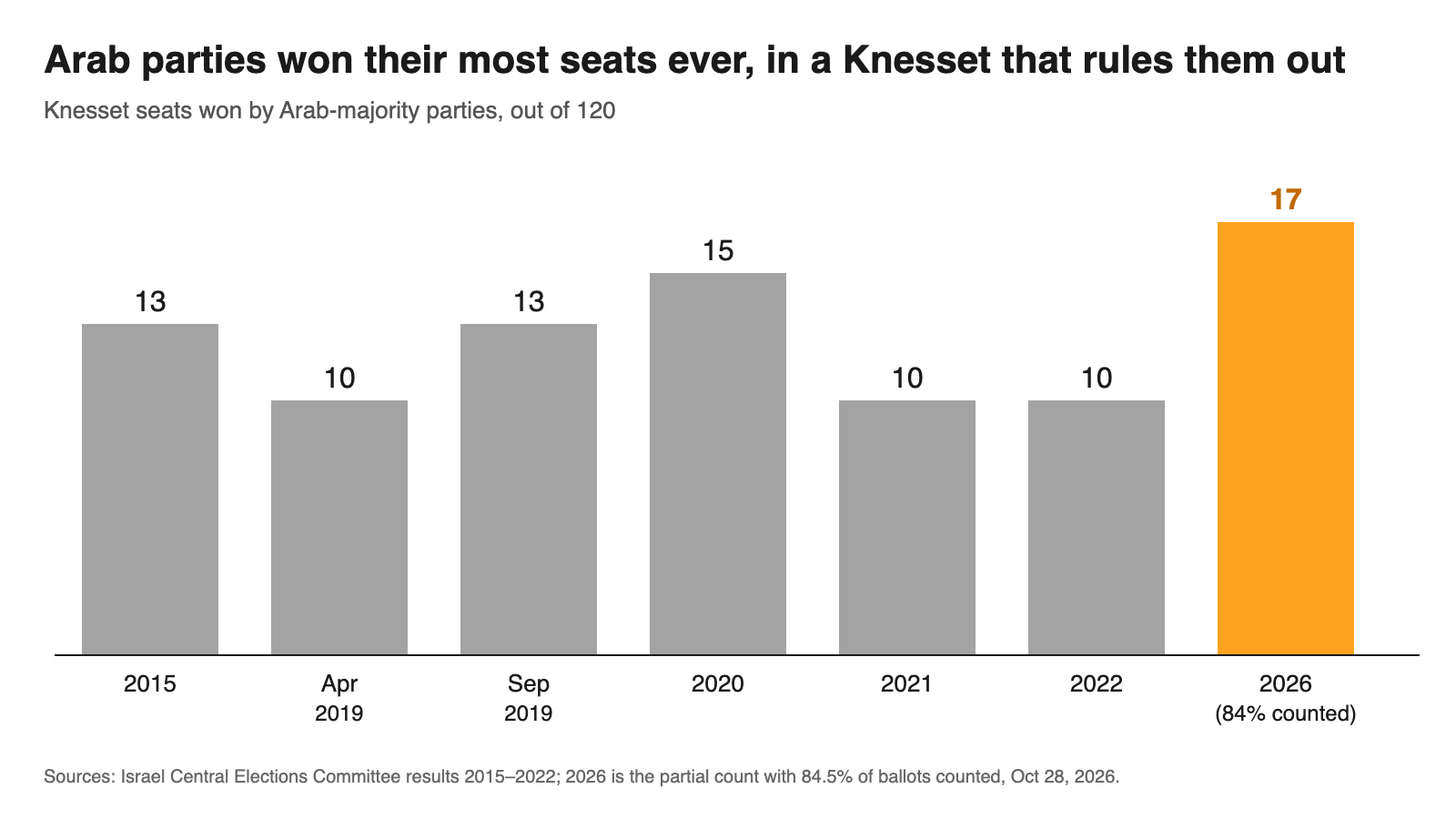
The exit polls promised a close race, and the count delivered a stalemate. With 84 percent of ballots counted on Wednesday afternoon, the Central Elections Committee gave Netanyahu’s bloc 54 seats, Gadi Eisenkot’s opposition bloc 49 and the Arab parties 17. Neither bloc comes close to the 61 needed to govern. Turnout reached 77.7 percent, the highest since 1999. Saul Sadka saw only two paths: a unity government of Netanyahu and Eisenkot, or Netanyahu as caretaker until another election in the spring. For weeks, Washington, London and Brussels will read the coalition talks as a test of Israeli democracy.
Watch: The Quiet Part Out Loud on Israel's election.
The Joint List and Ra’am are on track for 17 seats, up from 10 in the outgoing Knesset, the most Palestinian citizens of Israel have ever sent to parliament. They won those seats against a state that worked to keep them home.
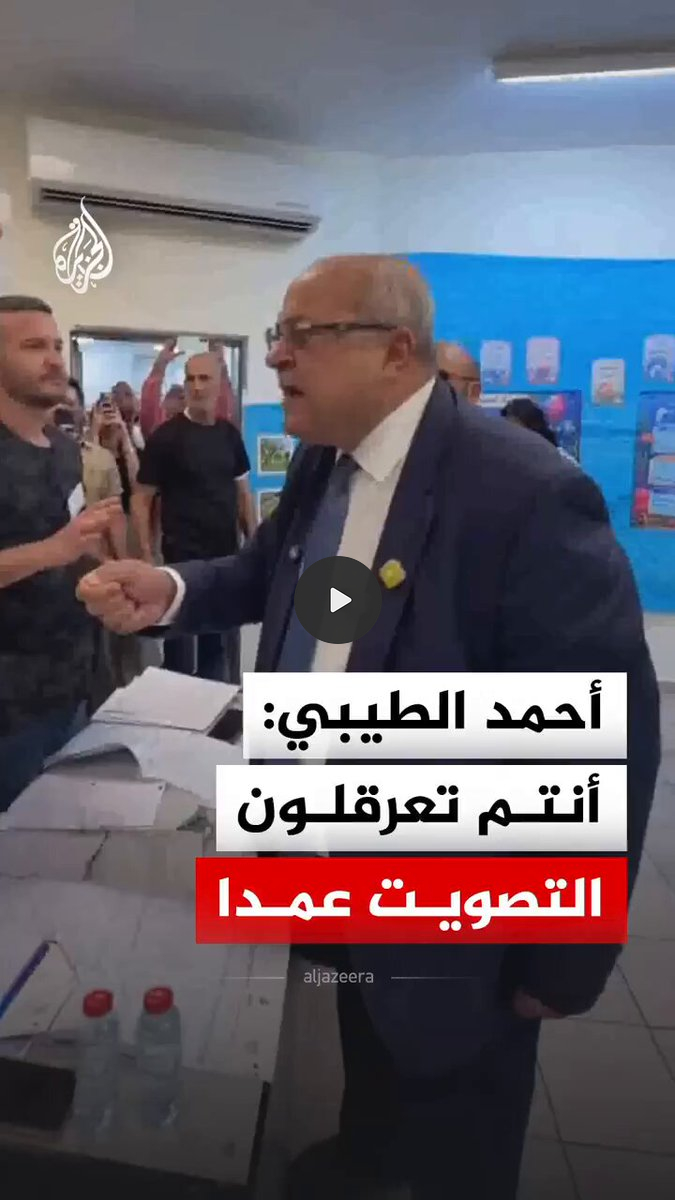
On election day, Muhammad Shehada reported what he saw: incitement from the top of government, Ben Gvir’s police at Arab polling stations, election workers obstructing Arab voters, Hebrew-only ballots, and Likud activists sent to film and intimidate.

A month before the vote, the Central Elections Committee, whose voting members come from the parties of the outgoing Knesset, voted 18 to 5 to disqualify both Arab lists. In past elections the committee went after single candidates, or a single party like Balad in 2022. This year it moved to strike every Arab-majority party from the ballot at once, while it rejected the petitions against Ben Gvir’s Otzma Yehudit and Smotrich’s Religious Zionism. The Supreme Court overturned the ban unanimously on October 2. Palestinian citizens had to win their place on the ballot before they could cast one. When the exit polls came in, Finance Minister Bezalel Smotrich told his supporters he could see Arabs celebrating on the screens. “We won’t let them celebrate,” he said.
Amjad Taha posted on X that the ballot box had exposed the apartheid charge as a lie, since Arab turnout topped 70 percent in town after town and Arabs now hold about 14 percent of the Knesset, more than Muslim MPs hold in Britain. “Odd kind of apartheid,” he wrote. The Israeli state wants the world to take exactly that reading from Tuesday night. It counts the votes of some two million Palestinian citizens and asks everyone to forget the millions more left outside the count.
Out Loud is independent and funded by its readers.
Subscribe for free to get every essay, or go paid to keep this work coming.
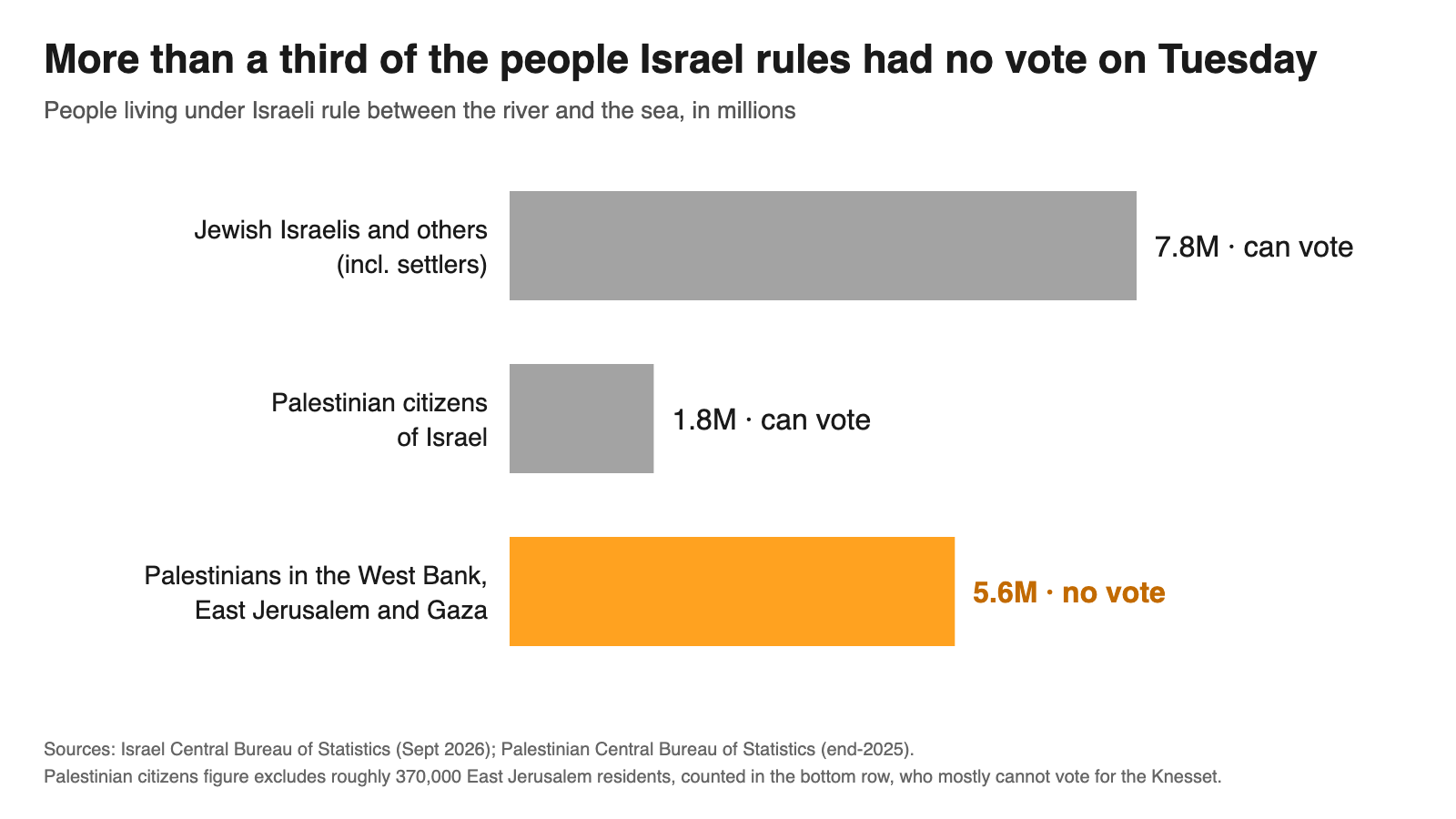
About five and a half million Palestinians live under Israeli rule in the occupied West Bank, East Jerusalem and Gaza, by Palestinian official estimates. Israel decides who enters and leaves their towns. It controls their water, their roads, their population registry and the sky over their heads. Its soldiers raid their homes at night, and for three years its army has bombed Gaza into rubble. Not one of them voted on Tuesday. Most Palestinians in occupied East Jerusalem hold only residency permits and cannot vote for the Knesset either. Meanwhile, more than half a million Israeli settlers living on that same occupied land voted, many at polling stations inside their settlements. Two peoples share the same hills and the same roads, and only one of them chooses the government that rules both. Beyond them are the refugees, the families Israel expelled in 1948 and has barred from returning ever since.
In an exchange with Emma Vigeland, the official Israel War Room account asked what country on Earth would let non-citizens in “neighboring territories” vote. Vigeland answered that those territories have been illegally occupied and controlled by Israel since 1967. The account replied that West Bank Palestinians are free to vote in Palestinian Authority elections, if Mahmoud Abbas ever holds them again.


The phrase “neighboring territories” turns land Israel has ruled for 59 years, land it keeps filling with its own voting citizens, into a foreign country next door. It turns people living under Israeli tanks into strangers who happen to live nearby. Then it hands their political life to an authority that controls none of its borders and has not held a national election since 2006. A state that admitted it governs these people would have to explain why they cannot vote, so the state calls them neighbors.
Eisenkot, the man much of the world hopes will replace Netanyahu, set his terms for coalition partners: accept Israel as a Jewish democratic state, the values of its Declaration of Independence, and an obligation of service. He later added recognition of Hamas as a terrorist group that must be dismantled, and said no Arab party meets his conditions. In April he called for a “Zionist majority.” Naftali Bennett said the Arab parties are not Zionist, so he will not rely on them, and Avigdor Liberman will not sit with them at all. Buttu points out that not one opposition candidate supports a Palestinian state. Eisenkot himself is a former army chief of staff who in 2008 gave the Dahiya doctrine its name, a plan to flatten civilian neighborhoods with deliberately disproportionate force until the enemy’s society breaks.
People on X spent the night casting the Arab parties as kingmakers, in a Knesset where both blocs that might govern have already ruled their seventeen seats out. Eisenkot’s 49 seats and the Arab parties’ 17 add up to 66, the only majority on the board that leaves Netanyahu out. Yair Golan of the Democrats urged the bloc to take it. Taking it would mean breaking every condition Eisenkot set. Nadav Eyal, one of Israel’s best-known political commentators, set out the arithmetic the way the Israeli center sees it: Eisenkot lacks the 61 seats for “a cohesive, centrist, Zionist coalition,” as if Zionist were a measure of coherence. Eyal also wrote that Arab citizens turned out over their rights as citizens, over Ben Gvir’s police and the crime left to spread in their towns, more than over Gaza or a Palestinian state. They had every reason to. The ballot lets Palestinians inside Israel defend the narrow ground the state allows them, and asks them to leave the rest of their people at the door. The last time an Arab party sat in a coalition, Ra’am in the Bennett-Lapid government of 2021 and 2022, that government kept building settlements and kept Gaza under siege. The limits on what their votes can buy were written into the system long before Tuesday.
Israel has no written constitution. It has Basic Laws, and they state plainly what the state exists to do. The 2018 Nation-State Law declares that the right to national self-determination in Israel is “unique to the Jewish people.” It downgrades Arabic from an official language and names Jewish settlement a national value. Basic Law: Human Dignity and Liberty, the closest thing Israel has to a bill of rights, never uses the word equality. Basic Law: The Knesset lets a list be barred for rejecting Israel as a Jewish and democratic state, the clause the elections committee reaches for every cycle against Arab parties. The law of the land tells Palestinians, in writing, what place they hold.
Democracy promises equality, the idea that every person living under a government has an equal say in it. Between the river and the sea, Palestinians and Jewish Israelis are roughly equal in number. One people chose the government. Most of the other watched from behind checkpoints, from refugee camps, from tents pitched on the rubble of Gaza. Frantz Fanon named this arrangement in The Wretched of the Earth: “The settler makes history and is conscious of making it.”
If this essay sharpened how you see Tuesday’s vote, pass it to someone still watching it as a horse race. And if you can, become a paid subscriber.
Independent writing on Palestine survives on readers, and on nothing else.
Netanyahu is wanted by the International Criminal Court. Israel faces a genocide case at the International Court of Justice. Gaza’s death toll runs into the tens of thousands, and its hospitals, universities and homes lie flattened. None of it was on the ballot. Buttu traces the reason: since 1948, she writes, Israeli society has never faced consequences for land theft, killing, imprisonment, collective punishment or genocide. A society that has never paid a price for these crimes stops treating them as crimes. They become campaign slogans. One of this year’s, she notes, was “Occupy. Expel. Settle.”
The leader of the opposition ran on a Zionist majority. The governing coalition tried to strike every Arab party from the ballot, and its finance minister promised to spoil their celebration. Second on that minister’s list sits Moshe Feiglin, who went on Israel’s most-watched news show in 2024 and quoted Hitler to argue that Gaza must be emptied of what he calls “Islamo-Nazis.” Earlier this month he said even newborn babies must leave Gaza. With his party on track for six seats, he is headed back to the Knesset. Ben Gvir’s longtime chief of staff, Hanamel Dorfman, ran seventh on his list, and Otzma is on track for seven seats, enough to bring him in if the final count holds. In July, Israeli media reported that investigators had arrived at the ministry with an arrest warrant for Dorfman, over allegations that he tried to influence investigations into Jewish extremist violence. Muhammad Shehada’s thread on incoming members lists more like them. Three years of genocide in Gaza produced an election where no major Jewish party offered Palestinians anything at all. Every coalition now under discussion, from a Netanyahu caretaker to an Eisenkot unity deal, keeps the occupation, the siege and the settlements in place.


Buttu argues that change will reach Israel only from outside, through sanctions that teach Israelis they hold no special right to commit atrocities. The governments that could impose them are already drafting their congratulations. Washington and Berlin will keep shipping the bombs. Brussels will keep the trade deal whose own terms demand respect for human rights. They will call the next government, whoever leads it, a democratic partner, as they called the last one through three years of starvation in Gaza.
Jaffa voted on Tuesday too. My grandfather’s city has polling stations now, in a place most of its Palestinian families were forced out of in 1948, and the people voting there chose between men who agree he and his descendants must never come home. The colonists queued at schools and community centers to decide who will hold the keys to our cages for the next four years, and the commentators called it drama. Palestinians have watched this ritual for seventy-eight years. We were never on the ballot. Any child in Jabalia or Jenin or the camps of Lebanon can name her family’s village. She learned it the way her grandmother taught it, and she will teach it to her own children.
Out Loud stays independent because readers fund it directly. A paid subscription from you helps make it possible. Subscribe to Out Loud
Palestinians may not have a chance of winning the elections in their homeland, but around the world they are winning every election. Palestine's freedom will come, and one day soon israel and zionism will be the subject of trials for war crimes. Zionist israelis are living in a microcosm, outside of that entitled position their actions are despised for what they are, racism.
A perpetually expanding illegally occupying apartheid regime founded on and maintained through the systemic oppression, dispossession, destruction and erasure of the people of Palestine cannot be fixed from the inside. And it would be absurd to imagine thst it could.
Israel has no chance of changing today or tomorrow.
The idea that this Israeli regime is a democracy just because equipped with an electoral system that excludes the illegally occupied people of Palestine, has fed this mirage: selling a brutal perpetually expanding illegally occupying apartheid regime as a beacon of democracy is a lie.
Israel is founded on and maintained through the systemic oppression, dispossession, destruction and erasure of the people of Palestine. It has never been anything else, not for a single day.
Antizionism is a humanism.