


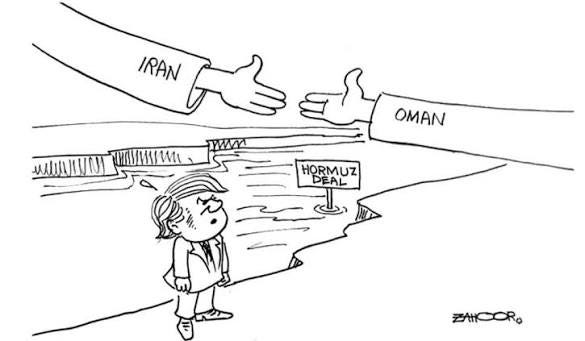
Iran’s Foreign Ministry says it and Oman mapped out new shipping routes through the strait on their own, with the US left out. The strait moves something close to a fifth of the world’s oil, and Tehran has been clear that none of it reopens fully until Washington makes good on commitments Iran says it already broke.
Trump, meanwhile, is talking about declaring the strait American territory once he decides the war is won prompting Iran’s deputy foreign minister answered that one directly, saying a strait “cannot be seized with a tweet,” or an aircraft carrier for that matter.
That’s not just tough talk, either. Ships the US Navy has encouraged toward the Omani side of the strait keep getting hit. The IRGC struck a bulk carrier there earlier this month, one of several vessels targeted on a route Iran has declared illegal. UK maritime monitors count fifty-six vessels damaged since the war began, and more than a dozen seafarers killed. Washington somehow still keeps saying it has the waterway under control, despite the facts.
You can see the same pattern at sea, on a single aircraft carrier that’s been stuck out there for the better part of a year.
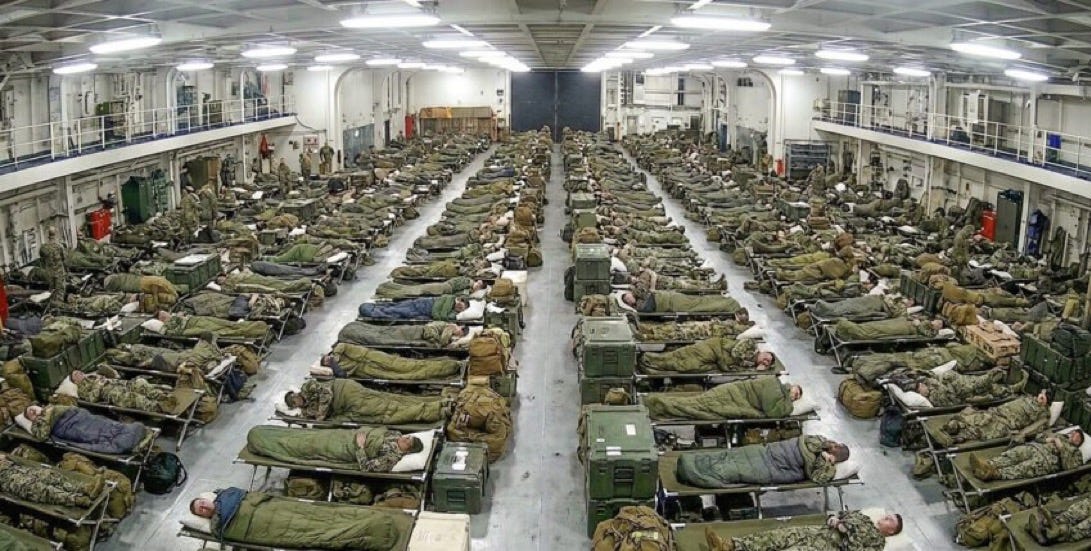
Somewhere in the Arabian Sea, five thousand sailors haven’t touched land in more than two hundred and fifty days. They ration food. They don’t trust the water. Some of them have tried going over the side of the ship, not to escape at sea, but to escape the ship itself. The Navy calls this an extended deployment. The families calling their senators call it something closer to abandonment.
In the opening days of the war, Iranian missiles and drones tore into Naval Support Activity Bahrain, headquarters of the Navy’s Fifth Fleet and the main artery feeding food, fuel, spare parts, and mail to every American warship in the Gulf. Command centers, warehouses, piers, were all gone or badly damaged within days: decades of infrastructure that was built to keep the navy fed a short sail away from its ships.
Basically, the Navy panicked. It picked the one place far enough away that Iran, they hoped, couldn’t touch it: Diego Garcia, a speck of land in the middle of the Indian Ocean, more than two thousand two hundred miles from the carriers it now has to supply. Fuel, ammunition, mail, every part these ships need now has to travel that whole distance before it even reaches the Gulf.
To be fair, it’s not like there was a better option sitting around. Bahrain got hit. Fujairah, the other regional port the Navy has traditionally used, sits well within range of Iranian missiles too, and has been struck multiple times since the war started. Diego Garcia was the only spot on the map that still felt safe. And and as it turns out, that wasn’t true either. Iran fired two ballistic missiles at the island back in March. One got intercepted. And, one fell short.
Diego Garcia doesn’t belong to the people who used to live there. Starting in the late 1960s, Britain forcibly removed the entire Chagossian population, more than a thousand people, so it could lease the island to the United States as a military base. Families were shipped out and told they’d never come back. And it is telling that the base holding this whole war together sits on land where people used to actually live, until they got forcibly displaced off it.
Senator Richard Blumenthal pressed the Pentagon to account for what’s happening aboard the Lincoln including contaminated water, broken plumbing, and mail that never arrives. One sailor’s family says the ship’s own doctor warned the crew needed a port soon, before people started to break. The Defense Secretary’s response, from a trip through Panama, was to call it “completely misrepresented.” Trump went further. Asked about it directly, he said the deployment had been “not nearly long enough.”
The USS George Washington is crossing the Pacific right now to take the Lincoln’s place. USS George H.W. Bush is already out there holding the line alongside it. Pete Hegseth, the Secretary of War, says the blockade can run “indefinitely.” But somebody has to keep feeding those ships, from that same island, over that same distance, for as long as Washington wants this to go on.
Every war is supposed to end somewhere, on a calendar, in someone’s head, if nowhere else. Hegseth says the blockade holds indefinitely. Trump says the deployment wasn’t long enough. Iran says nothing reopens until Washington pays for what it broke. Three men, three sentences, and not a single one of them contains an end date. Somewhere on the Lincoln tonight, some sailor barely into their twenties is doing the math on day two hundred and fifty one, and nobody’s told him what number he’s counting to.
Very well written and laid out, Ahmed.
Thank you.
I'm glad I saw it.
Very well explained thanks. I wasn’t aware what a pressure point this is