


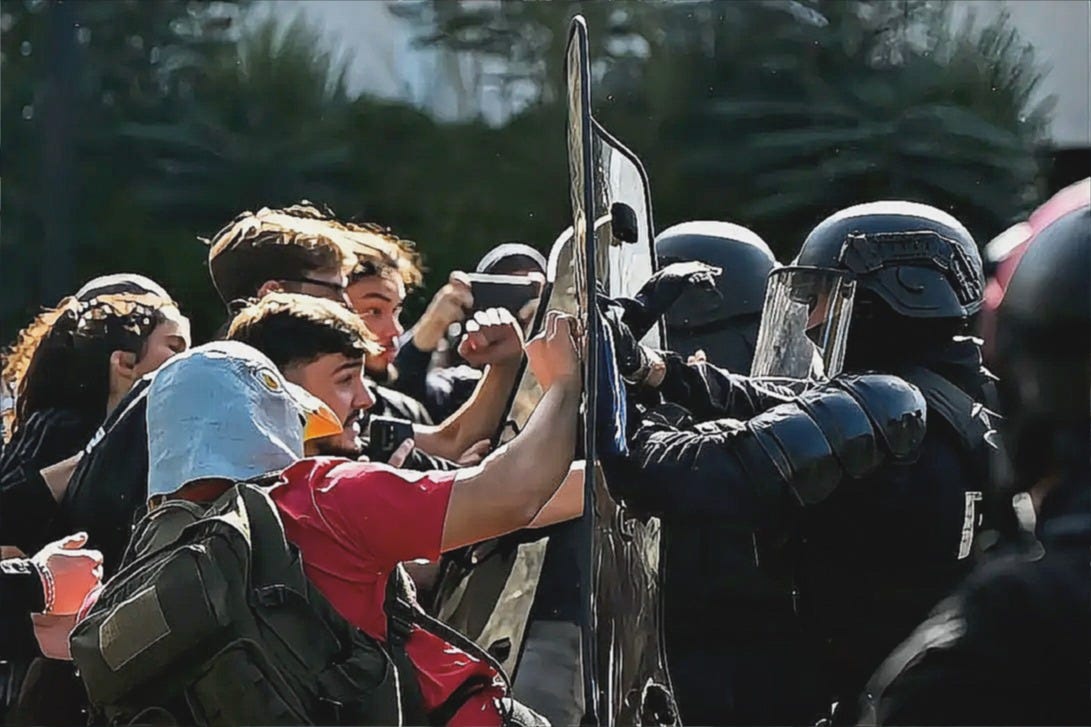
On October 1, police across France arrested 1,949 people as the high school movement spread to 1,027 schools, more than three times as many as the day before. By the end of the first week, Interior Minister Laurent Nuñez said, more than 5,000 people had been arrested, and 85% of them were minors. The state closed more than 400 schools and had prefects ban gatherings outside them.
In Saint-Ouen-l’Aumône, a police grenade launcher hit Eden, 14, in the face during a blockade at his school, leaving him with a double jaw fracture, every upper tooth broken and four lower teeth missing. In Lens, a grenade tore off a 15-year-old’s hand outside a high school.
Jonno Hull, writing from Paris, describes a girl in Alençon, dragged away in a chokehold, who was filmed afterward telling the officer through tears, “I’m fourteen years old!”
According to Hull, teachers started this. He traces the movement to the Saint-Exupéry high school north of Paris, where on September 17 teachers walked out because the school had no math, French or history teacher, no nurse and no social worker. When nobody answered them, their students blockaded the school. Within weeks the education authorities sent new teachers, and classes are running again. Hundreds of schools learned the same lesson from Saint-Exupéry. The strike got ignored, and the blockade got results.
The students are demanding what any school should have. In Lille they listed classrooms too hot in summer and too cold in winter, bedbugs and broken showers in the boarding school, an expensive canteen and too few staff. Across the country they are denouncing unsanitary schools and teacher shortages, and calling for the end of Parcoursup, the platform that sorts them into universities. France has gone through seven education ministers in four years. A report by Anthony Boulogne, a National Rally deputy, examined by the National Assembly’s finance committee last week, found that 20 million hours of teaching never happened in public middle and high schools in 2024-2025.
The government’s answer is in its 2027 budget. Education gets €1.2 billion more, for a total of €64 billion, while the ministry plans to take back more than 9,600 teaching posts, citing falling enrollment. Teachers’ unions warn inflation could reach 2.9% by year’s end, which would eat that increase alive. The armed forces get €6.4 billion more, the biggest increase of any budget. Macron set out to double the military budget, from €32 billion in 2017 to €64 billion in 2027. In 2027, France will spend the same on its soldiers as on its schools, and only the soldiers are getting a real raise. Hull sets this beside the advanced weapons France keeps sending to Israel, the UAE and Saudi Arabia. The government has given up one thing so far. It withdrew a measure that would have charged non-scholarship students to enroll in BTS and preparatory classes, the same evening it was announced. Le Monde reported that the prime minister’s office had pushed it through without the support of either the education minister or the higher education minister.
One clip from these protests has been traveling widely. Vincent Lapierre, a reporter who came up through Égalité et Réconciliation, Alain Soral’s movement, before starting his own outlet, went to interview students in the 9th arrondissement of Paris, one of the city’s wealthier neighborhoods. A teenager in a keffiyeh told him the movement’s demand “isn’t only at the level of the high school. It’s institutional.” He wanted Macron gone, along with the prime minister and an education minister he mocked for botching a simple dictation. “We don’t want these successive governments that are absolutely useless.” When Lapierre balked at the idea of a radical left, the boy said France had already tried the far right. “We already tested fascism. It was 1940.”
He traced the national police back to Vichy and said it never made the break it needed. Lapierre asked whether this was only a social question, and what could justify hitting a police officer. The boy answered with poverty. Kids who turn violent are living in distress, he said, and if they had a five-room home and enough to eat they would be in class every day. Then he told Lapierre, “La fin justifie les moyens, Vincent.” Hunger justifies the means. Lapierre came looking for a culture war and the boy kept handing him a budget.
French media has mostly gone along with Lapierre. The media watchdog Acrimed timed France 2’s news bulletins from September 28 to October 1. Of nearly 25 minutes spent on the movement, the students’ demands got less than two, and three quarters of the coverage went to violence and damage. The government blamed La France Insoumise and its ultra-left “proxies” for the unrest. The far-right site Boulevard Voltaire went further and asked whether Islamist organizations were behind the “riots,” pointing to a Muslim student group it says a 2025 government report tied to the Muslim Brotherhood. So when 256,000 people marched across France on Tuesday, by the Interior Ministry’s count, Donald Trump had a story ready to pick up. He blamed mass migration and Islam and wrote, “What's happening in France is nothing less than out of control mass migration. This isn't about schools, this is about Islam wanting to take over a once great Country!" He offered no evidence, and the students’ demands are public. The day before, Glenn Beck had called the “riots in France” a warning to the rest of the West, and MAGA commentators have spent weeks passing footage around to sell their immigration message before next month’s midterms. Republicans are leaning on migration because they fear Trump’s unpopularity and his Iran war could cost them Congress.
Trump’s post follows a policy his government put in writing. Last December’s National Security Strategy warned that Europe faces “civilizational erasure” because of migration and EU integration. It committed Washington to “cultivating resistance” across Europe by supporting parties that fight migration and promote nationalism. Carl Bildt, Sweden’s former prime minister, said the document placed the US further right than Europe’s own extreme right. Most people still read Trump’s posts about Europe as noise. They come out of a stated strategy to move European politics toward the far right, and every protest on the continent now gets fed into it. French teenagers asking for teachers have become evidence in an American campaign about a civilization under siege.
On Tuesday, Iran summoned France’s ambassador, Pierre Cochard, and accused Paris of “violent treatment” of the protesters and flagrant human rights violations. Foreign Ministry spokesman Esmaeil Baqaei accused France of double standards, noting that Paris called for restraint toward protesters in Iran in January and has answered its own high schoolers very differently. He has a point, and his government is the last one that should be making it. During Iran’s protests in January, the authorities themselves reported more than 3,000 deaths, which they blamed on the United States and Israel, while foreign-based rights groups say security forces fired on protesters. Both governments are guilty of what they accuse each other of, which is exactly why the summons matters.
Governments treat human rights as a weapon, picked up when the other side’s police are swinging the batons and put away when their own are. France lectured Tehran about restraint in January, then sent riot police against fourteen-year-olds. Washington claims to defend free speech in Europe, with JD Vance accusing EU leaders of suppressing it. On Tuesday, the officer who fired at Eden was placed under formal investigation for violence resulting in mutilation or permanent disability. The students in Paris and the protesters in Tehran are up against the same thing: governments that only discover the language of rights when it can be used against someone else.
The boy in Paris was describing something far bigger than France. Carnegie counted at least 120 significant anti-government protests in no fewer than 73 countries in the year to March 2026, the most since 2017. Young people in Madagascar rose up over water and power cuts. In Morocco it was inequality in schools and hospitals, and in Kenya it was new taxes. Governments fell in Bulgaria, Madagascar and Nepal. Nearly everywhere, whether those in power gave ground or not, the state answered with violence. Hull points to Stephen Miller’s claim that the world is ruled by strength, force and power, and that has become the working creed of governments that answer schoolchildren with riot police. The grievances differ from country to country, and the shape stays the same. Young people say their governments have stopped working for them, the police come, and someone with a platform explains that the real problem is a scarf, a mosque or a migrant.
When the next clip of burning cars in France reaches your feed, find out who posted it and which election they’re working on. Look up what the students asked for and measure the coverage against it. Read the budget before you read the commentary, including the military one, and check how many of the people arrested are children. When a government speaks up for protesters in another country, look at how it treats its own. When a politician tells you a protest has nothing to do with what the protesters are demanding, ask what he gains from saying so. The students in France have said exactly what they want, in their own words, on camera.
Wow - the young man in the video is more eloquent and principled than most adults. Thanks for the great reporting and warning about using our media literacy skills whenever we see coverage of this situation.
Great article and completely on point! In Australia we are also seeing migration weaponised and migrants blamed for issues they are not responsible for. They are just convenient scapegoats used by the powerful to divert attention and, unfortunately, too many people are still falling for the ruse.